Why do investors Google companies before making investment decisions?
Before a meeting, investors routinely search companies and executives on Google, check LinkedIn, and increasingly query AI engines such as ChatGPT and Perplexity. What they find shapes the specific questions they bring into the room, and any gap between the company's own narrative and the public record is a problem they will surface.
Investor pre-meeting research is now a structured, multi-platform routine. A pitch deck or deal memo opens the conversation, but Google, LinkedIn, and AI engines shape what the investor thinks before the meeting starts.
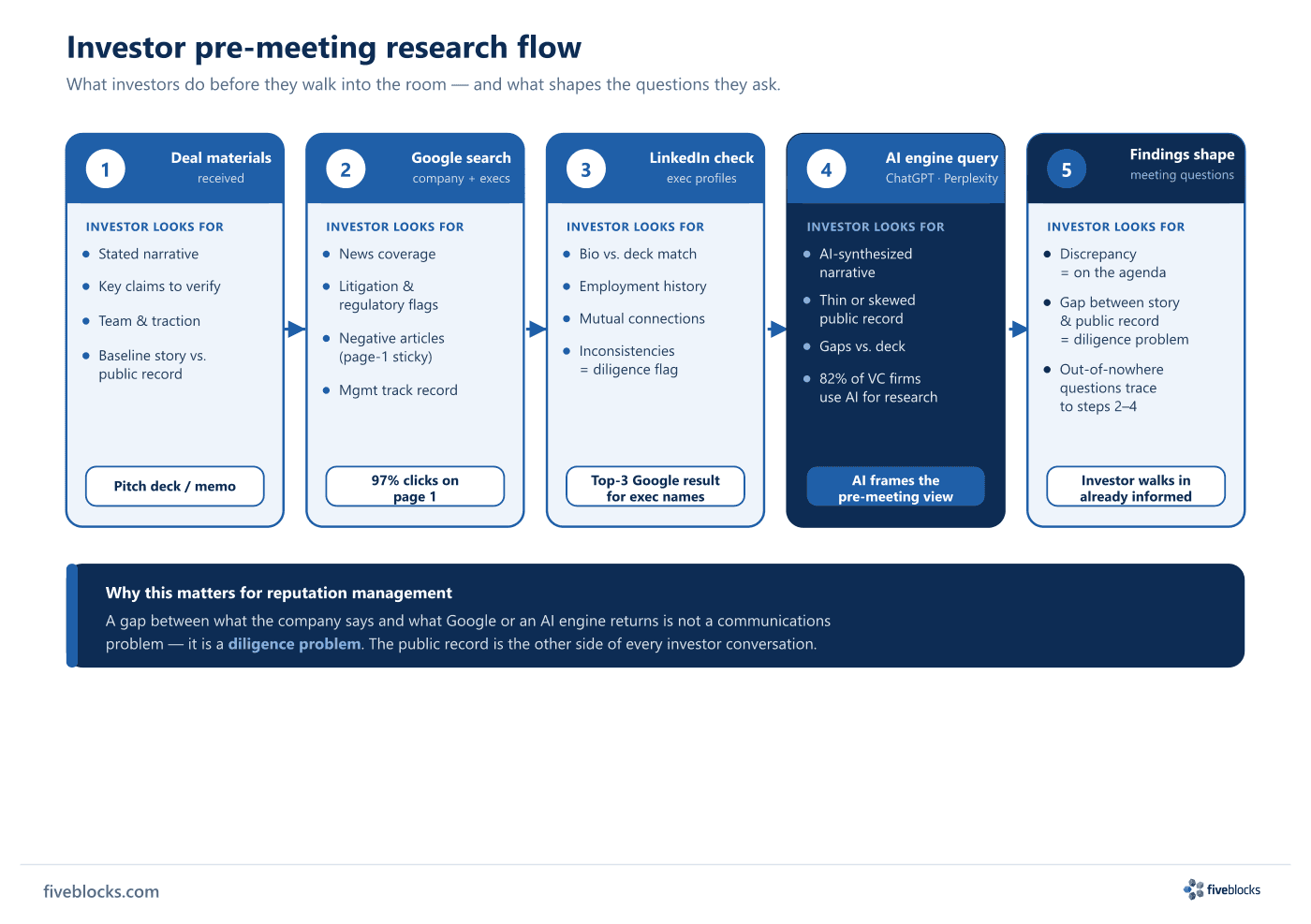
Step 1, deal materials received
The investor reviews the pitch deck, one-pager, or deal memo. This sets the baseline narrative, the story the company wants told.
Step 2, Google search
The investor Googles the company name, its executives, and any notable events cited in the materials. The first page of Google is the primary filter: nearly 97% of search clicks land within the top ten results, and page two captures a fraction of a percent of attention. Investors are checking for:
- News coverage. Does third-party coverage corroborate or contradict the stated narrative? A negative article from a credible outlet can hold a top-page position for years.
- Litigation and regulatory action. Adverse legal coverage tends to appear quickly in branded searches.
- Management track record. Prior ventures, exits, and any controversies attached to leadership names.
Step 3, LinkedIn check
LinkedIn profiles usually rank in the top three Google results for most executive names because the platform has high domain authority. Investors cross-reference bios, employment history, and mutual connections. Inconsistencies between the LinkedIn profile and the pitch deck materials are a common diligence flag.
Step 4, AI engine query
Investors and allocators increasingly prompt AI engines, ChatGPT and Perplexity in particular, with the same questions they would otherwise type into Google. Research from Affinity (2026) found that 82% of VC firms using AI now apply it to deal sourcing research. Academic work published on SSRN has examined ChatGPT specifically as a due diligence tool. KPMG’s 2025 analysis of AI in M&A transactions notes that AI is now used to speed up review of management materials and unstructured documents in financial and commercial diligence.
AI engines build a narrative from whatever sources they have indexed. If the public record is thin or skewed, the AI answer reflects that, and the investor walks into the meeting carrying that framing.
Step 5, findings shape meeting questions
Discrepancies, gaps, or negative signals found in steps 2 through 4 become the investor’s agenda. Questions that appear to come out of nowhere often trace back to something found in a Google search or an AI engine response that the company’s own materials did not address.
What this means for reputation management
The public record is the other side of every investor conversation. A gap between what the company says and what Google or ChatGPT returns is a diligence problem, not just a communications one. Engagements are regularly triggered by an investor finding something in a search or AI engine response that the company’s narrative did not address.
Last reviewed: 19/05/2026
