How do investors evaluate an executive’s digital reputation during due diligence?
Investors review an executive's Google results, LinkedIn, Wikipedia, news coverage, and AI engine responses during diligence. Gaps and accuracy problems become deal-relevant questions in the investment committee memo and on reference calls.
Investor diligence on executives has become far more systematic over the last several years, and it now reaches well past the traditional background check. The review follows a predictable sequence, and what it turns up affects the deal terms.
What the pre-investment review covers
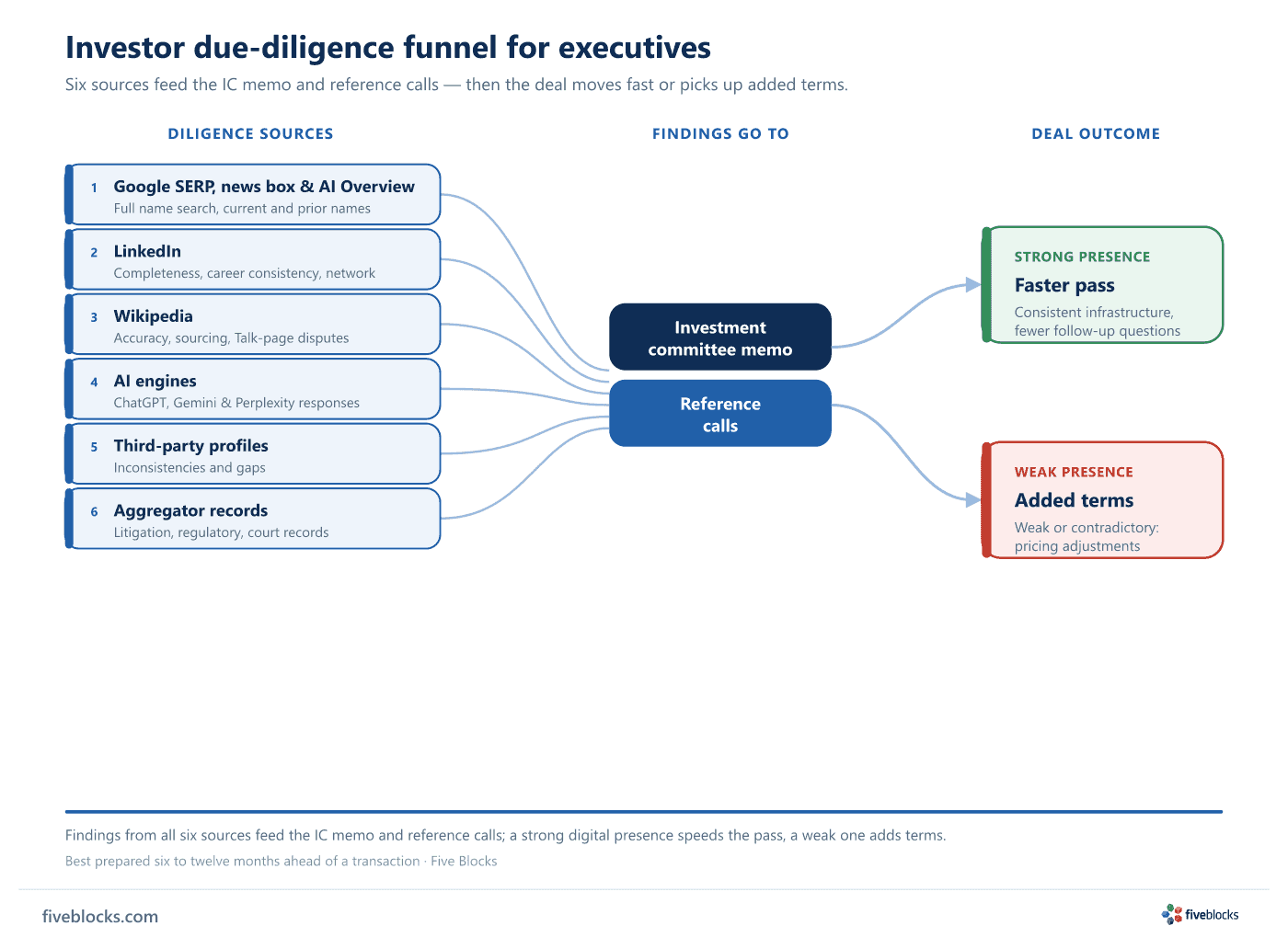
A diligence sweep on a named executive usually works through these sources in order:
- Full Google SERP for the executive’s name and any prior names, including how the news box and AI Overview are composed.
- LinkedIn for completeness, career consistency, and connection patterns. LinkedIn profiles typically rank in the top three Google results for an executive’s name, so a reviewer usually sees this first.
- Wikipedia article, where one exists, for accuracy, sourcing, and any unaddressed Talk-page disputes. For most branded searches the Wikipedia article ranks in the top three Google results.
- AI engine responses across at least ChatGPT and Perplexity for biographical claims. AI-driven diligence using engines such as ChatGPT, Gemini, and Perplexity is now standard practice on the buyer side of most institutional transactions.
- Third-party profiles for inconsistency or gaps.
- Aggregator sites for any litigation, regulatory, or court records.
Where the findings go
Two places: the investment committee memo and the reference calls. What the reviewer finds there changes how the deal proceeds:
| Digital presence | Effect on the deal |
|---|---|
| Strong, consistent digital infrastructure | Moves through diligence faster, with fewer follow-up questions. |
| Weak or contradictory digital presence | Often faces additional terms or pricing adjustments. |
Preparing for this is not complicated. It is best done six to twelve months before an anticipated transaction.
Last reviewed: 19/05/2026
