What is an executive digital reputation audit?
An executive digital reputation audit is a full diagnostic of how a leader appears across every layer people actually encounter: the Google SERP, the eight major AI engines, Wikipedia and the Knowledge Panel, owned-property authority, social presence, and entity signals. It ends in a prioritized set of recommended interventions backed by the underlying data.
An executive digital reputation audit reads the current state across every layer stakeholders actually encounter, then turns that read into a prioritized set of interventions. It is not a one-off check of name search. It maps the connected system – search, AI engines, Wikipedia, owned properties, social profiles, and the entity signals that tie them together – that decides what people learn about an executive before they click a single link.
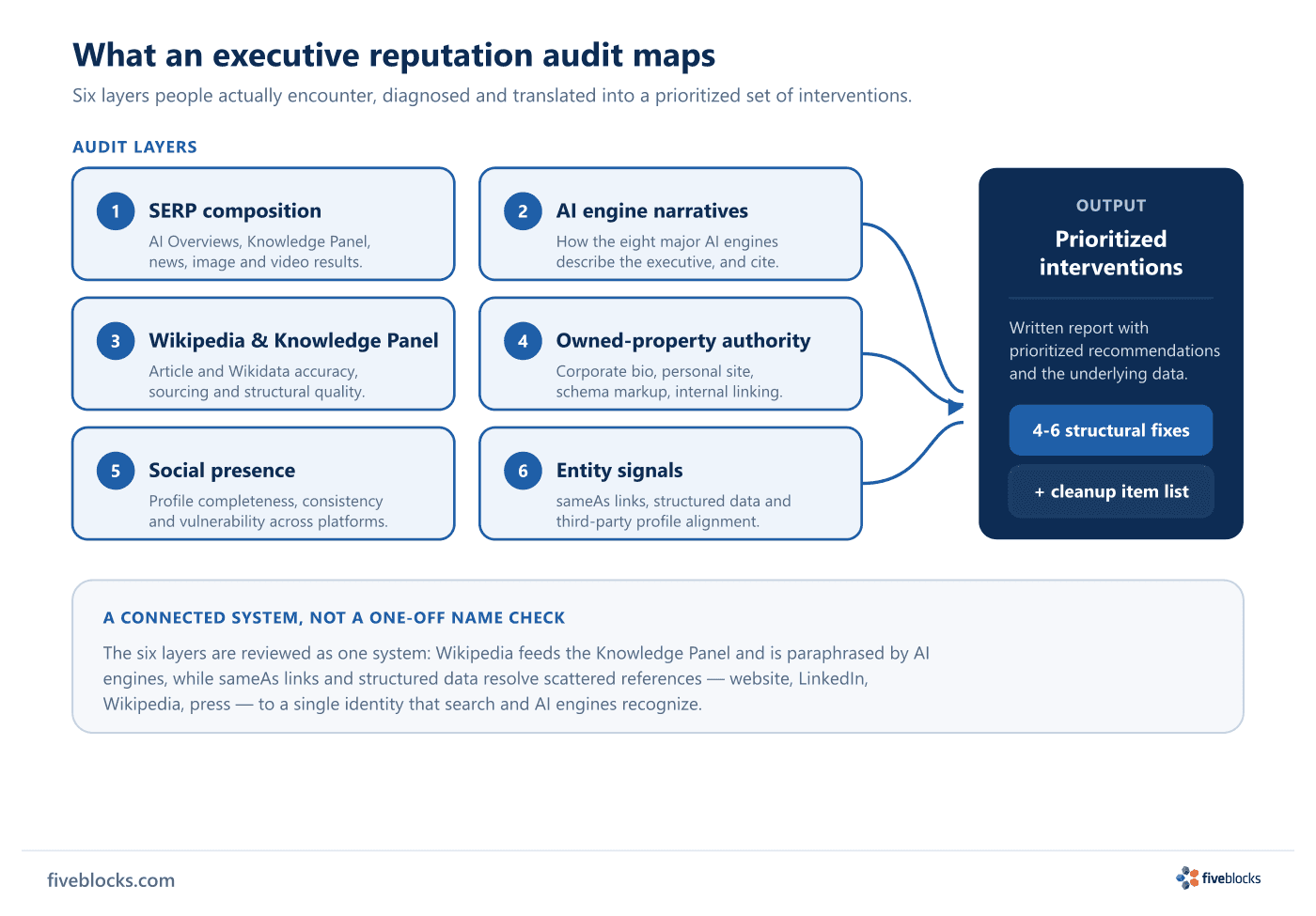
What the audit covers, layer by layer
- SERP composition. We run IMPACT™ against the executive’s name and priority queries to map the full Google results page, including AI Overviews, the Knowledge Panel, news boxes, and image and video results. These are the building blocks of a modern name SERP.
- AI engine narratives. AIQ captures how each of the eight major AI engines – ChatGPT, Gemini, Copilot, Perplexity, Claude, Grok, Google AI Overviews, and Google AI Mode – describes the executive and which sources each cites. The engines answer the same question differently and draw on different sources, so each is reviewed on its own.
- Wikipedia and Knowledge Panel status. The Wikipedia article and Wikidata entry are reviewed for accuracy, sourcing, and structural quality. This layer carries outsized weight: Wikipedia feeds the Google Knowledge Panel and is paraphrased by AI engines as a canonical reference, and Knowledge Panel data is drawn from Wikidata, Wikipedia, and the Knowledge Graph.
- Owned-property authority. The corporate bio, the personal site if one exists, schema markup quality, and internal linking are assessed. Person schema with
sameAslinks connects an executive bio to their Wikipedia article and Wikidata ID, which helps search and AI engines attach the page to the correct entity. - Social presence. Social profiles are audited for completeness, consistency, and vulnerability. LinkedIn ranks consistently well on name SERPs and is cited by AI engines for executive perspectives, while inconsistent bios across platforms create conflicting signals that weaken entity recognition.
- Entity signals.
sameAslinks, structured data, and third-party profile alignment are checked end to end. These are how Google and AI engines resolve scattered references – website, LinkedIn, Wikipedia, press mentions – to a single identity.
The deliverable
The output is a written report with prioritized recommendations and the underlying data, typically four to six structural interventions plus a longer list of cleanup items.
Last reviewed: 19/05/2026
