What is Five Blocks’ digital reputation audit process?
Five Blocks' digital reputation audit maps a client's full Google SERP footprint via IMPACT, assesses Wikipedia and Wikidata status, captures what the eight AI engines AIQ currently tracks say via AIQ, benchmarks named competitors, and reviews entity signals, delivering a prioritized intervention plan with workstreams, time estimates, and success criteria.
Almost every Five Blocks engagement begins with a digital reputation audit, because acting before diagnosing produces wasted effort at best and counterproductive activity at worst. The audit builds a picture across five layers, then turns the findings into a prioritized intervention plan.
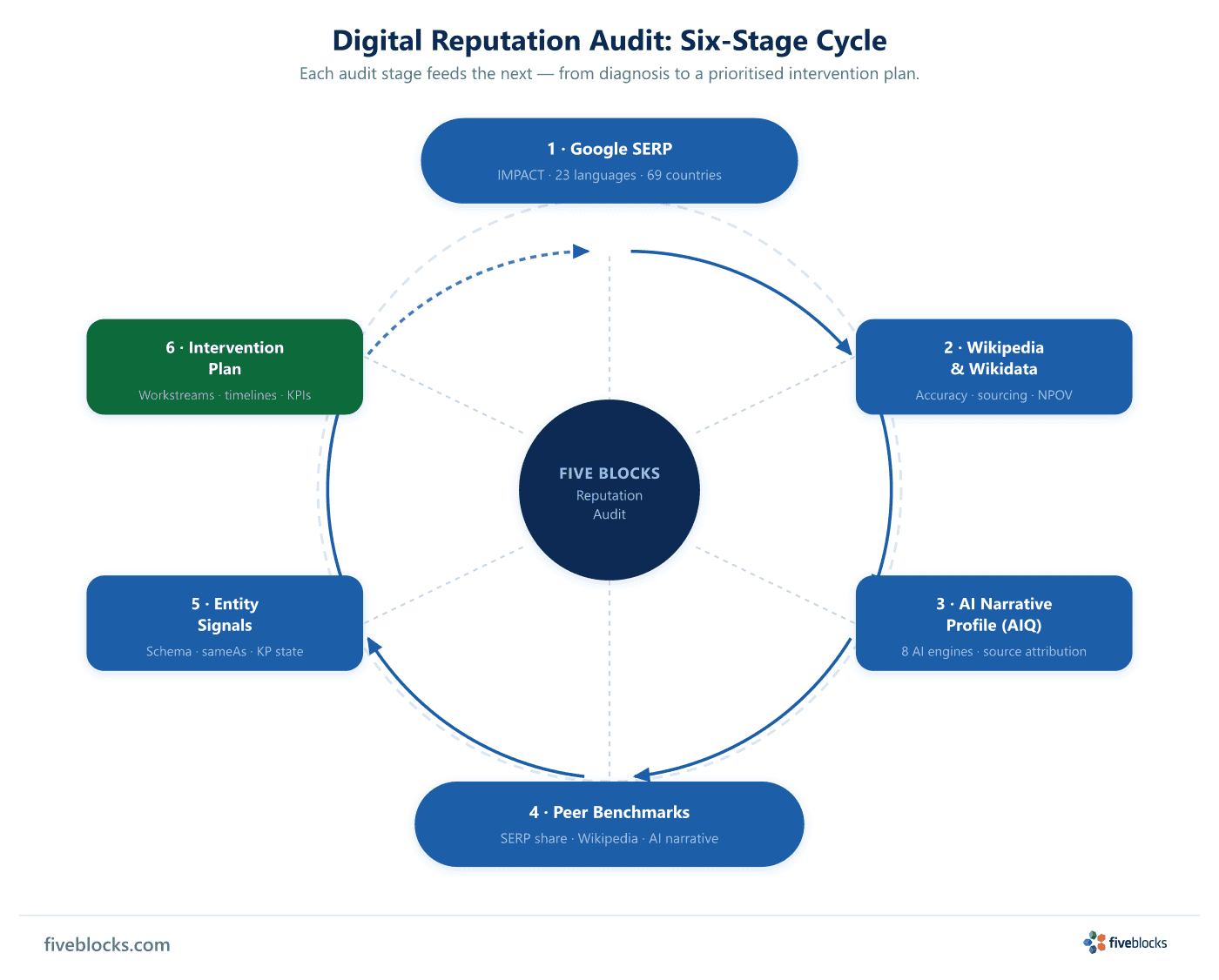
Step 1: Google SERP analysis
Using IMPACT, Five Blocks maps the client’s search-engine results pages for priority keywords across priority geographies. Every ranking URL is classified and processed so the team can see what content is surfacing, whether it is positive or negative, and where gaps or risks exist. IMPACT covers 23 languages and 69 countries with city-level granularity across 500 locations.
Step 2: Wikipedia and Wikidata review
The client’s Wikipedia article (or its absence) is assessed for accuracy, sourcing quality, NPOV compliance, and structural completeness. Wikidata fields are reviewed for completeness and entity-linking. Wikipedia content feeds directly into Google’s Knowledge Panel and AI engine answers, so the state of the article and its linked structured data tells the audit a great deal.
Step 3: AI narrative profile via AIQ
AIQ captures what the eight AI engines it currently tracks: ChatGPT, Copilot, Gemini, AI Overview, Perplexity, Grok, Claude, and Google AI Mode, say about the client, with source attribution and sentiment scoring. AI engines build answers by weighting authority signals such as Wikipedia, Knowledge Graph data, owned properties with schema markup, and third-party coverage, so the AIQ output shows which sources are driving the narrative and where corrections are most needed.
Step 4: Peer benchmarks
The same diagnostics are run for named competitors so that the client’s position is comparative, not absolute. SERP share, Wikipedia status, and AI narrative quality are measured side-by-side to establish a realistic baseline for what is achievable and where competitive gaps exist.
Step 5: Entity signal review
Entity signals, schema markup, sameAs links, Knowledge Panel state, are audited as a connected web of references that identify the company to platforms and feed the Google Knowledge Graph. A complete entity infrastructure (Wikidata entry, linked Wikipedia article, Organization and Person schema with sameAs links) is what allows AI engines and search platforms to attribute content to the correct entity with confidence.
Deliverable: Prioritized intervention plan
The output of the audit is a prioritized intervention plan with named workstreams, time and resource estimates, and the success criteria for each. Workstreams are ranked by expected impact and execution feasibility, so the client and team put effort where it will count first.
Last reviewed: 19/05/2026
