What is an AI narrative audit and what does it cover?
An AI narrative audit is a structured read of what the major AI engines say about a brand, covering engine responses, source attribution, recurring themes, per-engine sentiment, peer comparison, accuracy gaps, and risk areas, and ending in a prioritized list of actions to shift the narrative.
An AI narrative audit is a structured read of where a brand stands across the AI engines and what to do about it. A chief communications officer reading it should come away knowing which few fixes to the underlying sources will produce the most movement, and on what timeline.
What the audit covers, section by section
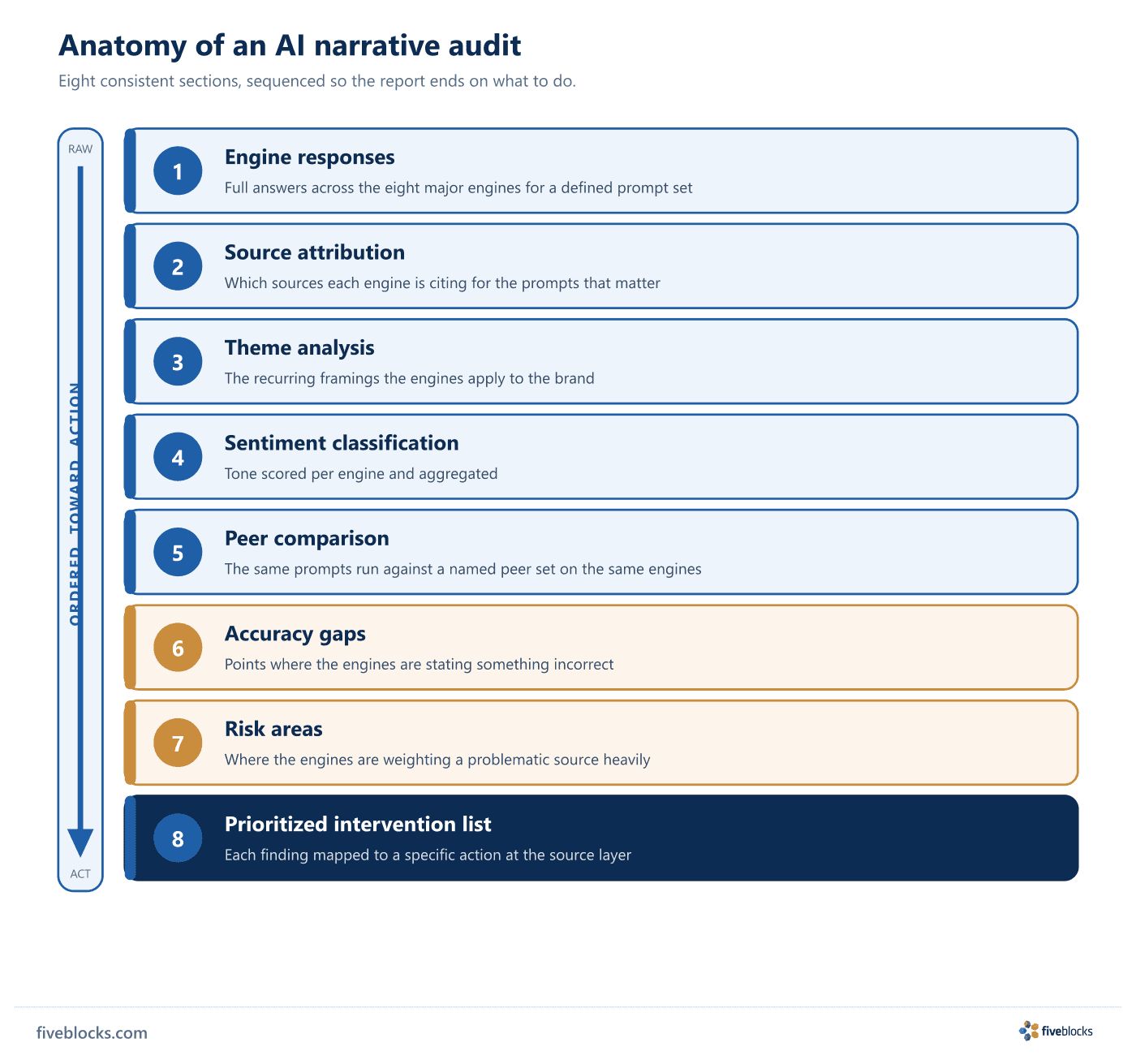
The sections are the same from one audit to the next, and they run in this order:
- Engine responses: the full responses across the eight engines AIQ currently tracks (ChatGPT, Gemini, Copilot, Perplexity, Claude, Grok, Google AI Overviews, and Google AI Mode) for a defined prompt set.
- Source attribution: which sources each engine cites for the prompts that matter.
- Theme analysis: the recurring framings the engines apply to the brand.
- Sentiment classification: tone scored per engine and aggregated.
- Peer comparison: the same prompts run against a named peer set on the same engines.
- Accuracy gaps: points where an engine states something incorrect.
- Risk areas: where an engine weights a problematic source heavily.
- Prioritized action list: each finding mapped to a specific action on the underlying sources.
Why the order matters
The audit runs from raw engine output through diagnosis to a ranked set of recommendations, so the reader ends on what to do rather than on a pile of observations. The major engines often answer the same prompt differently and cite different sources, so capturing the full set AIQ tracks is what keeps the diagnosis honest instead of a single-engine snapshot.
Last reviewed: 19/05/2026
