What reporting should stakeholders receive about AI reputation?
Decision-grade reporting on AI reputation has six components: a dashboard summary, peer comparison, theme trends, a source-quality assessment, accuracy concerns, and a prioritized list of interventions, with the recommendations pulled to the front. A report that stops at description, telling stakeholders what is happening without telling them what to do, is not useful.
Stakeholder reporting on AI reputation has to be built around decisions, not observations. A decision-grade report has six components and puts the recommendations at the front, with the data behind them. A report that fails this test is purely descriptive: it tells the audience what is happening without telling them what to do.
The six components of a decision-grade report
- Dashboard summary: the headline metrics (sentiment, share of voice, accuracy concerns) at a level a CEO or board can absorb at a glance.
- Peer comparison: how the entity is represented against the named competitor set. AI engines pull competitor content into their synthesized summaries and answer comparative prompts from third-party sources.
- Theme trends: which framings are gaining or losing weight in the AI narrative. Engines synthesize recurring themes across many sources, not any single mention.
- Source-quality assessment: what the engines are citing and how authoritative it is. Engines weight sources by credibility and build answers from that underlying pool.
- Accuracy concerns: where an engine is stating something incorrect, including the confident, fluent fabrications (nonexistent lawsuits, fictitious executives, unshipped features) that AI engines deliver in the same tone as true statements.
- Prioritized interventions: the actions the data points to, with timing and ownership attached.
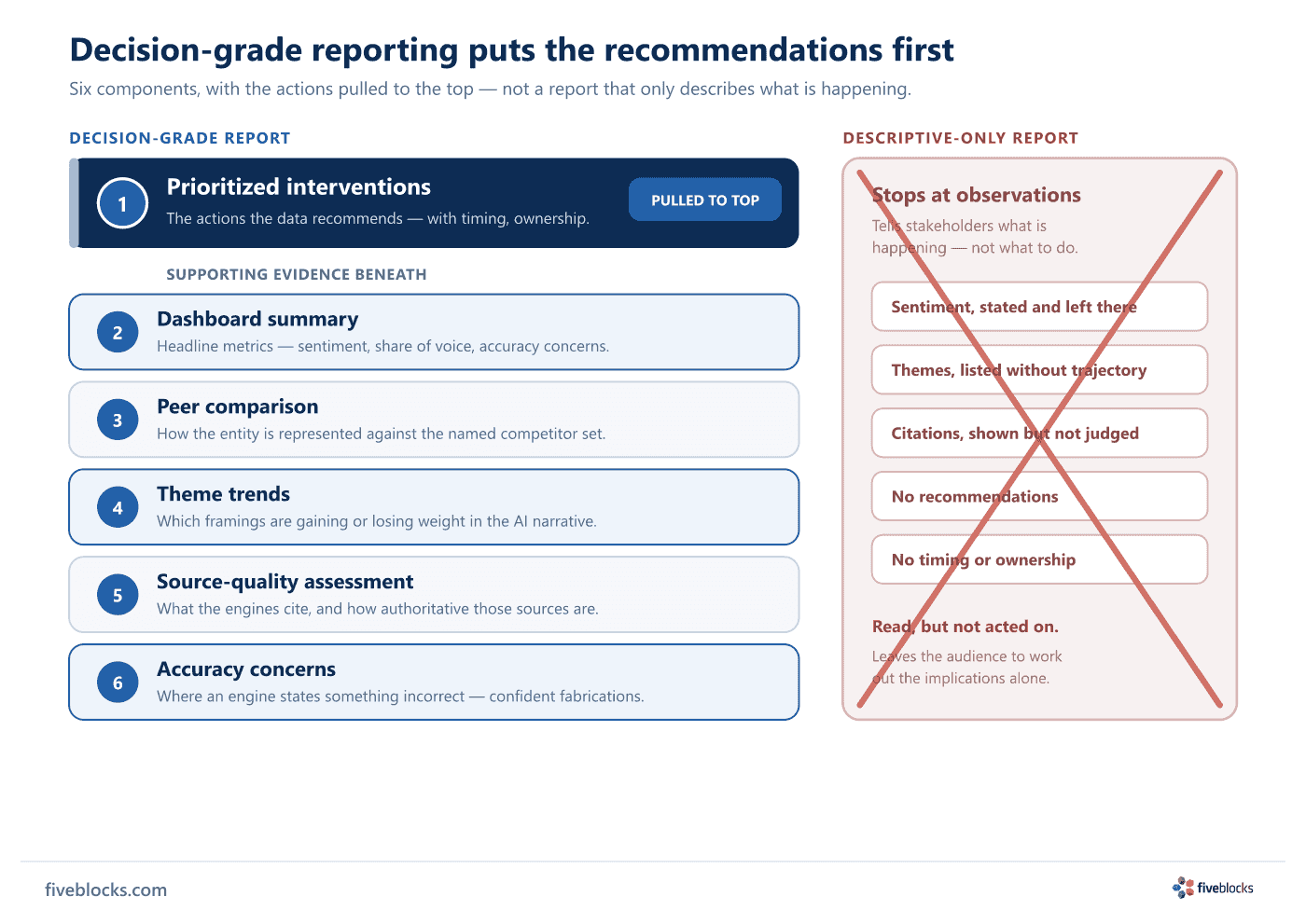
Descriptive vs. decision-grade
This distinction separates a report stakeholders act on from one they only read. A descriptive report lays out sentiment, themes, and citations and stops there, leaving the audience to work out the implications. A decision-grade report leads with the prioritized interventions and uses the same underlying data (the dashboard, the peer set, the theme trajectory, the source quality, and the accuracy flags) as the evidence behind each recommendation. Putting the recommendations first, with the supporting analysis behind them, is what makes the reporting useful rather than informational.
Last reviewed: 19/05/2026
