What is a digital reputation audit, and what should it reveal?
A digital reputation audit reveals what the branded SERP actually looks like for priority queries, where the entity sits in Wikipedia, Wikidata, and the Knowledge Graph, how the major AI engines describe the brand or executive and which sources drive each answer, how all of it compares to named peers, where entity signals are weak, and which content gaps would have the most impact if filled. It is delivered as a written report with the underlying data and a prioritized list of interventions.
A full reputation audit answers a small number of questions clearly. The deliverable is a written report with the underlying data attached and a recommended scope. It is the diagnostic that turns a vague sense of how a brand or executive is perceived into a defensible read of the current state and a prioritized plan.
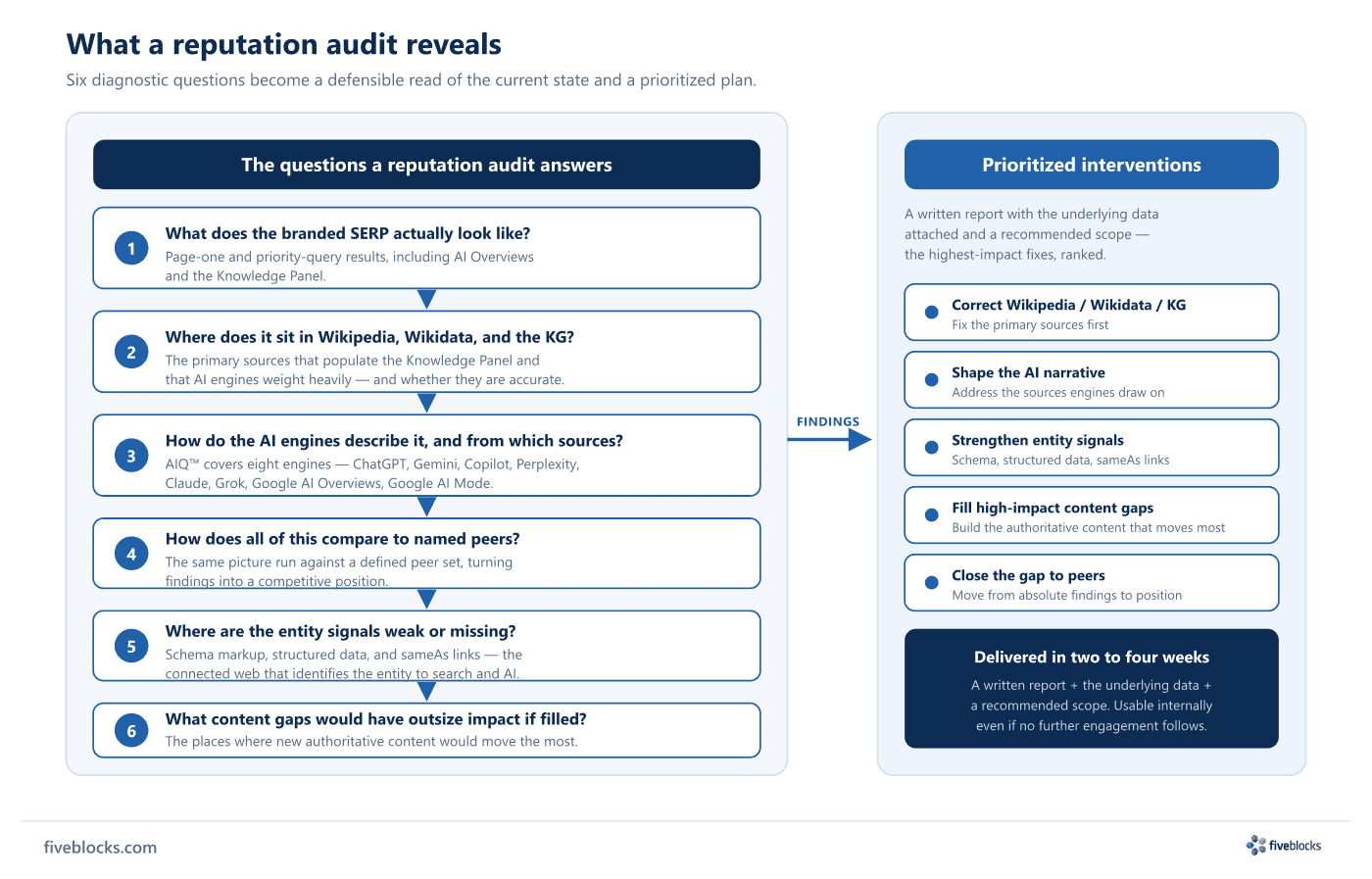
The questions a reputation audit answers
- What does the branded SERP actually look like? The page-one and priority-query results for the brand or executive, including AI Overviews and the Knowledge Panel.
- Where does the entity sit in Wikipedia, Wikidata, and the Knowledge Graph, and is the data accurate? These are the primary sources that populate the Knowledge Panel, and AI engines weight them heavily. Errors here reach everything they feed.
- How do the major AI engines describe the brand or executive, and which sources drive each answer? AIQ covers eight major AI engines (ChatGPT, Gemini, Copilot, Perplexity, Claude, Grok, Google AI Overviews, and Google AI Mode) and shows which sources each engine is drawing on.
- How does all of this compare to named peers and competitors? The same picture, run against a defined peer set, so absolute findings become a competitive position.
- Where are the entity signals weak or missing? Schema markup, structured data, and sameAs links: the connected web of references that identifies the entity to search and AI engines.
- What content gaps exist, and which would have the most impact if filled? The places where new authoritative content would move the most.
The deliverable
The audit produces a written report with the underlying data attached and a recommended scope. It typically runs two to four weeks and gives you something usable internally even if no further engagement follows: a defensible read of the current state and a prioritized list of interventions.
Last reviewed: 19/05/2026
