What is a digital footprint and how do you audit it?
A digital footprint audit catalogs every signal about a brand or person across the owned, earned, and third-party layers, then scores each one on three axes: authority (do Google and AI engines trust the source), accuracy (is what it says correct), and risk (is there exposure if a stakeholder reads it). The output is a ranked map of where intervention changes outcomes.
A digital footprint audit is structural, not promotional. The goal is not to find positive content. It is to build a complete inventory of what exists about the entity, score each item the way an engine would weigh it, and identify where the leverage sits.
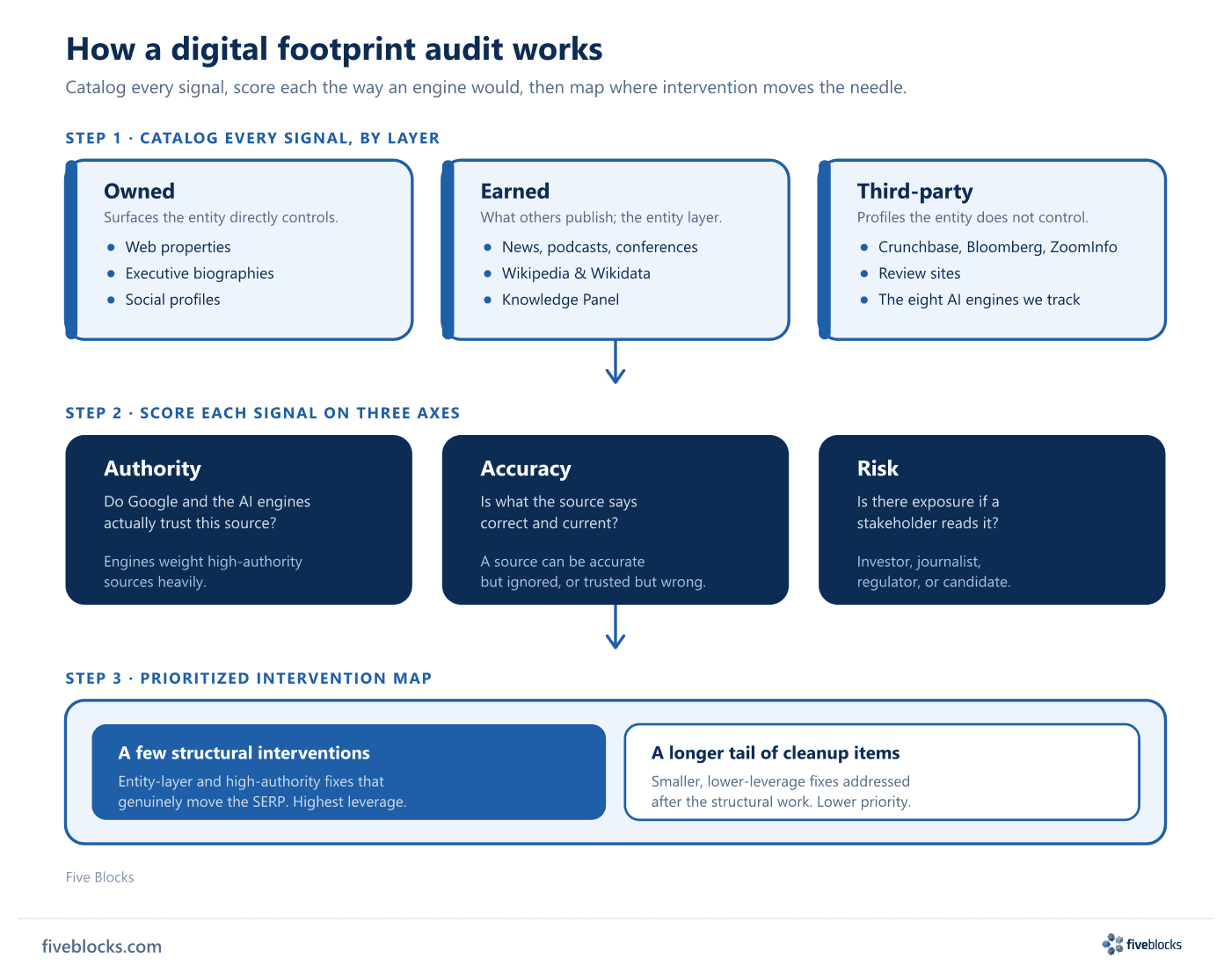
Step 1: catalog every signal, by layer
We list every source that says something about the entity, grouped into three layers:
| Layer | What it includes |
|---|---|
| Owned | The entity’s own web properties, executive biographies, and social profiles. These are the surfaces the entity directly controls. |
| Earned | News coverage, podcast and conference appearances, and the entity layer the engines read from: the Wikipedia article if one exists, the Wikidata entry, and Knowledge Panel content. |
| Third-party | Profiles the entity does not control, such as Crunchbase, Bloomberg, and ZoomInfo, review sites, and the responses returned by the eight AI engines AIQ currently tracks. |
Step 2: score each signal on three axes
Each catalogued signal is scored on the same three dimensions, because a source can be accurate but ignored, or trusted but wrong:
- Authority. Do Google and the AI engines trust this source? Engines weight high-authority sources heavily, so a signal on a trusted surface carries far more reach than the same claim on an obscure one. A present Knowledge Panel, for example, means Google has resolved the entity with enough confidence to display it, and high-authority profiles such as LinkedIn tend to rank near the top of a name SERP.
- Accuracy. Is what the source says correct, current, and consistent with the rest of the footprint?
- Risk. Is there exposure if an investor, journalist, regulator, or candidate reads this? A low-authority but high-risk item can outrank a polished owned page when it sits on a trusted domain.
Step 3: produce a prioritized intervention map
The output is a ranked map of where work changes outcomes, not a report card. The same exercise that shows which signals are trusted also shows which ones are both consequential and fixable, so effort goes to the highest-leverage items first. In a typical engagement the audit separates a small number of structural interventions, the entity-layer and high-authority fixes that move the SERP, from a longer tail of smaller cleanup items.
Last reviewed: 19/05/2026
