How does the quality of your digital footprint affect what AI says about you?
Directly. AI engines build what they say about you from your digital footprint: your Wikipedia article, Wikidata entry, Google Knowledge Panel, owned properties with schema markup, and third-party coverage. The accuracy and consistency of those components determine the accuracy of the AI description.
AI engines build their answers about you from your digital footprint, so the quality of that footprint determines the quality of the answer. A clean, consistent, well-structured footprint gives the engines accurate material to work from. A thin, outdated, or contradictory one forces them to fill gaps or reconcile conflicts, and the results drift toward wrong or unflattering.
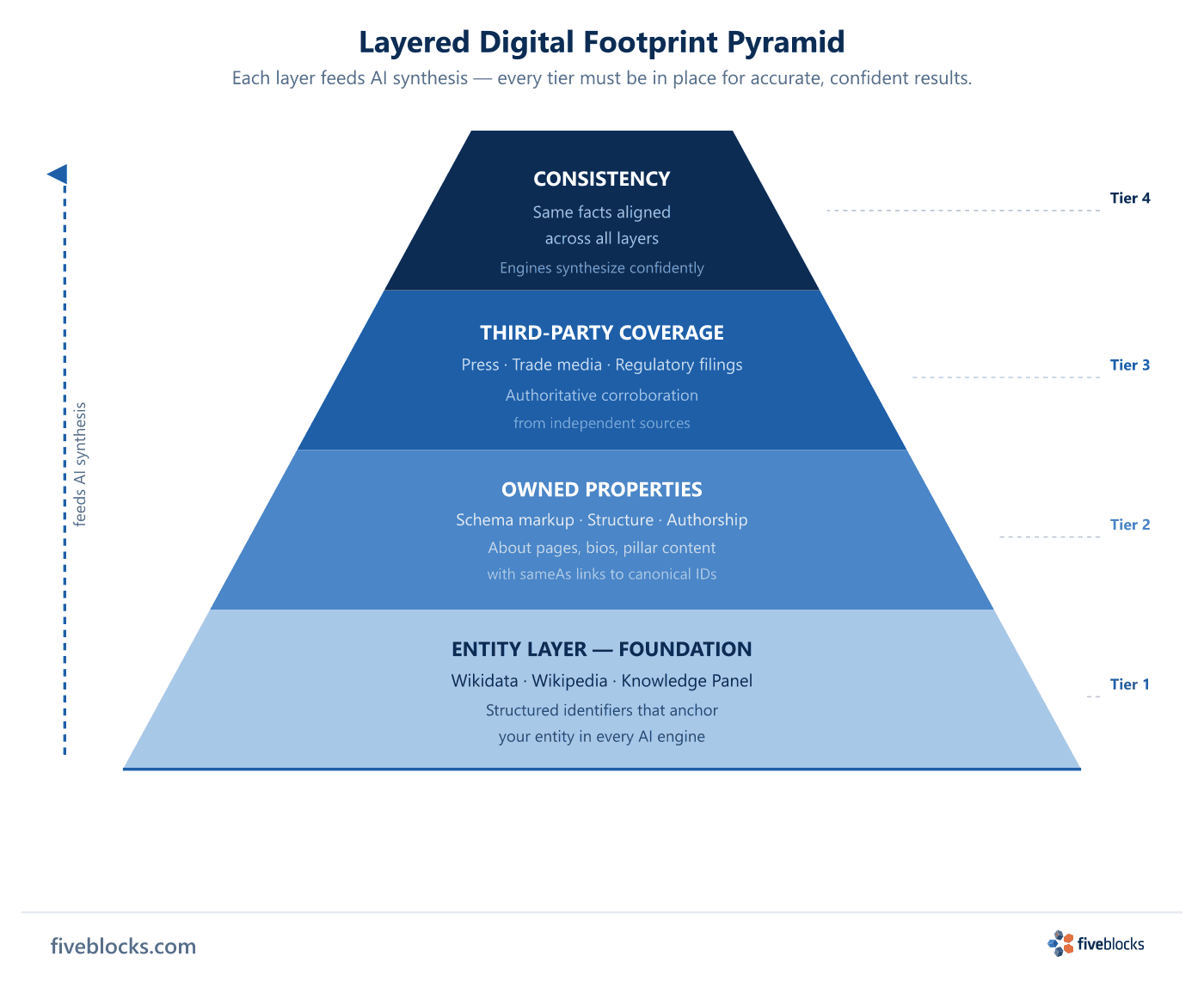
The five components that move the engines
- Wikipedia article
- An accurate, balanced, well-sourced Wikipedia article is among the most heavily weighted signals across the major engines. Many engines paraphrase or summarize it directly as the canonical entity reference. An outdated, thin, or missing article leaves a gap the engines fill from whatever else is available.
- Wikidata and Knowledge Panel
- The Wikidata entry is the structured-data backbone that links an entity to its Wikipedia article, language versions, and external identifiers. The Google Knowledge Panel is built from this layer. Engines that query the Knowledge Graph directly, Gemini in particular, are sensitive to what the Wikidata record says. Stale or broken entries here carry through into AI responses.
- Owned properties with schema markup
- An About page, executive bio, or pillar content page with proper Organization and Person schema markup, named authorship, and
sameAslinks to canonical identifiers (Wikidata, Wikipedia, LinkedIn) tells the engines which entity the page is about and how it connects to the rest of the footprint. Without schema, the engines infer from text and HTML structure, which gives them lower confidence and lowers citation rates. - Third-party coverage
- Press coverage and independent references in outlets the engines weight, such as mainstream business and trade press, government and regulatory filings, and academic citations, corroborate the rest of the footprint. Thin, low-authority, or scattered third-party coverage gives the engines little to work from and makes the entity easier to misrepresent.
- Consistency across all components
- The engines weight sources by authority and structure, but they also look for agreement across them. When the same facts line up across Wikipedia, structured data, owned properties, and third-party coverage, the synthesis is confident and accurate. When sources contradict each other, the engines have to reconcile conflicting signals, and the answer can come out wrong even when each source looks fine on its own.
Why this matters for reputation work
Footprint quality is the foundation, and every other reputation intervention builds on top of it. A strong earned-media push lands differently depending on whether the entity infrastructure is in place to let the engines connect the coverage to the right entity description. The same press placement in a weighted outlet moves the AI synthesis visibly when the Wikipedia article, structured data, and owned properties are aligned, and barely at all when they are not.
Last reviewed: 19/05/2026
