Can you influence what AI says about your company?
Yes, but only indirectly. No one can edit what an AI engine outputs; that route is closed. What works is improving the five source layers the engines draw on: Wikipedia, the Knowledge Graph, owned content, third-party coverage in trusted outlets, and Wikidata. As the source layer improves, the AI narrative follows, usually within weeks for retrieval-heavy engines and over a six-to-twelve-month horizon for broad, durable change.
Direct control is not available. The engines are proprietary, prompts belong to the user, and asking a model to change its answer has no durable effect. What works is improving the inputs the engines weight, the source layer they synthesize from. AIQ™ shows which sources each engine draws on for each prompt, so the work can target the right ones instead of spreading thin.
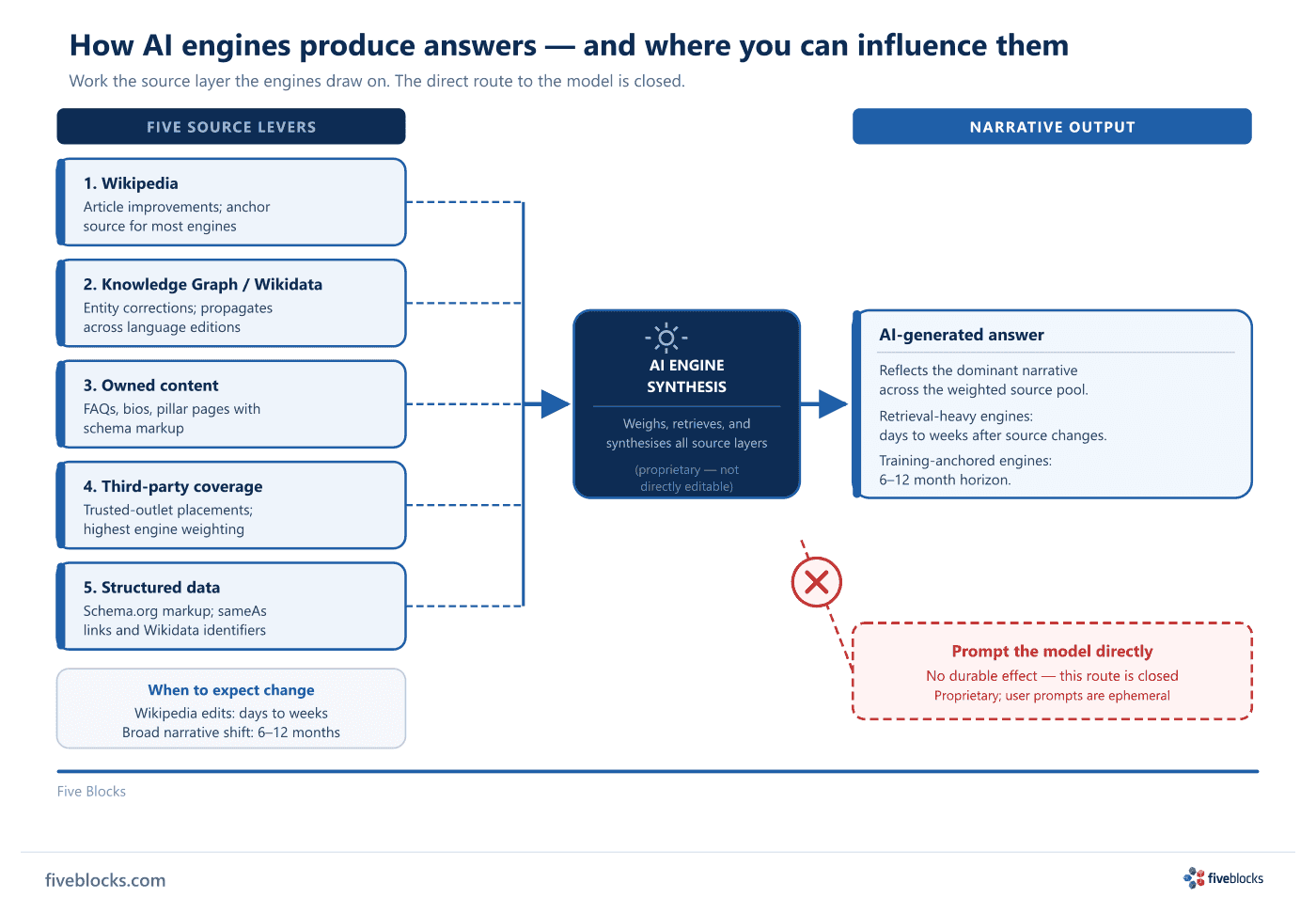
Five source levers, work these, not the model
- Wikipedia improvement. For most notable companies and individuals, the Wikipedia article is the anchor the engines keep returning to; they paraphrase it, quote it, and treat it as the reference. Improving the article through Talk-page requests and disclosed conflict-of-interest editing is usually the single highest-leverage step. Retrieval-heavy engines can reflect accepted edits within days to weeks; training-anchored engines respond over months as the broader ecosystem catches up.
- Knowledge Graph and Wikidata corrections. When a structured-data error is driving the wrong answer, a wrong founding date, a misclassified entity type, a broken sameAs link, fixing it at source pushes the correction across Google’s Knowledge Panel and into engines that query structured data directly. Wikidata links entity records across language editions, so one correction carries across multilingual surfaces.
- Owned content strengthening. FAQ pages, executive bios, and pillar content written in clear, extractable language give engines first-party material to draw on. Schema markup on owned properties helps engines attach that content to the right entity. Third-party authority still outweighs owned pages in most engine weighting, so this lever works best alongside steps 4 and 5.
- Third-party coverage in trusted outlets. AI engines weight authoritative press heavily. Placements in outlets the engines trust, the ones that rank independently for relevant queries, enter the source pool and move the narrative more reliably than additional owned pages. Retrieval-equipped engines can pick up new coverage in the same news cycle; the effect on training-anchored engines builds over months.
- Wikidata structured corrections. Fixing factual errors in Wikidata entries, names, dates, relationships, identifiers, closes a low-visibility gap that produces stubbornly persistent wrong answers across multiple engines. Wikidata entries feed the Knowledge Graph and the sameAs infrastructure engines use to resolve entities.
What ‘visible progress’ looks like, and when
Progress comes in two phases. Retrieval-heavy engines (Perplexity, Google AI Overviews, ChatGPT Search) can reflect source-layer changes within days to weeks of an authoritative edit or a credible new placement going live. Engines anchored more to their training data respond over months, as the broader web absorbs and republishes the improved source material. A full, durable shift across the major AI engines, ChatGPT, Copilot, Gemini, AI Overview, Perplexity, Grok, Claude, and Google AI Mode, usually takes a six-to-twelve-month engagement. AIQ™ monitors the eight engines it currently tracks continuously, so the trajectory shows up in monthly reporting well before the engagement ends.
The direct route is closed. Any firm claiming it can edit AI outputs or guarantee specific model responses is misrepresenting what the work can do. The work is at the source layer, and results are measurable through consistent monitoring.
Last reviewed: 19/05/2026
