How does a brand’s Wikipedia page influence what AI says about it?
A brand's Wikipedia article is one of the strongest signals shaping what AI engines say about it. Wikipedia is one of the most-cited domains across ChatGPT, Google AI Overviews, and Perplexity, and it was part of the training corpus of every leading LLM. The article is often the AI's default summary of the brand, so improving it through proper disclosed-COI processes produces measurable engine-level changes.
For most companies and individuals with a Wikipedia article, that article is the de facto AI summary. Wikipedia was part of the training corpus for every leading large language model: GPT-3 drew on roughly 3 billion Wikipedia tokens, and BERT was trained on 2,500 million words of English Wikipedia. It remains one of the most-cited domains at query time. In Semrush’s three-month citation study, Reddit and Wikipedia are ChatGPT’s two most-cited domains; Profound reports Wikipedia as ChatGPT’s single most cited source at 7.8% of total citations.
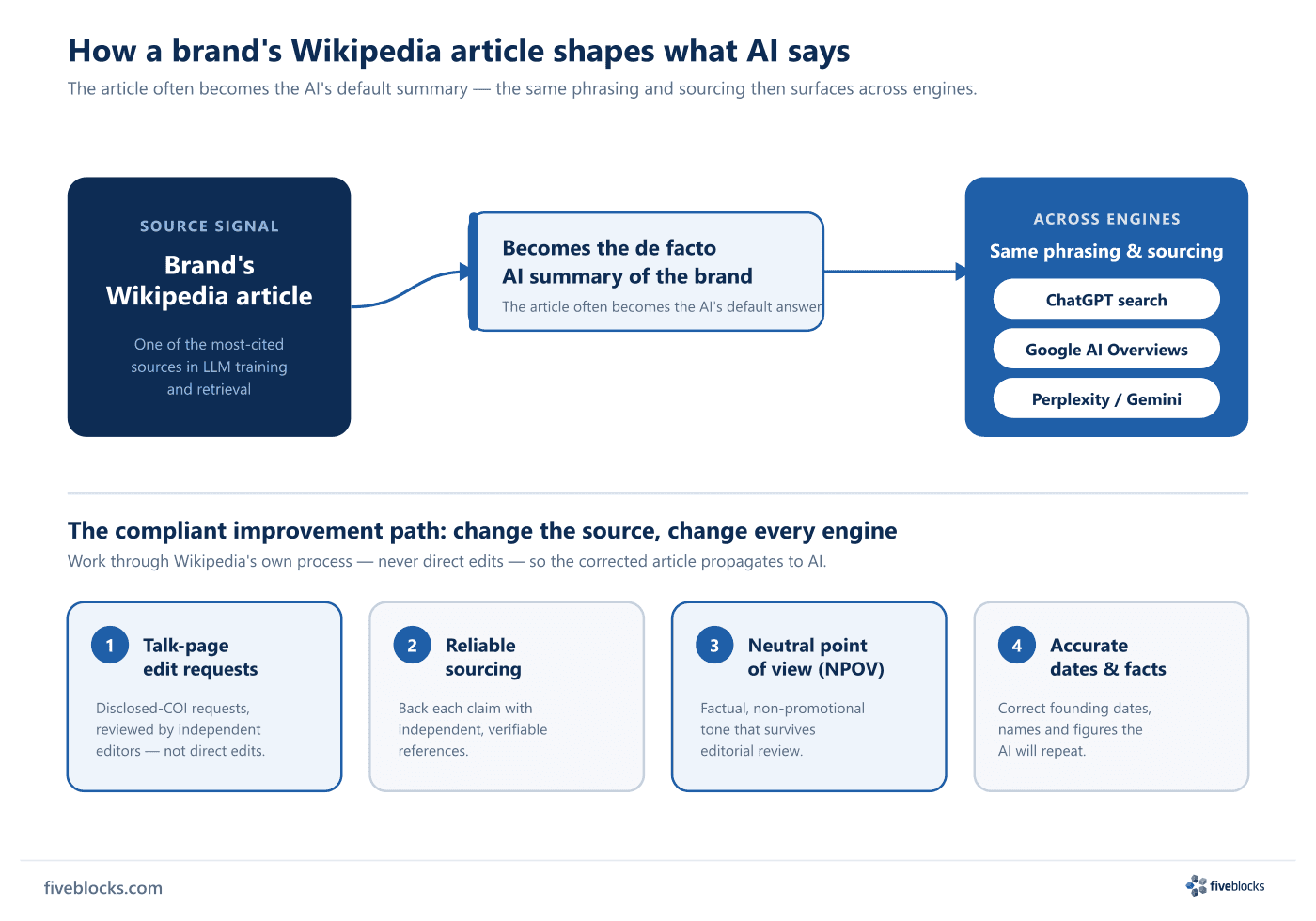
How AI engines use Wikipedia
- Training corpus: Wikipedia featured in the pre-training data of the major LLMs, embedding its descriptions into the models’ baseline knowledge.
- Live retrieval: Retrieval-equipped engines (ChatGPT Search, Perplexity, Google AI Overviews, Gemini) query Wikipedia at query time and cite it directly with inline links. Recent Wikipedia edits can influence retrieval-based AI answers within days or weeks.
- Knowledge Graph feed: Wikipedia article infoboxes and text feed Google’s Knowledge Graph, which Gemini and Google AI Overviews draw on for entity facts.
What happens without a Wikipedia article
For a subject that meets notability but lacks an article, the AI engines fall back on weaker sources, aggregator sites, directory listings, press releases, and the picture they produce is less controlled and less reliable. The absence itself is a measurable gap in AIQ reporting.
The improvement path
Because Wikipedia is community-governed, the only compliant route for a party with a conflict of interest is through Wikipedia’s own process: disclosed-COI Talk-page edit requests with reliable secondary sources, neutral phrasing, and accurate facts. Direct edits from an interested-party account get reverted. Done correctly, improvements to sourcing, accuracy, and completeness tend to propagate into AI responses for retrieval-based engines within days to weeks. The timeline for engines that rely primarily on a training baseline is longer and tied to their retraining cycle.
Last reviewed: 19/05/2026
