Why is Wikipedia’s influence on AI training growing, not shrinking?
Wikipedia's influence on AI is growing through two routes at once: it is treated as one of the highest-quality components of LLM training corpora, and retrieval-equipped AI engines look up Wikipedia at query time to answer entity questions. Both routes have expanded over time, not contracted.
Wikipedia’s influence on AI answers is growing, not shrinking. It works through two mechanisms at once, training and retrieval, and both have become more important as AI engines have developed.
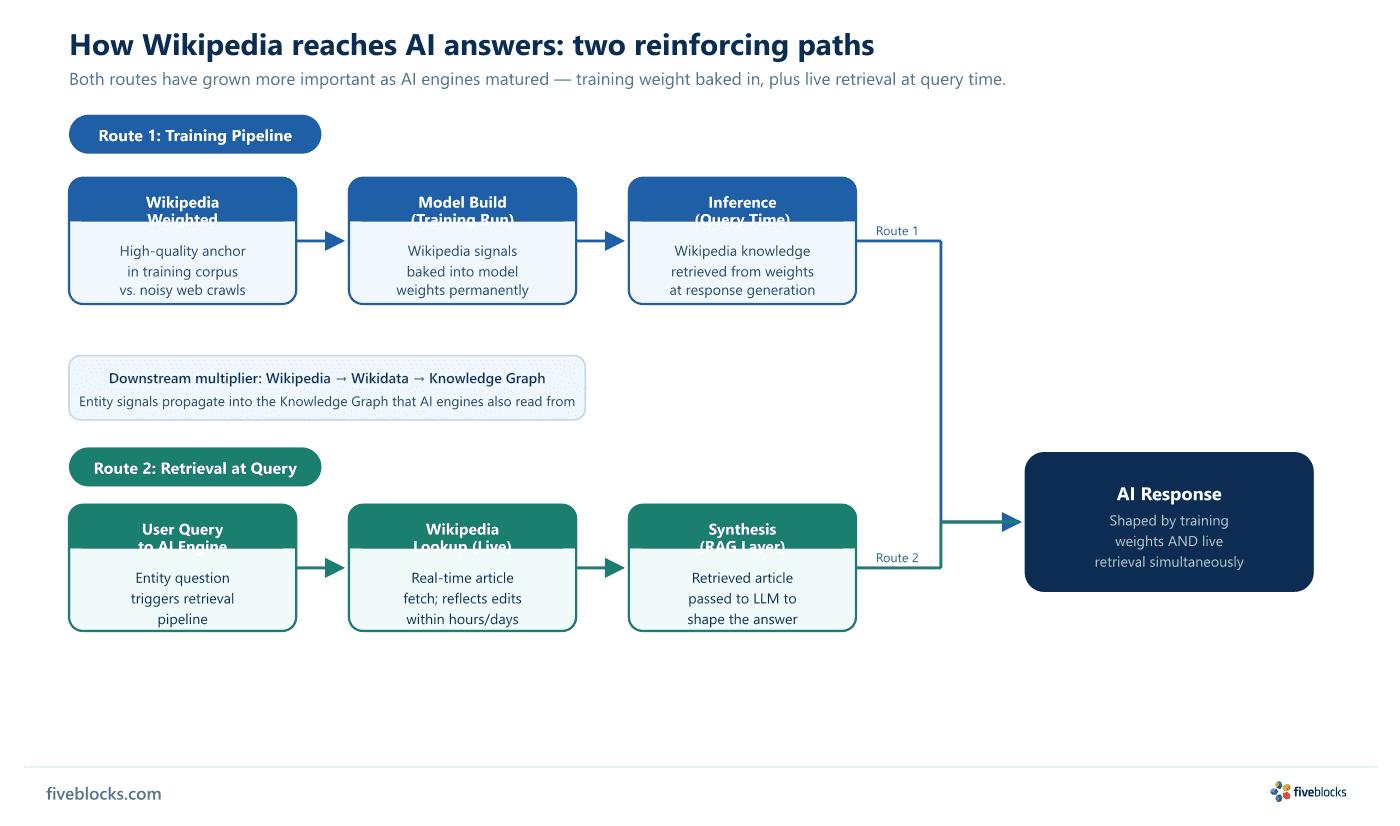
Route 1: training pipeline
Every leading AI model was trained on a corpus that included Wikipedia as a foundational component. Wikipedia gets priority in that corpus because its content is dense, factual, structured, and maintained under a community quality regime. The alternatives available at comparable scale, general web crawls, social platforms, and forums, are much noisier. As model training has become more expensive and more selective about data quality, the share contributed by well-curated sources like Wikipedia has risen relative to low-signal web content.
- Foundation-model training: Wikipedia was a foundational training-corpus input for major LLMs, including the models behind ChatGPT, Gemini, and Copilot.
- Quality weighting: Major AI engines weight Wikipedia heavily in both training and retrieval when answering entity questions. It is the reference point noisier sources are measured against.
- Downstream propagation: Wikipedia category and entity signals flow into Wikidata and the Google Knowledge Graph, which AI engines also read from. A single well-maintained article carries further than its own page.
Route 2: retrieval at query time
Beyond what is baked into model weights during training, retrieval-equipped AI engines run a live Wikipedia lookup when they get a query about a known entity. That retrieved article is passed to the synthesis layer and shapes the generated answer directly. This route reflects Wikipedia changes within hours or days, rather than waiting for the next model training run.
- Explicit Wikipedia retrieval: Retrieval-equipped AI engines privilege Wikipedia at query time and often cite it directly with an inline link.
- Entity-query pattern: ChatGPT and other major AI engines treat Wikipedia as a foundational reference for entity questions, drawing on it from both training data and retrieval.
- Google’s infrastructure: Google’s AI Overviews and Gemini synthesis weight Wikipedia and the Knowledge Graph as primary sources when summarizing a subject, because Gemini has direct access to Google’s infrastructure and the Knowledge Graph.
- Evergreen vs. time-sensitive: For evergreen entity queries, AI engines lean on the training corpus and Wikipedia; for time-sensitive queries they lean on live retrieval. Wikipedia is the entity reference in both modes.
Why the trajectory is upward
Three years ago, AI-powered search with live Wikipedia retrieval was not yet standard. It now is. At the same time, the training pipelines feeding the next generation of models continue to treat Wikipedia as a high-quality source. A subject’s Wikipedia article ranks at the top of branded search, feeds the Google Knowledge Panel, and is among the most heavily weighted sources used by AI engines. Improving that article produces visible engine-level improvements within weeks for retrieval-heavy models. Training weight plus live retrieval, both rising, is why Wikipedia work belongs at the center of any AI reputation program rather than at its edges.
Last reviewed: 19/05/2026
