How does reputation management work for private companies with no public profile?
Private companies still need reputation management because customers, candidates, partners, and investors all search, and none of them limit their research to publicly listed companies. The core entity work (Wikipedia where notability exists, Knowledge Panel, Crunchbase profile, structured-data site, AIQ monitoring) is the same; only the footprint is smaller.
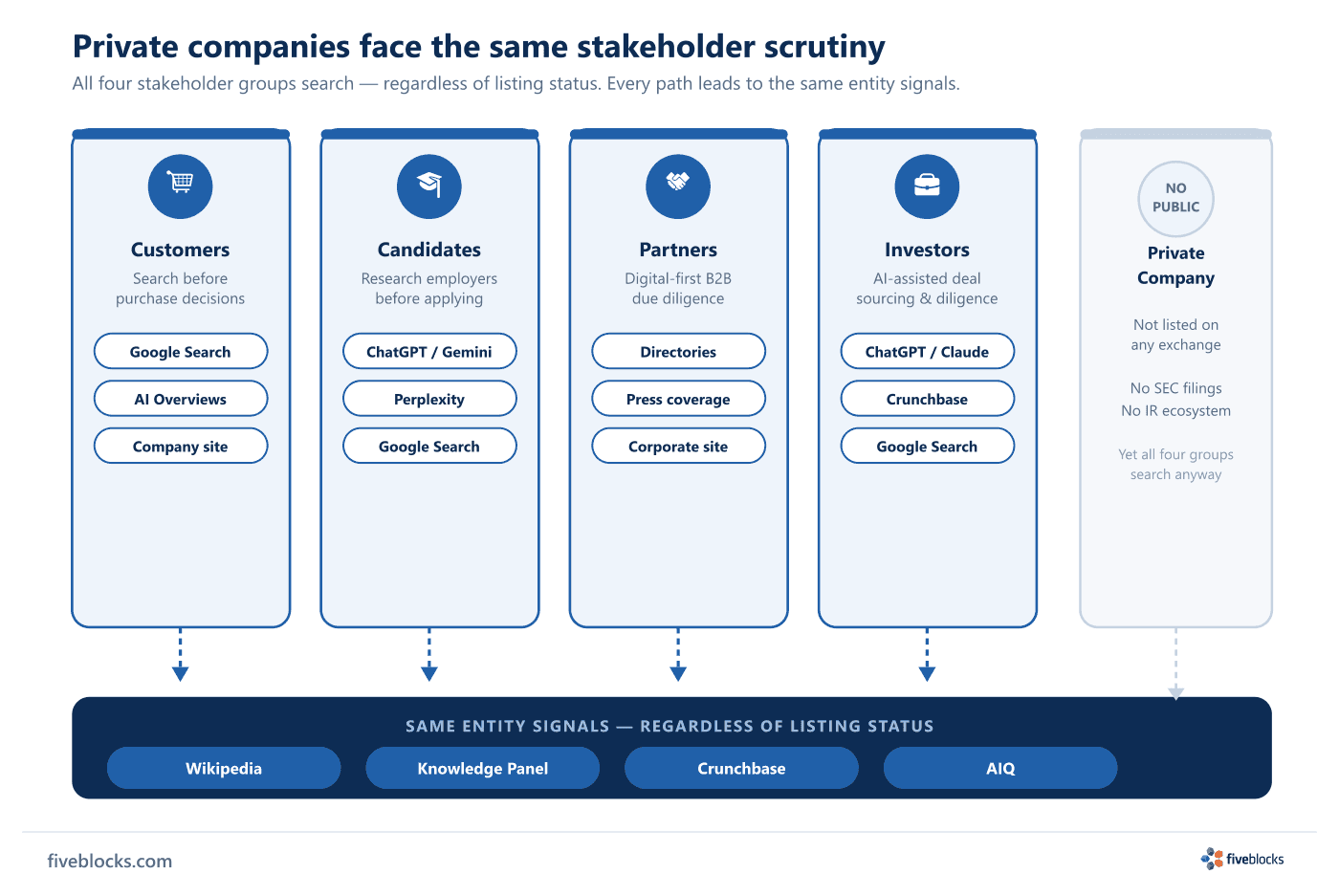
The idea that private companies do not need reputation work runs against what stakeholders actually do. Customers search before they buy. Candidates research employers before accepting interviews, and many now prompt AI engines directly to judge whether a company is worth pursuing. Partners check before signing supplier or distribution agreements. Investors run digital due diligence before committing to a deal. None of them limit their search to publicly listed subjects.
Who searches, and what they find
- Customers: a Google search for the company name returns whatever the entity layer supports, a Knowledge Panel, the corporate site, third-party references, and AI-generated overviews.
- Candidates: research shows candidates now treat tools like ChatGPT as a search engine for company reputation, asking AI to judge whether a company is worth pursuing before they apply.
- Partners and suppliers: business-to-business due diligence is digital first. They check the corporate site, directories, and any press coverage they can find.
- Investors and allocators: AI tools are used for early-stage deal sourcing research and diligence screening, pulling from the same entity signals that shape any entity’s AI representation.
What differs for private companies
The core entity program is the same in kind. It differs only in footprint:
- Wikipedia: viable where independent notability supports one. Private companies must clear the same notability standard as public ones, but without the built-in source layer of SEC filings and investor-relations coverage that public companies generate automatically. That makes source-building harder, not the standard lower.
- Knowledge Panel: depends on the same entity signals (Wikidata, structured data, authoritative references) whether the company is public or private.
- Crunchbase: especially useful for private companies. Crunchbase profiles supply structured business data (founding date, funding history, leadership, category) that Google’s Knowledge Graph reads as a credible reference; Search Engine Land lists it as one of the reputable sites that feeds the Knowledge Graph. For a private company with no SEC filings and limited press, Crunchbase often supplies the structured firmographic layer that public companies get for free from financial databases.
- Corporate site with Organization schema: structured data (sameAs links to Wikipedia, Wikidata, Crunchbase) signals entity identity to both Google and AI engines.
- AIQ monitoring: AI engines answer questions about private companies the same way they answer questions about public ones. What they say depends on the quality and coherence of the entity signals, not on exchange listing status.
Cost and scope
A private-company program usually costs less than a comparable public-company program because the content footprint is smaller: no retail investor relations ecosystem, no earnings-call transcript layer, no SEC filing corpus to manage. But each layer matters relative to its cost in the same way. A thin or inaccurate entity presence leaves every stakeholder search underserved.
Last reviewed: 19/05/2026
