How does reputation management work differently for individuals vs companies?
Individual and company reputation programs share the same source-layer methodology but differ in signals: individuals use Person schema, LinkedIn, and a bio site; companies use Organization schema, Crunchbase or Bloomberg, and the corporate site. Founder-led engagements often run both tracks together.
Individual and company reputation programs use the same underlying methodology: build credentialed external signals that anchor the entity, then surface those signals through owned content and structured data. The specific layers and signals differ between the two tracks.
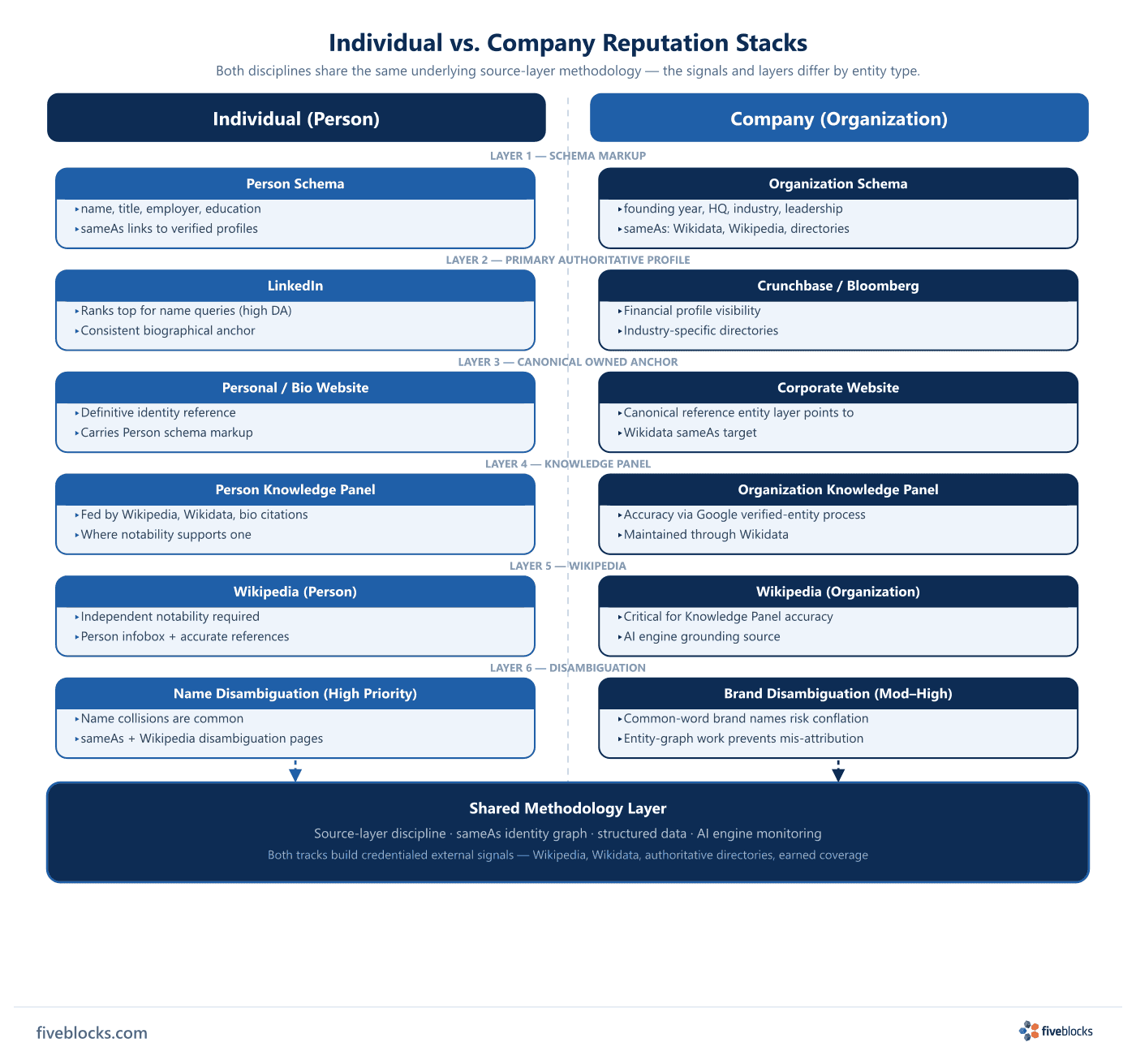
Individual vs. company: where the reputation stacks differ
| Reputation layer | Individual (Person) | Company (Organization) |
|---|---|---|
| Schema markup | Person schema on the bio page and any owned site, with full name, title, employer, education, and sameAs links to verified profiles |
Organization schema on the corporate site, with founding year, headquarters, industry, leadership, and sameAs links to Wikidata, Wikipedia, and authoritative directories |
| Primary authoritative profile | LinkedIn, consistently ranks in the top results for name queries due to its high domain authority | Crunchbase or Bloomberg for financial-profile visibility; industry-specific directories for operational presence |
| Canonical owned anchor | A personal or bio website that is the definitive identity reference and carries Person schema |
The corporate website, the canonical reference that the entity layer (Wikidata sameAs, structured data) points to |
| Knowledge Panel | A Person Knowledge Panel where notability supports one, fed by Wikipedia, Wikidata, and consistent external bio citations | An Organization Knowledge Panel, with accuracy maintained through the Google verified-entity correction process and Wikidata |
| Wikipedia | Where independent notability supports an article; Person schema infobox and references must be accurate | Where independent notability supports an article; critical for Knowledge Panel accuracy and AI engine grounding |
| Disambiguation priority | High, name collisions are common; sameAs links, Wikipedia disambiguation pages, and consistent biographical anchors are required |
Moderate to high, common-word brand names and multi-entity groups require entity-graph work to prevent conflation |
What the two tracks share
- Source-layer discipline: search and AI engines weight credentialed external sources heavily. The work runs at those sources: Wikipedia, Wikidata, authoritative directories, earned coverage, rather than purely on owned content.
- Structured data and
sameAslinks: both tracks usesameAsproperties to build a connected identity graph the engines can resolve unambiguously. - AI engine monitoring: both individuals and companies need ongoing monitoring for accurate AI narrative treatment, as engines train on different source sets and produce different results per entity type.
Combined engagements: founder-led and family businesses
For founder-led companies and family businesses, individual and corporate programs are frequently run together as related but distinct workstreams. The individual’s reputation affects the company’s perceived leadership quality, and the company’s Wikipedia and Knowledge Panel coverage often references the founder directly. Running both tracks under a shared strategy avoids conflicting signals and produces stronger entity resolution for both entities.
Last reviewed: 19/05/2026
Sources (4)
- Creating Helpful, Reliable, People-First Content developers.google.com
- Organization Structured Data | Google Search Central | Documentation developers.google.com
- GEO: Generative Engine Optimization arxiv.org
- How LinkedIn's High Domain Authority Affects Anyone With a LinkedIn Profile natlawreview.com
