How should private equity firms manage their AI reputation during fundraising?
Run an AIQ-style audit on the firm and the named principals well before the formal fundraise, monitor the allocator-style prompts LPs would ask, and fix the gaps in the underlying sources so the engines return materially different answers by the time LP diligence begins.
A private-equity firm manages its AI reputation during fundraising by running the diligence on itself first: audit what the engines say about the firm and its named principals months before the raise, watch the allocator-style prompts LPs would ask, and fix the underlying sources while there is still runway. Prompting the engines directly changes nothing. They don’t remember what you tell them; they rebuild every answer from the sources they trust, so the durable work is on those sources. Fundraising is a high-stakes moment for AI reputation because the audience is small, sophisticated, and increasingly uses the engines for early diligence.
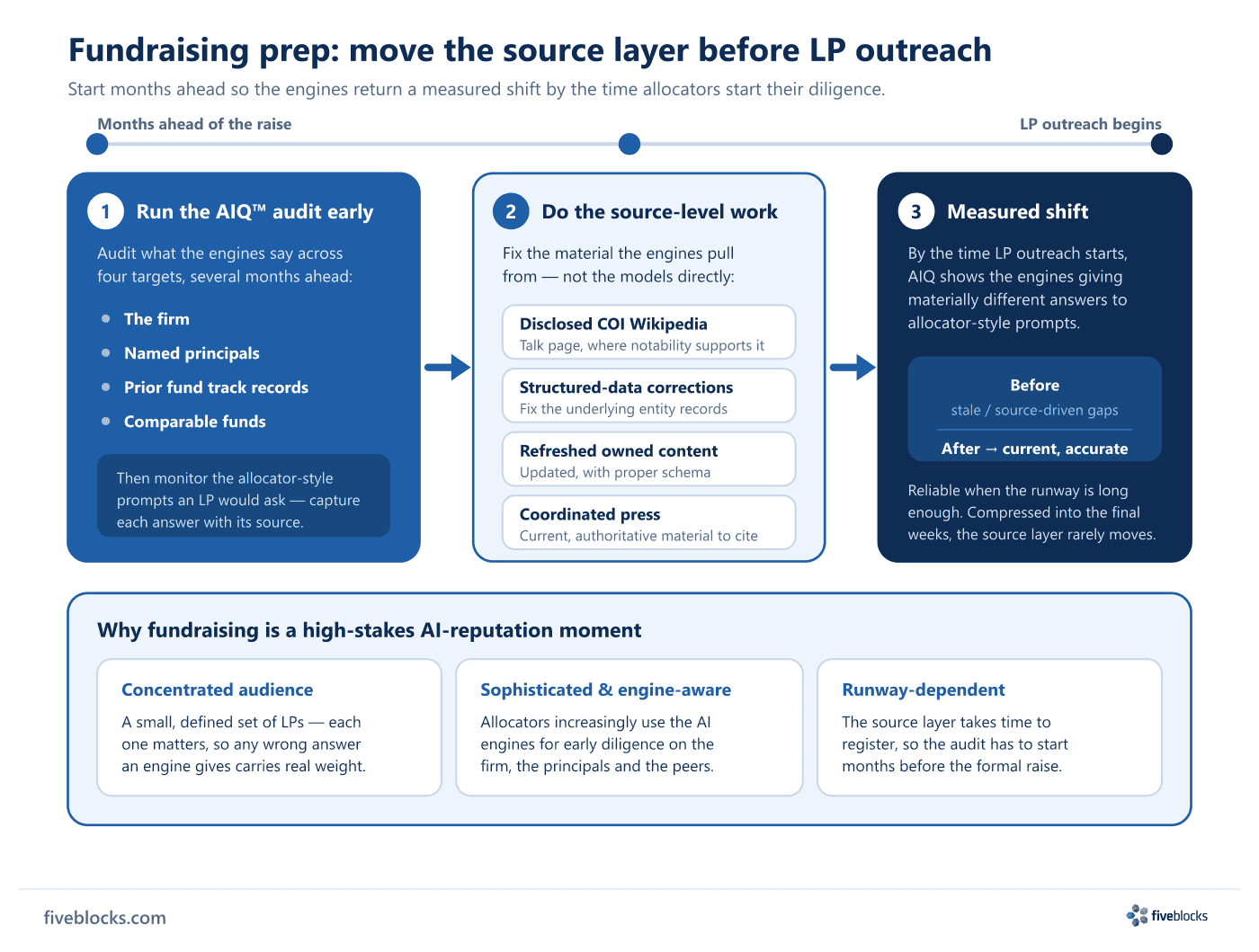
The fundraising-prep sequence
- Run the audit early. An AIQ audit covers the firm, the named principals, prior fund track records, and the relevant comparable funds. Run it several months ahead of the formal fundraise, long enough that the source work has time to register.
- Monitor the allocator-style prompts. Track the questions an LP would actually ask the engines about the firm’s track record, the principals, and how it stacks up against named peer funds. Capture the responses with their source attribution so you can see which underlying material is driving each answer.
- Fix the gaps in the underlying sources. Work on the sources the engines draw from rather than prompting the models:
- disclosed conflict-of-interest (COI) Wikipedia work, on the Talk page, where notability supports an article;
- structured-data corrections;
- refreshed owned content with proper schema;
- coordinated press coverage that gives the engines current, authoritative material to pull from.
By the time the formal LP outreach starts, AIQ shows the engines producing materially different responses to allocator-style prompts than they did at the start of the work. This holds when the runway is long enough. Compressed into the final weeks before a raise, there is rarely time for the underlying sources to change.
Last reviewed: 19/05/2026
