How does reputation management help with institutional investor relations?
Reputation management closes the gap between what a company says about itself and what an investor finds when they check. IR controls the official channel - filings, calls, the investor site - but analysts and shareholders also run their own searches, and a contradiction between the two becomes a credibility question.
Reputation management supports investor relations by closing the gap between what a company says about itself and what an investor finds when they check. IR controls the official channel – filings, calls, the investor site – but analysts and shareholders also run their own searches, and a contradiction between the official narrative and the public record becomes a credibility question.
Two records investors compare
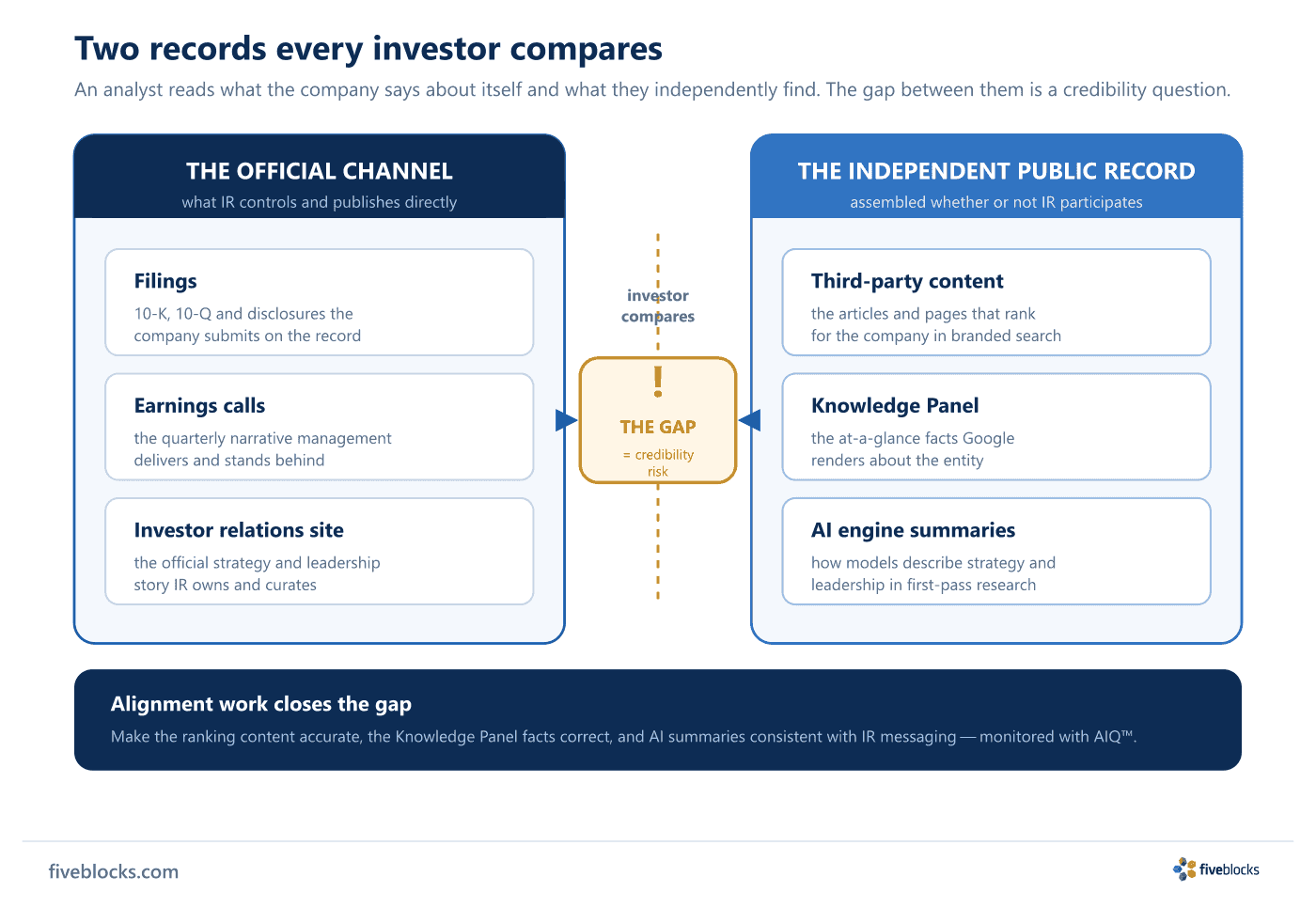
- The official channel. Filings, earnings calls, and the investor relations site – the narrative IR controls and publishes directly.
- The independent public record. The third-party content that ranks for the company, the facts Google renders in the Knowledge Panel, and the AI engine summaries that describe strategy and leadership – assembled whether or not IR takes part.
Analysts and shareholders read both when they do first-pass research. Alignment between the two records backs IR up. Contradiction creates the friction IR exists to remove.
What the alignment work covers
The work is alignment. That means making sure the authoritative third-party content that ranks for the company is accurate, the Knowledge Panel renders correct facts, and AI engine summaries describe strategy and leadership consistently with IR messaging. We monitor those AI answers with AIQ, because analysts increasingly use models for first-pass company research, and a synthesized summary that lags the company’s current story creates the same friction. The aim is that independent research corroborates the company instead of complicating it.
Last reviewed: 20/05/2026
