What reputation challenges are unique to pharmaceutical companies?
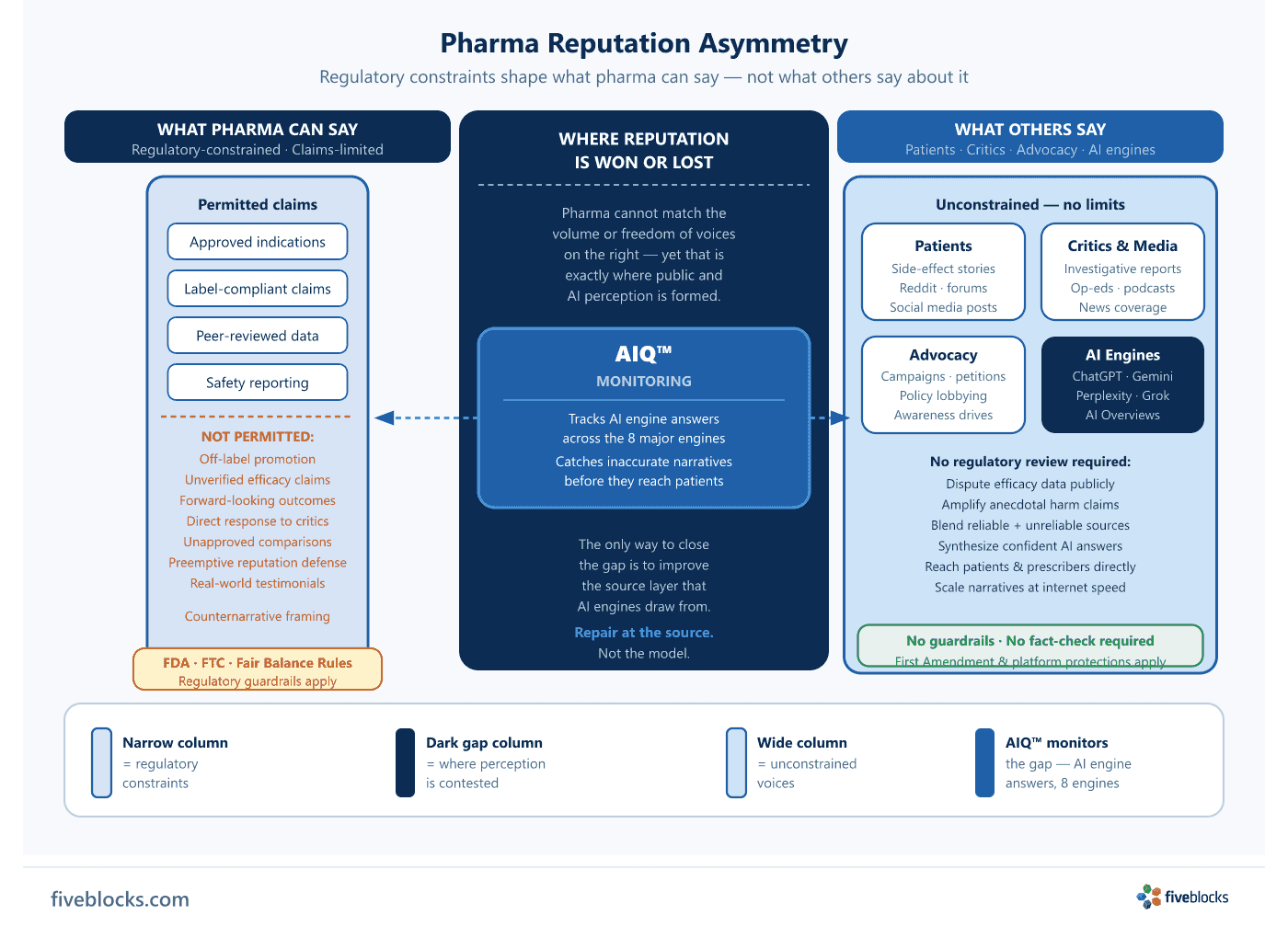
Pharmaceutical companies face an asymmetry: regulatory constraints tightly limit what they can say about their own products, while patients, critics, advocacy groups, and AI engines face no such limits. That gap is where pharma reputation is won or lost, which is why AI monitoring has to be continuous.
Pharmaceutical reputation problems come down to asymmetry. Regulation puts tight limits on what a company can say about its own products. There is almost no limit on what patients, critics, advocacy groups, and now AI engines say about them.
The four challenges that follow from that asymmetry
- Regulatory constraints on claims
- The company often cannot respond to a narrative as directly as it would like. The work is accurate, compliant content that occupies the space available without overstepping it.
- Non-negotiable scientific accuracy
- Errors carry both regulatory and safety consequences, so every public-facing statement is held to a higher standard than in most industries. Precision here is a compliance requirement.
- Patient-advocacy dynamics
- Advocacy communities cut both ways. They can amplify legitimate concerns, and they can mobilize around incomplete information. Genuine engagement holds up better than spin, and silence reads as disregard.
- AI-driven medical misinformation
- This is the newest and fastest-moving risk. AI engines build confident answers about drugs from a mix of authoritative and unreliable sources, and those answers reach patients and prescribers alike. The company usually cannot correct the model directly. It can only improve and anchor the source layer the model draws from.
Where AIQ monitoring fits
We monitor AI engine answers with AIQ™ across pipeline, safety, and outcome prompts. The gap between what a pharmaceutical company is permitted to say and what the engines are saying about it is where reputation is won or lost, and catching an inaccurate or harmful AI narrative early is the only way to correct it at the source before it reaches patients and prescribers.
Last reviewed: 20/05/2026
