How do you manage reputation during a pharmaceutical product recall?
During a pharmaceutical product recall, factual accuracy outranks speed. Coordinate disclosure with the FDA notification process, tell patients and providers plainly what is affected and what to do, and monitor the AI engines with AIQ™ for misinformation about scope and risk. Once the acute phase passes, publish durable content on remediation and the safety controls now in place, so the public record shows a company that managed a recall responsibly.
A pharmaceutical product recall is an information event where misinformation can affect patient safety directly. So the reputation work runs alongside regulatory and medical communication, and one rule holds at every stage: accuracy outranks speed-over-substance.
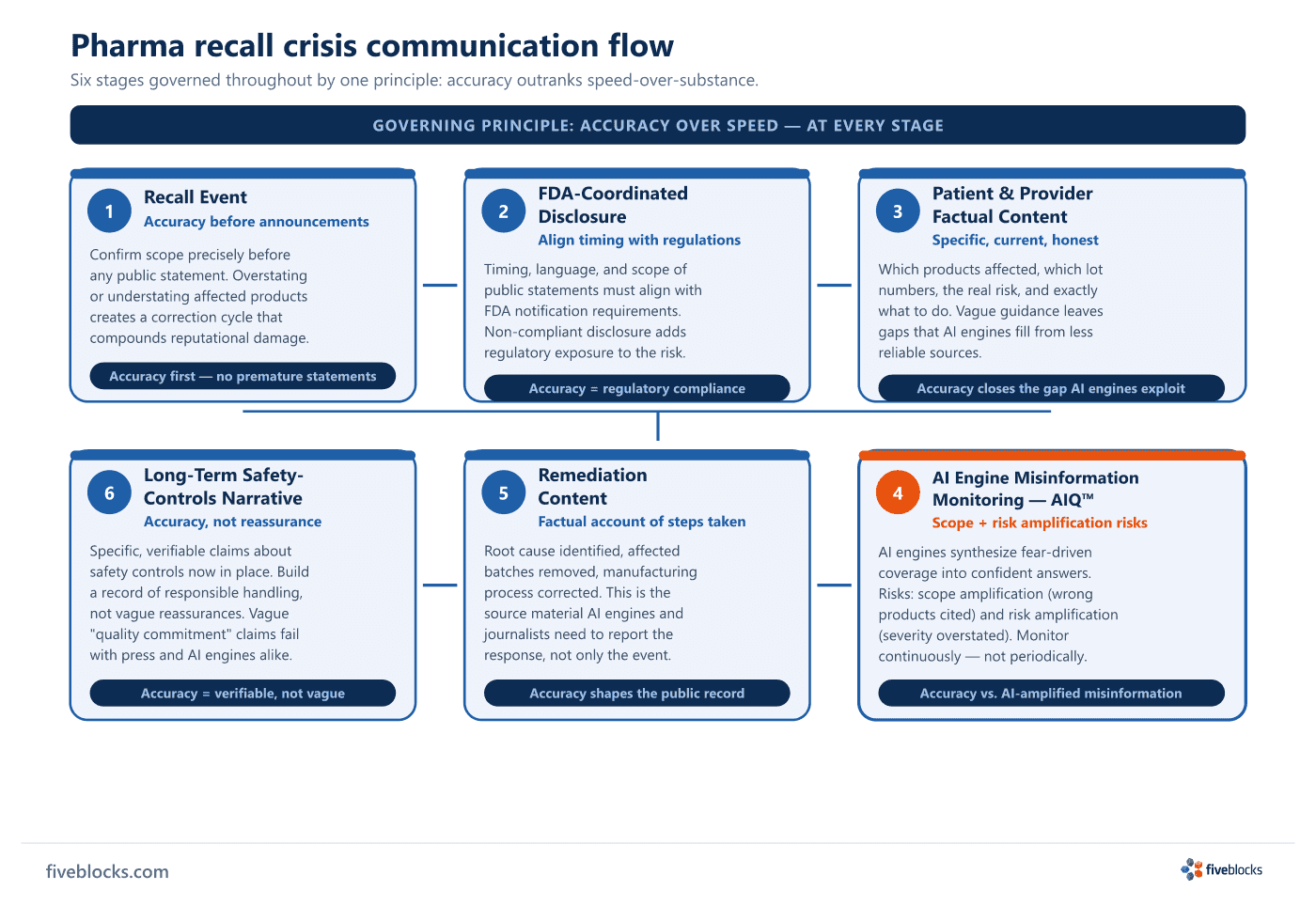
The six-stage recall communication arc
- Recall event, accuracy before announcements: Confirm the scope of the recall precisely before any public statement. Overstating or understating the affected products or batches in the first disclosure starts a correction cycle that compounds the reputational damage. Everything that follows depends on getting this right.
- FDA-coordinated disclosure: Recall communication runs through the FDA notification process. The timing, language, and scope of public statements have to line up with regulatory requirements. A premature or non-compliant disclosure adds regulatory exposure on top of the reputational risk and can prejudice the recall’s legal standing.
- Patient and provider factual content: Give patients and healthcare providers a clear, honest account: which products are affected, which lot numbers are involved, what the risk is and is not, and exactly what to do. This content has to be specific and current. Vague guidance leaves patients without what they need to make safe decisions, and the AI engines will fill any gap from less reliable sources.
- AI engine misinformation monitoring with AIQ™: Recalls generate fear-driven coverage and social chatter, and the AI engines turn that into confident answers quickly. Two failure modes matter here: scope amplification, where engines overstate which products are affected, and risk amplification, where they overstate severity. We monitor those answers with AIQ™ through the acute phase and after it. Real-time browsing engines can surface and repeat new coverage within hours of publication, so the monitoring has to be continuous rather than periodic.
- Remediation content: Once the acute phase is contained, publish an authoritative, factual account of what was actually done: the root cause identified, the affected batches removed, the manufacturing process corrected. That gives AI engines and journalists source material about the response itself. Without it, the recall stays the most recent authoritative fact in the public record.
- Long-term safety-controls narrative, accuracy rather than reassurance: Over the months that follow, build durable content on the safety controls now in place. Aim for a public record that shows a company that handled a recall, not one defined by it. Claims about safety controls have to be specific and verifiable. Vague statements about a commitment to quality are the one thing that reliably fails here, because neither the press nor the AI engines treat them as evidence.
Why accuracy comes first at every stage
In a pharmaceutical recall, the cost of a confident, wrong statement goes well beyond reputation. Patients and providers act on the information they receive. An overstated scope triggers unnecessary treatment interruptions; an understated risk fails to prompt the actions the recall requires. The same logic applies to AI engine answers. A model citing early, inaccurate coverage about a recall’s scope or severity can produce patient-safety consequences that outlast the recall itself. Accuracy is not a constraint on speed. It is the substance that makes the communication useful.
What holds up afterward
Companies that communicate specifically and accurately through a recall end up with a record that reads as a handled episode rather than a defining failure. Companies that put speed ahead of accuracy generate a correction trail that often draws more coverage than the recall did. In pharma, getting the facts right before publishing them is the reputation strategy.
Last reviewed: 20/05/2026
