How should biotech companies manage reputation during clinical trials?
Biotech reputation during clinical trials is a controlled-disclosure problem. Regulatory rules strictly limit what can be said about trial outcomes, while investors, patients, and patient-advocacy communities speculate freely, and AI engines can repeat that speculation as fact. The work is regulatory-aware messaging, active monitoring of AI narratives for misinformation, and accurate compliant content on the underlying science and pipeline.
Biotech reputation during clinical trials runs on a mismatch. What the company can say about trial outcomes is severely constrained. What everyone else says is not constrained at all. The gap between those two is where reputation is won or lost.
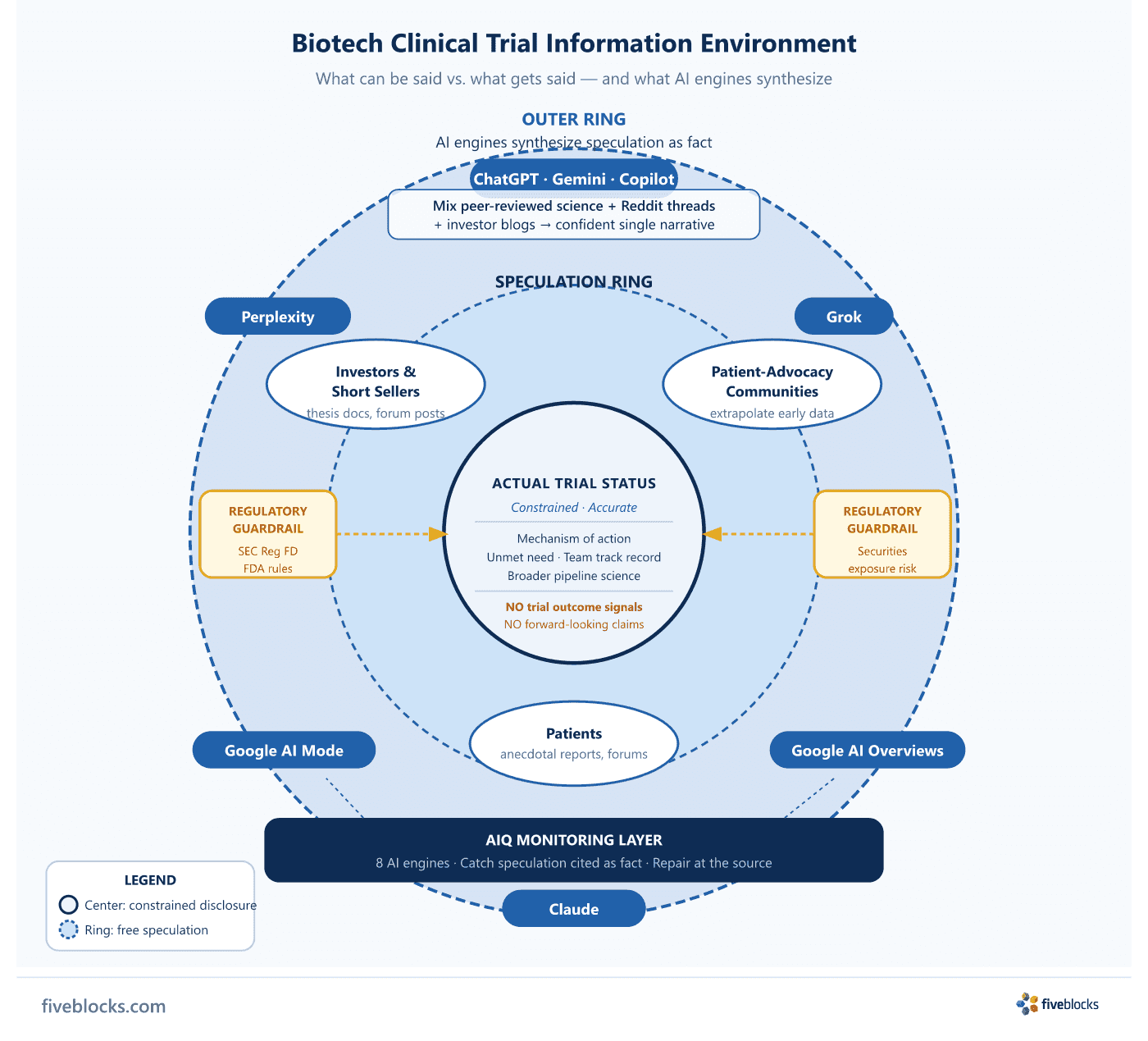
The controlled-disclosure problem
Forward-looking claims about trial outcomes carry both securities exposure and FDA regulatory exposure. Companies that signal optimism, even in informal channels, create material information risk and invite enforcement scrutiny. The pressure to do it anyway is real: the market moves on trial readouts, and investors and analysts push constantly for a hint of direction. Holding the line is a reputation decision as much as a legal one. A company that has spoken carefully and accurately throughout a trial is far harder to damage when results come in mixed or delayed than one that has been leaking optimism for months.
Where misinformation concentrates
- Investors and short sellers publish thesis documents and forum posts that present speculation as settled fact.
- Patients and patient-advocacy communities discuss trial readouts intensely, often extrapolating from early data or anecdotal reports well beyond what the data supports.
- AI engines synthesize this chatter alongside legitimate scientific content, and can surface speculation as if it were the company’s actual trial status, without flagging the difference.
A biotech company in an active trial period routinely finds AI answers about its programs that blend peer-reviewed data with Reddit threads and investor blogs into one confident narrative. That narrative reaches analysts, potential partners, and patients who are making real decisions.
What the monitoring and content work looks like
We monitor AI engine answers with AIQ™ across the eight major engines: ChatGPT, Gemini, Copilot, Perplexity, Claude, Grok, Google AI Overviews, and Google AI Mode, on prompts about the company’s programs, pipeline, and trial status. The point is to catch the moment speculation about an outcome starts being repeated as fact, and to identify which sources are feeding that synthesis, so the repair happens at the source instead of in an argument with the model.
The constructive content work is accurate, compliant material on the underlying science and the broader pipeline. That means the legitimate scientific story rather than trial-outcome commentary: mechanism of action, the unmet need being addressed, the company’s track record and team. It gives the engines authoritative, on-message content to weigh alongside the speculative layer. Companies that leave this space empty hand the narrative to rumor and short interest.
Discipline during the trial pays off at readout
The constraint works in the company’s favor. A biotech that has held strict regulatory discipline through a trial period arrives at readout with a clean record, accurate third-party coverage, and AI narratives that track the actual science rather than amplified speculation. One that has been careless with forward-looking language arrives at the same moment with a reputation problem stacked on top of whatever the data shows.
Last reviewed: 20/05/2026
