How does reputation management work for healthcare organizations?
Healthcare reputation work is accuracy-first across four layers: regulatory-aware content, patient-trust signals (accreditation, credentials, outcomes) that carry an authority marketing cannot, compliant review-platform management, and AI medical-information monitoring. That last layer carries the most risk, because a confident, wrong AI answer about an organization's services or outcomes can reach a patient's care decision, which makes it a patient-safety problem as much as a reputational one.
Healthcare organizations are held to a higher accuracy standard than any other sector, because the information at stake affects real health decisions and the regulation around it is strict. Most industries work to be well described. Healthcare organizations have to be correctly described as well, and those are not the same requirement.
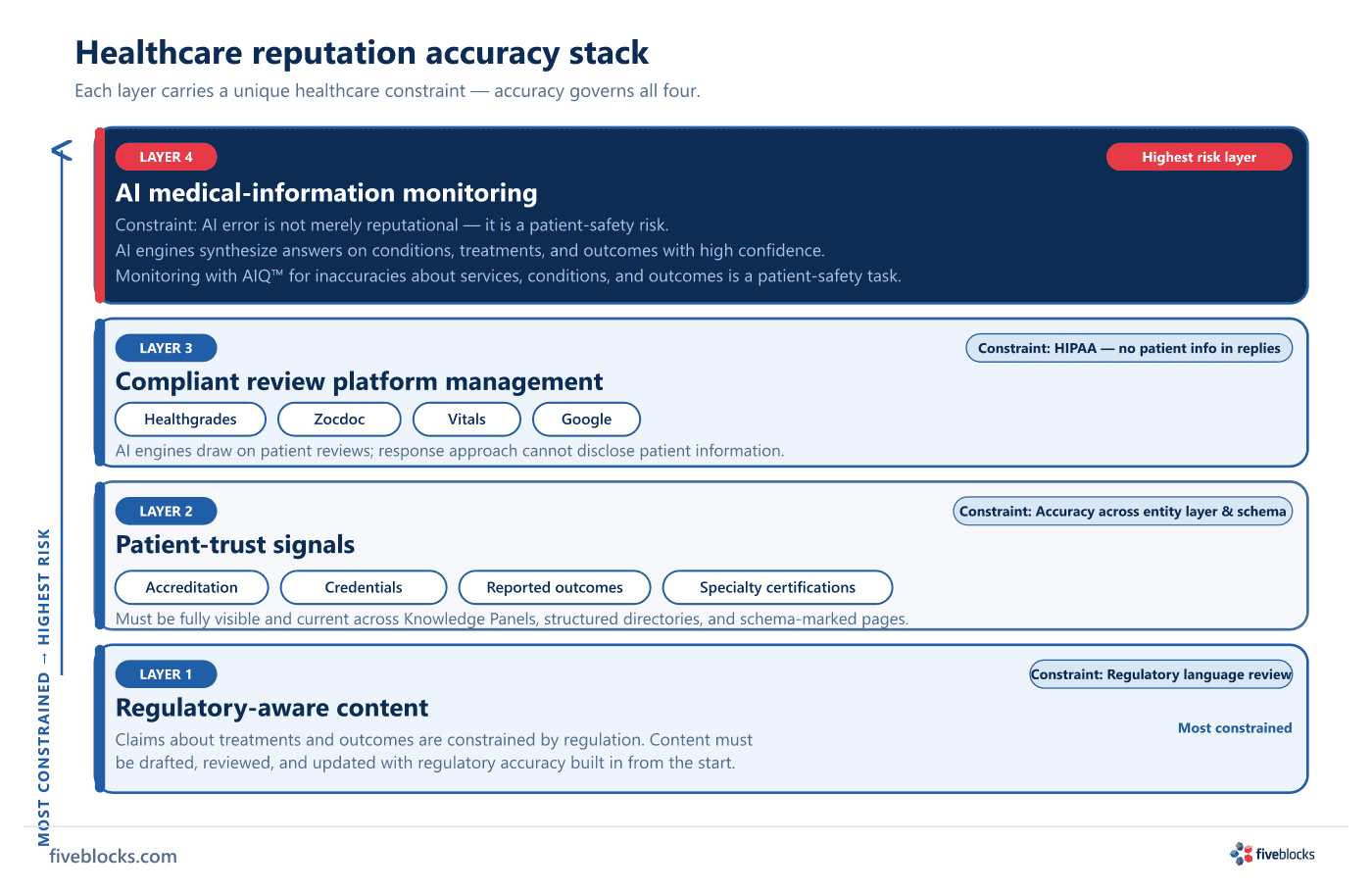
The four layers of healthcare reputation
- Regulatory-aware content
- Regulation limits what an organization can claim about treatments and outcomes. Overstating efficacy, implying outcomes that are not established, or framing a service so that it reads as an advertising claim invites regulatory exposure and liability. Content has to be drafted, reviewed, and updated with that constraint built in from the start rather than added afterward.
- Patient-trust signals: accreditation, credentials, and outcomes
- Accreditation by recognized bodies, physician credentials, specialty certifications, and publicly reported outcomes carry an authority that marketing language cannot manufacture. Patients weigh them, and so do the AI engines that now answer care-seeking queries. They have to be accurate and current everywhere they appear: the entity layer, the Knowledge Panel, structured directories, and the organization’s own schema-marked pages.
- Compliant review-platform management
- Patient reviews on Healthgrades, Zocdoc, Vitals, Google, and similar platforms rank prominently for provider-name and condition searches, and AI engines draw on them when generating care recommendations. Healthcare review response cannot work like a restaurant’s: HIPAA and related rules prohibit disclosing patient information even in a reply, so the work needs a structured, compliant response strategy instead of the direct engagement other industries use. The aim is to give patients and the engines more to go on than a raw star rating.
- AI medical-information monitoring
- This layer carries the most risk. AI engines answer health questions with confident synthesized summaries that patients treat as a starting point. When a model describes what conditions a hospital treats, what outcomes a procedure carries, or what a specialist is credentialed in, an error can reach a clinical decision. Research comparing AI answers against clinical practice guidelines documents significant variability across models on medical queries. Monitoring those answers with AIQ™ for inaccuracies about the organization’s services, the conditions it treats, and the outcomes it achieves is patient-safety work rather than marketing work.
Why the accuracy standard is different here
In most industries a wrong AI summary costs a company consideration or trust. In healthcare it can cost a patient the right care. So the program is built around accuracy as the governing principle rather than favorability, and that applies to content drafting, review management, and AI monitoring alike.
Last reviewed: 20/05/2026
