How do patient reviews affect healthcare provider reputation?
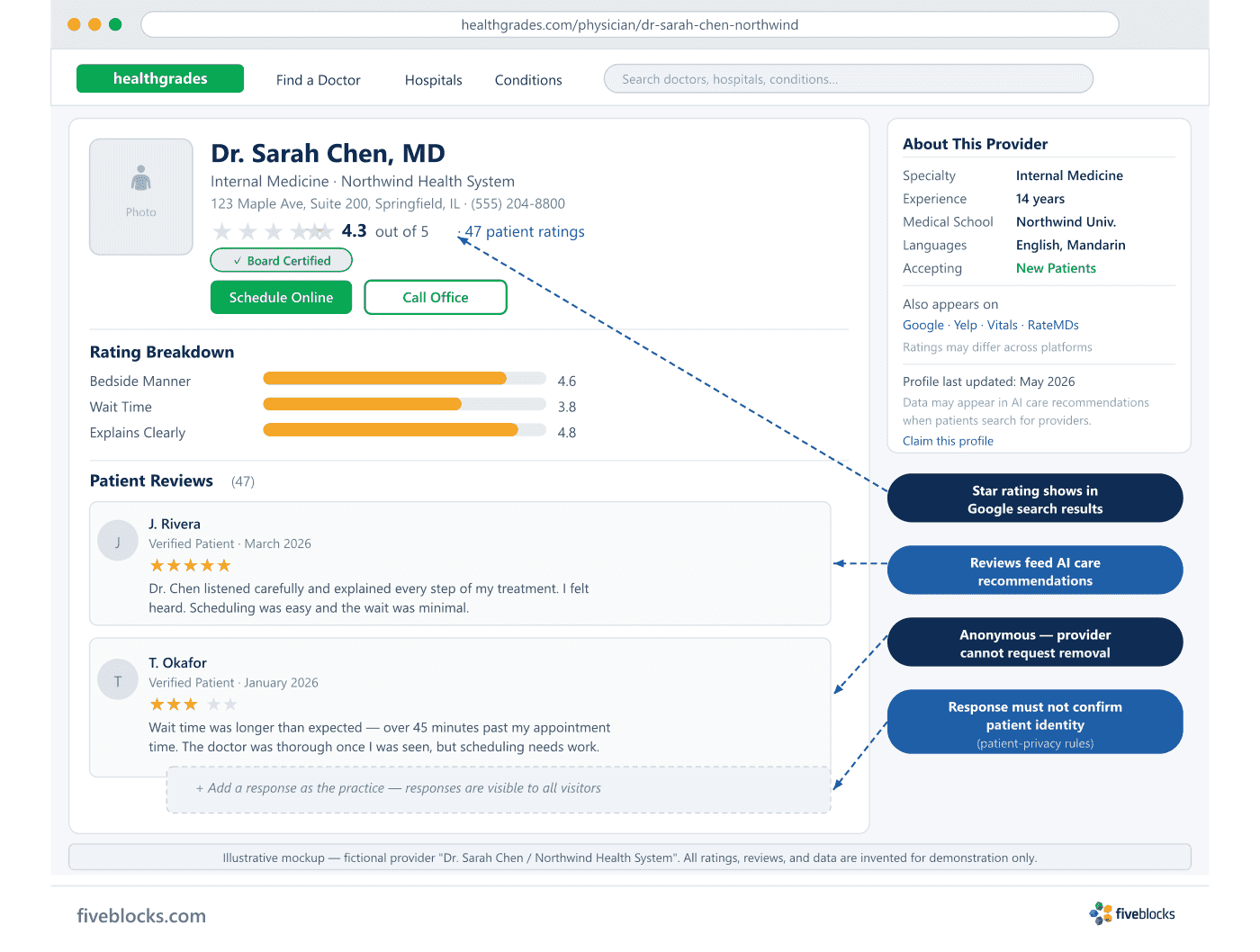
Patient reviews on Healthgrades, RateMDs, Vitals, Yelp, and Google rank prominently for provider-name searches and now feed AI care recommendations, so they are a central reputation signal for any healthcare provider. Patient-privacy rules limit how a provider can reply, which means the response strategy has to be compliant rather than direct. The parallel work is authoritative practice content: credentials, specialties, and clinical approach, structured so patients and AI engines have more than a star rating to go on.
Patient reviews sit at the center of healthcare provider reputation. The platforms that carry them rank prominently for provider-name searches, and AI engines now fold those reviews into the care recommendations patients read when choosing a doctor or specialist.
Why patient reviews carry outsized weight
- Search visibility
- Healthgrades, RateMDs, Vitals, Yelp, and Google all rank for provider-name queries, often above the provider’s own website. A thin or skewed review set is frequently the first thing a prospective patient sees.
- AI care recommendations
- AI engines pull recurring themes from several review platforms at once and state them with confidence: “patients say,” “common complaints include.” Those summaries appear when someone asks which doctor to see or whether a provider is any good, and the answer is a referral the provider never sees being made.
- Volume and recency effects
- A handful of reviews can outweigh years of solid clinical work in how a provider is perceived online. Old reviews with nothing recent alongside them hold disproportionate weight.
Why response strategy is constrained
- Patient-privacy rules
- A healthcare provider cannot respond to a patient review the way a restaurant can. Acknowledging that someone is a patient, or referencing any detail of their care, risks violating patient-privacy obligations, even in a reply to a critical review. Responses have to be worded to avoid confirming or disclosing protected information.
- Prohibited practices
- Review platforms prohibit sentiment-based gating (soliciting reviews only from patients expected to be satisfied) and prohibit incentives in exchange for reviews. A compliant solicitation process asks all patients equally and offers nothing in return.
How the work is structured
- Compliant response strategy. A templated, privacy-aware framework that acknowledges feedback without disclosing protected information, applied the same way across every platform.
- Reputation-aware intake and follow-up. Processes that invite every patient to share their experience through the right channels, which builds review volume without gating or incentives.
- Authoritative practice content. Credentials, specialties, clinical approach, and provider biography, structured so patients and AI engines get a fuller picture than a star rating conveys.
- AI engine monitoring. Tracking what models say when patients ask care-seeking questions about the provider. A model summarizing a provider from a thin or skewed review set is making a recommendation, and the provider needs to see it and correct it at the source.
Last reviewed: 20/05/2026
