How do you manage reputation for a hospital system?
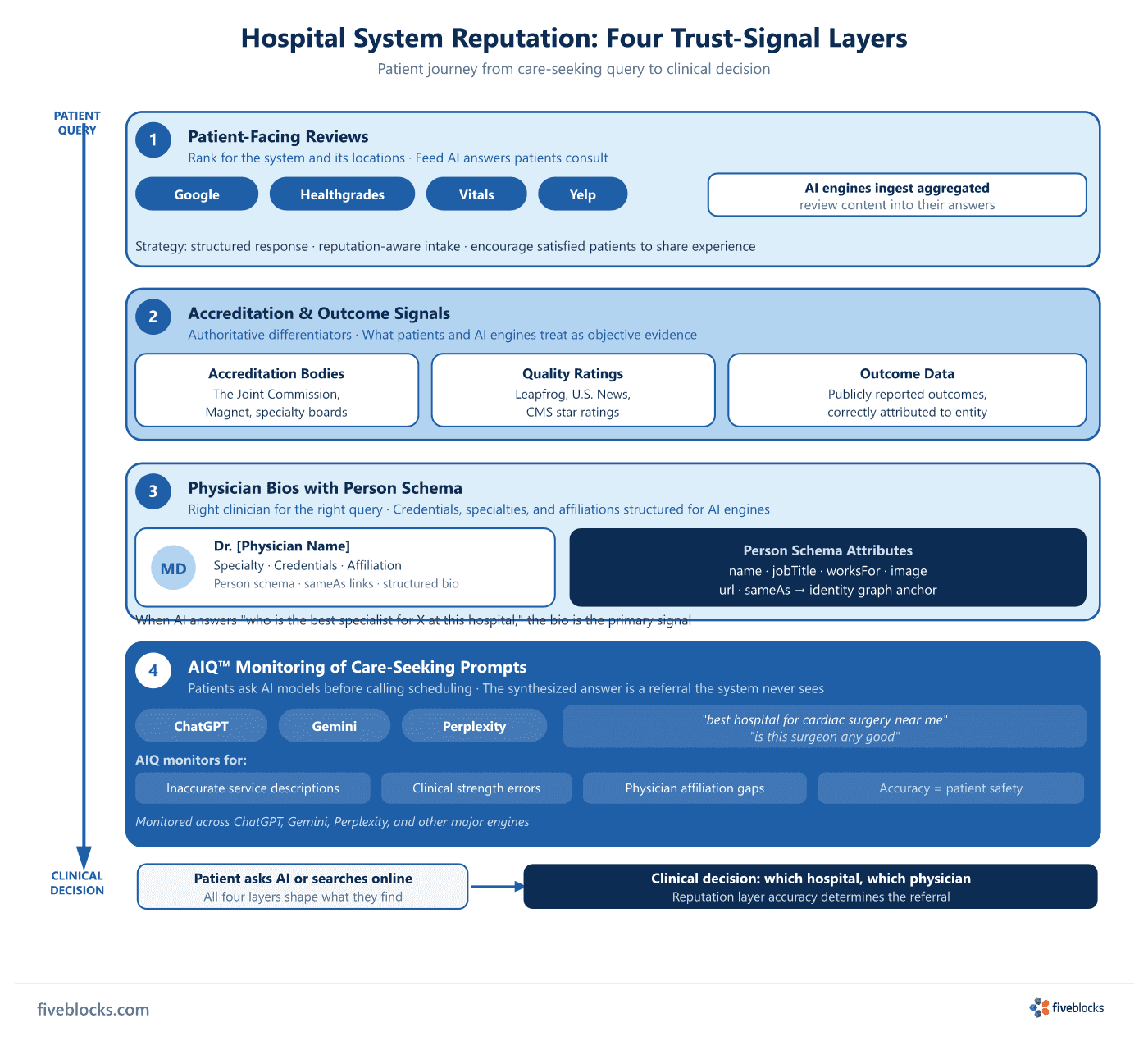
Hospital reputation runs on four trust-signal layers: patient-facing reviews, which rank for the system and feed AI answers; accreditation and outcome data, the third-party evidence patients and engines treat as objective; physician bios marked with Person schema, so the right clinician matches the right query; and AIQ™ monitoring of care-seeking prompts. Patients ask models where to seek care before they call a scheduling line, and that last layer catches the referrals the system would otherwise never see.
A hospital system’s reputation feeds real clinical decisions: which hospital a patient chooses, which physician they trust. That makes the work a matter of trust signals rather than marketing. Four layers shape how patients, AI engines, and referring clinicians read the system, and each needs separate handling.
- Patient-facing reviews
- Reviews rank for the system and its individual locations, and they feed the AI answers patients consult when deciding where to seek care. Managing this layer means a structured response strategy plus intake and follow-up that invites satisfied patients to share their experience, so the review record reflects current care quality instead of a few isolated past moments. Google, Healthgrades, Vitals, and Yelp all carry weight for provider-name and hospital-name queries.
- Accreditation, quality ratings, and outcome data
- Accreditation bodies, quality-rating organizations, and publicly reported outcome data are what patients and AI engines treat as objective third-party evidence of clinical standing. Marketing language cannot substitute for them. They have to appear accurately in search results and in the entity layer, current and attributed to the right organizational entity.
- Physician bios with Person schema
- Bios carry credentials, specialties, and affiliations, and Person schema markup is what gets the right clinician matched to the right query. When a patient searches a physician by name, or an AI engine answers “who is the best specialist for X at this hospital,” the bio is the primary signal. Bios that are incomplete or unmarked leave the answer to chance, or to a competitor whose content is better structured.
- AIQ™ monitoring of care-seeking prompts
- Patients ask AI models “best hospital for X” or “is this surgeon any good” before they call a scheduling line, and the synthesized answer is a referral the system never sees being made. We monitor those care-seeking and provider prompts with AIQ™ across ChatGPT, Gemini, Perplexity, and the other major engines, watching for inaccuracies in how the models describe the system’s services, clinical strengths, and affiliated physicians. Accuracy in this layer is patient safety as much as reputation.
Last reviewed: 20/05/2026
