How do you handle negative search results from malpractice lawsuits?
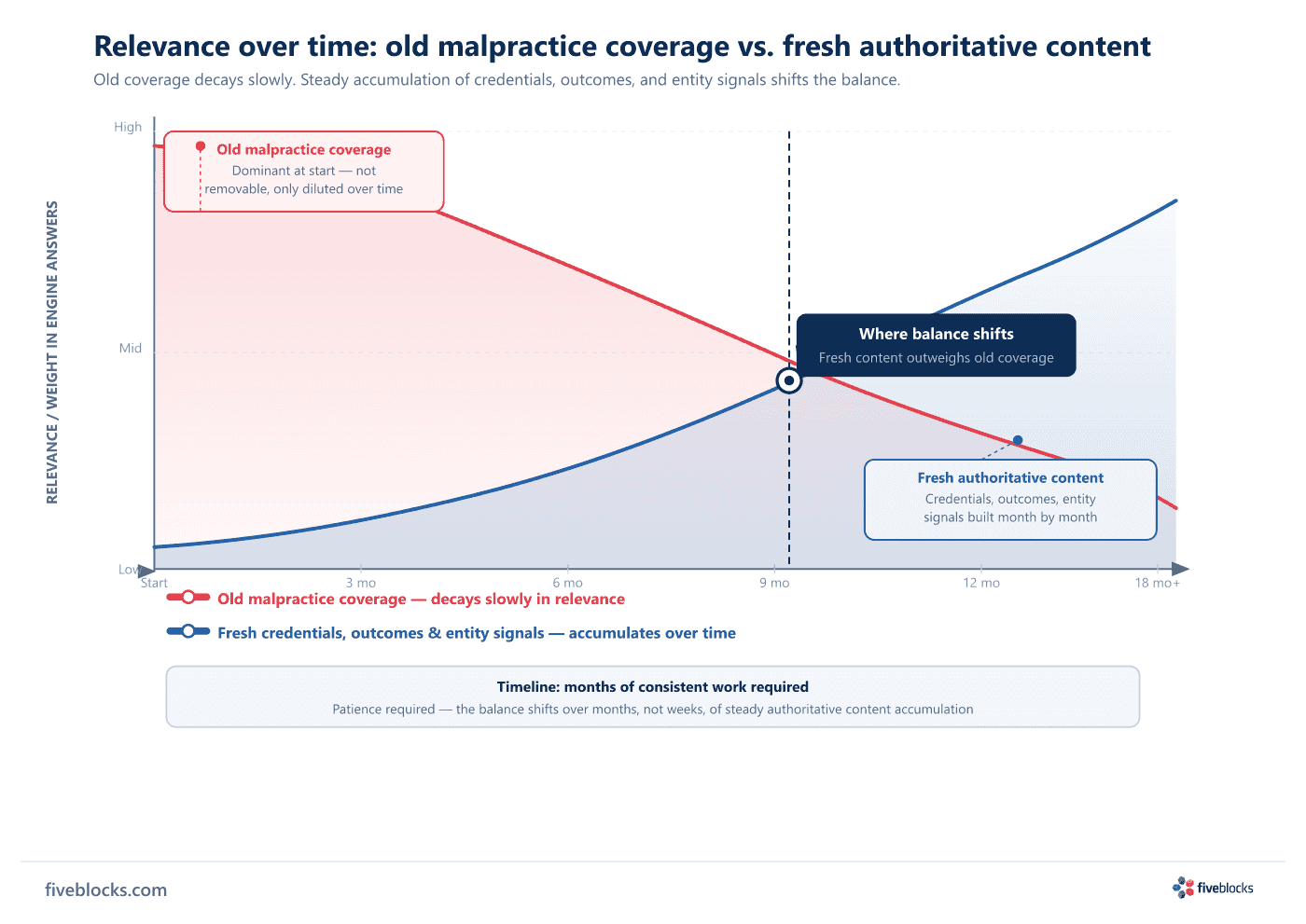
Malpractice-related search results are durable, but they do respond over time to a steady accumulation of current, authoritative content. The work is context and patience: accurate credentials, factual corrections at the source, refreshed entity signals, and monitoring of the AI engines, which sometimes present a years-old settled case as the defining fact about a provider.
Malpractice-related search results are durable and emotionally charged, so the starting point has to be honest. A legitimate, factual record will not come down, and trying to suppress it usually backfires. The work is context and patience, not removal.
How to approach malpractice search results
-
Build current, authoritative content
Accurate provider credentials, current practice information, and outcomes where appropriate give Google and the AI engines fresh, substantive material to weigh alongside an old case. The old case does not need to disappear; it needs to stop being the only material the engines have. When a provider’s recent, accurate content is thin, the engines fall back on the oldest coverage available. -
Pursue source-level corrections where errors exist
Some coverage contains plain factual errors: a dismissed case described as a judgment, a settlement amount misstated, a specialty attributed incorrectly. Where that happens, we take the correction to the outlet directly. A fix at the source lasts longer than any downstream tactic, because it changes what the AI engines and the search index actually read, not how one result looks for one query. -
Refresh entity signals
The canonical entity facts, meaning the provider’s current affiliation, credentials, specialties, and hospital privileges, need to be accurate and current across the structured directories and schema-marked pages that feed the Knowledge Panel and the AI engines. Stale or incomplete entity data leaves a gap, and old coverage fills it by default. -
Monitor AI engine answers
Models sometimes surface a years-old settled case as if it were the defining fact about a provider, particularly when the authoritative content layer is thin. We track AI engine answers with AIQ™ to catch that pattern and to see where the source layer needs strengthening. The AI narrative changes when the underlying sources change, not before.
Setting honest expectations on timeline
Older, resolved cases generally respond to a steady accumulation of accurate, current content. The balance does shift: old coverage becomes one data point among many rather than the dominant signal. But the timeline runs in months of consistent work, not weeks, and we say so at the start of every program.
Last reviewed: 20/05/2026
