How do you handle negative content from anonymous sources in search results?
Handle anonymous-source negative content with a factual public statement where one is genuinely warranted, platform reports on policy violations such as coordinated inauthentic behavior and harassment, sustained authoritative counter-content, and source-level monitoring that can reveal connected attacks.
Anonymous attacks – blog posts under pseudonyms, anonymous social accounts, and leaked-document sites – create a specific structural problem. The source is opaque, which takes some of the standard response options off the table. With no identifiable author to engage, correct, or hold accountable, the work runs across several layers instead of a single move.
How the response is structured
- Consider a factual public statement, carefully. Where the underlying claim genuinely demands a response, the client’s PR firm issues a careful, factual statement. Weigh this step, because a public response can sometimes draw more attention to content that would otherwise stay obscure.
- Report clear policy violations to the platforms. Most major platforms have published policies against coordinated inauthentic behavior, harassment, and certain kinds of defamation, and anonymous accounts often cross those lines. Meta’s Community Standards prohibit coordinated inauthentic behavior where false identities are central to the operation, and LinkedIn’s Professional Community Policies prohibit targeted personal attacks and harassment. Reporting specific violating posts through these channels is a legitimate remedy that does not depend on knowing who is behind the account.
- Build sustained authoritative counter-content. Develop credible material across owned and earned properties over time, so search and AI engines have stronger, more authoritative sources to weigh against the anonymous content.
- Monitor at the source level for patterns. Anonymous attacks often cluster in time or on a single platform, and pattern analysis can reveal coordinated structure that is invisible when each post is viewed on its own.
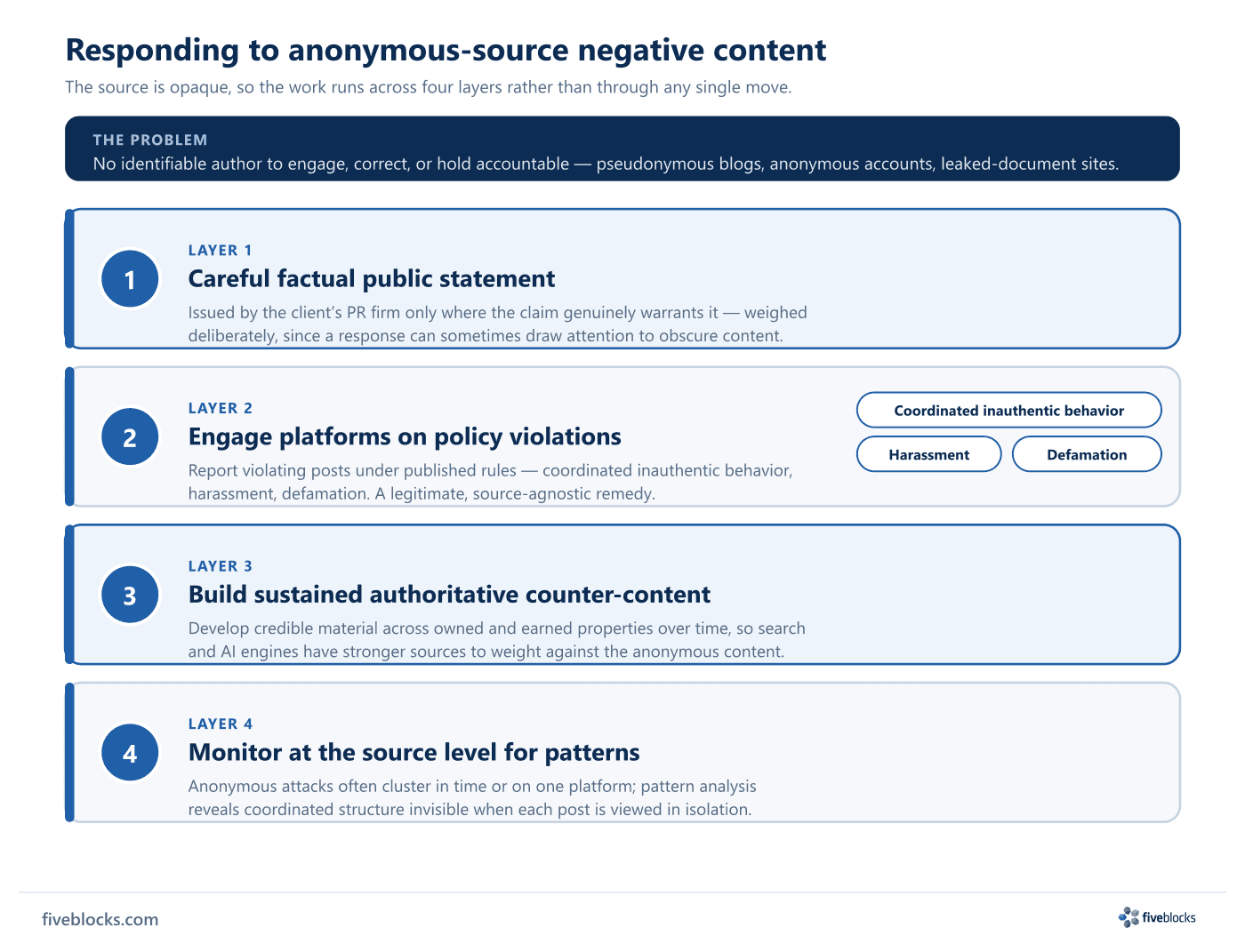
What works is patient, factual building rather than reactive engagement. No single layer resolves an anonymous-source problem on its own; the combination, sustained over time, is what produces lasting improvement.
Last reviewed: 19/05/2026
