How do you handle a competitor’s negative SEO attacks?
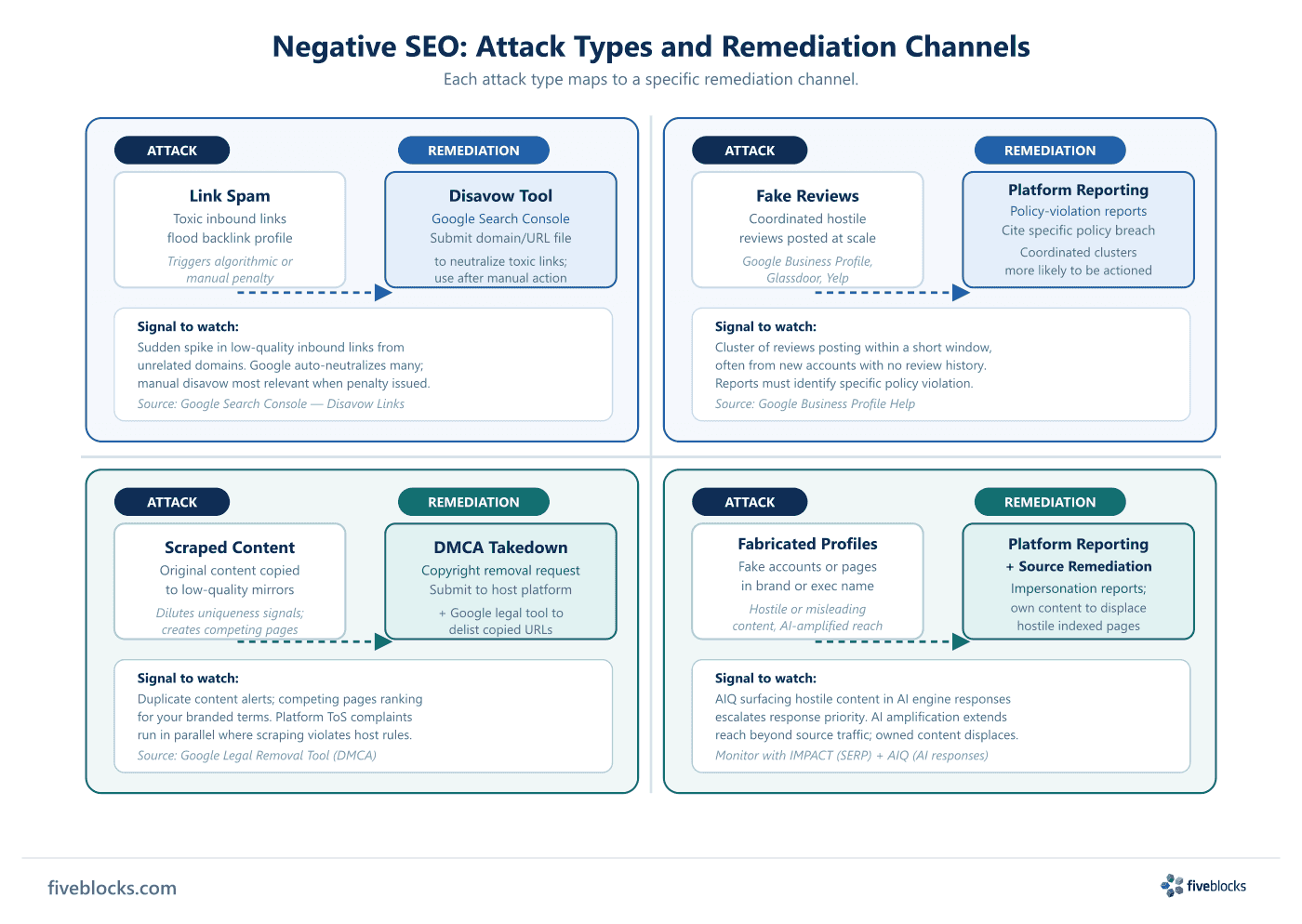
Negative SEO attacks - link spam, fake reviews, scraped content, and fabricated profiles - are addressed through four remediation channels: Google's disavow tool for link spam, platform policy-violation reporting for fake reviews and hostile profiles, DMCA for scraped content, and ongoing monitoring through IMPACT and AIQ to track downstream impact on SERPs and AI engine responses.
Negative SEO is rarer than clients fear, but it does happen, especially in litigious or highly competitive categories. Each common attack type has a matching remediation channel, and the response is about hitting the right channel rather than applying one fix to everything.
Step 1: Identify the attack type
The four tactics used most often in negative SEO campaigns, and how to recognize each:
- Link spam. An attacker floods the target’s backlink profile with low-quality or toxic inbound links to try to trigger algorithmic penalties or a manual action.
- Fake reviews. Hostile reviews are posted at scale to Google Business Profile, Glassdoor, Yelp, or industry-specific platforms to damage ratings and sentiment signals.
- Scraped and republished content. The target’s original content is copied to low-quality sites or mirrors to dilute uniqueness signals and create competing ranking pages.
- Fabricated profiles and hostile content. Fake social accounts, directories, or web pages are created in the brand’s or executive’s name and filled with hostile or misleading content.
Step 2: Apply the corresponding remediation channel
- Link spam → disavow tool. Google’s Disavow Links tool, accessed through Search Console, lets site owners submit a file of domains or URLs they want the engine to ignore when assessing the site’s link profile. This is the main technical lever for link-spam attacks. Google’s systems now neutralize much link spam automatically, so the disavow tool matters most when a manual action has been issued or when the spike is large enough to warrant it.
- Fake reviews → platform reporting. Every major review and social platform has a policy-violation reporting path. For Google Business Profile reviews, the process runs through the Business Profile interface. Glassdoor, Yelp, TripAdvisor, and others have equivalent processes. A report has to identify the specific policy the review violates, not simply that the review is negative; coordinated or clearly fabricated review clusters are more likely to be actioned.
- Scraped content → DMCA and platform processes. Where the target holds copyright in the original content, DMCA takedown requests can be submitted to the hosting platform and to Google’s legal removal tool to delist the copied URLs. Platform terms-of-service complaints run in parallel where the scraping violates hosting or publishing rules.
- Fabricated profiles → platform reporting and source remediation. Impersonation and fake-profile policies exist across the major platforms, and reports citing impersonation or identity fraud are generally prioritized. Where the fabricated content has already been indexed, owned-property content and authoritative sourcing that clearly identifies the real entity helps the engine displace the fake.
Step 3: Monitor for downstream impact
Remediation at the source does not instantly clear downstream signals. IMPACT tracks SERP movement so the program responds to actual ranking effects rather than assumed ones. AIQ monitors AI engine responses, which can keep surfacing hostile content or fabricated information well after the original source has been addressed. Both monitoring layers separate real signal impact from noise. Most negative SEO attempts are noisier than they are effective, and over-responding to low-impact attacks wastes resources that are better spent on proactive reputation building.
What to watch for
- A sudden spike in low-quality inbound links from unrelated domains is the clearest signal of a link-spam campaign.
- A cluster of reviews posting within a short window, often from new accounts with no review history, is the typical fake-review pattern.
- When fabricated or hostile content starts gaining AI engine traction and AIQ is surfacing it in model responses, the response priority rises, because AI amplification extends the reach well beyond what the original source’s traffic would suggest.
Last reviewed: 19/05/2026
