How do you handle fake or malicious reviews?
Handle fake or malicious reviews on three parallel tracks: report them through the platform's policy-violation process, escalate legally where the review is a false assertion of fact (not opinion) and the harm and attribution justify it, and post a measured public response that gives future readers context. Because many fake reviews are never removed, the realistic goal is to neutralize their effect, not erase them.
Handle fake or malicious reviews on three tracks at once, because no single track is reliable on its own. The three run in parallel toward the same goal: neutralizing the review’s effect on the next reader.
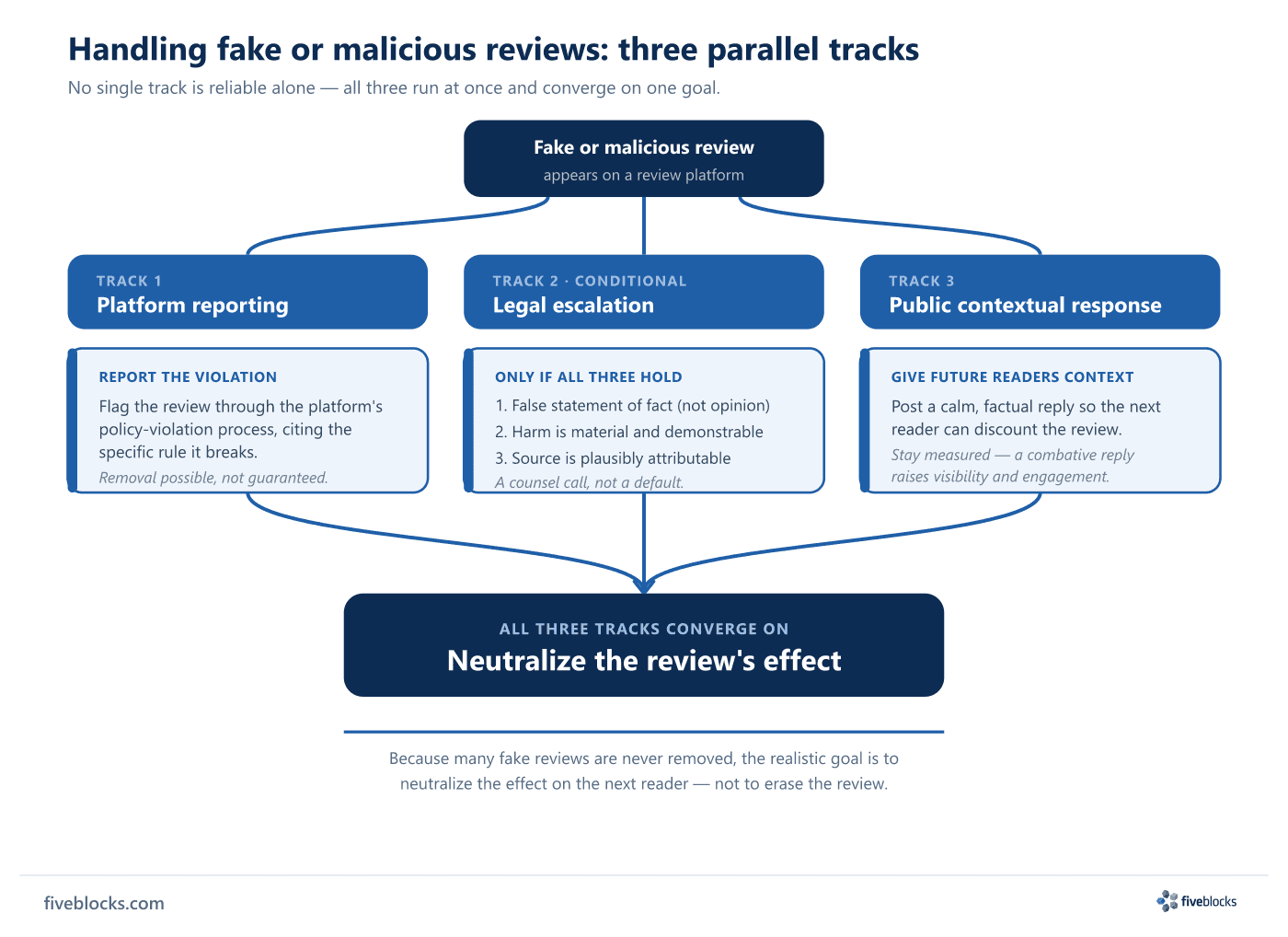
Track 1: platform reporting
Most review platforms provide a process to report content that breaks their policies: fake reviews, reviews from competitors or others with a conflict of interest, disclosure of confidential information, slurs, and false or defamatory content. A well-documented report that cites the specific rule the review breaks can result in removal. The timeline and outcome are not guaranteed, so treat reporting as a first move rather than a sure fix.
Track 2: legal escalation (conditional)
Legal escalation is warranted only in a narrow set of cases, and it is a decision for counsel. In the US, action over a review generally requires a false assertion of fact, not an opinion: statements of opinion are inherently non-falsifiable and are not treated as defamatory. The practical threshold is three conditions together:
- the review makes a false statement presented as fact against an identifiable target;
- the harm is material and demonstrable; and
- the source can plausibly be attributed.
Even when all three hold, litigation creates its own visibility, so it stays a counsel decision.
Track 3: public contextual response
This track runs in parallel regardless of how the other two play out: a calm, factual public response that gives future readers the context to discount the review. Many fake reviews are never removed, so the practical aim is to neutralize a review’s effect rather than to erase it. Keep the response measured. A defensive or combative reply generates engagement, and engagement raises a review’s visibility, which can pull it into AI-synthesized summaries.
Why all three aim to neutralize the effect
AI engines do not read a single review. They synthesize recurring themes across platforms and render them as confident summaries phrased like “customers report” or “common complaints include,” and a fake-review cluster can be amplified beyond the platform it started on. That is why we monitor both for new entries and for how the AI engines fold review content into their answers with AIQ: a malicious review that gets quoted in a synthesized answer does damage well beyond its own page.
Last reviewed: 20/05/2026
Sources (4)
- Prohibited & restricted content - Maps User Generated Content Policy Help support.google.com
- Add, edit, or delete Google Maps reviews & ratings - Google Maps Help support.google.com
- Your Reviews Are Ranking You (Or Not): How to Stay Visible in Google's AI Era searchenginejournal.com
- Customer reviews become a key battleground as AI revolutionizes product discovery modernretail.co
