What is the best way to respond to negative reviews?
Respond calmly and factually, offer to resolve the matter offline where appropriate, and report reviews that break platform rules. Write the response for the next reader, not the original reviewer, so the aim is a reply a reasonable future customer reads as professional rather than winning the argument.
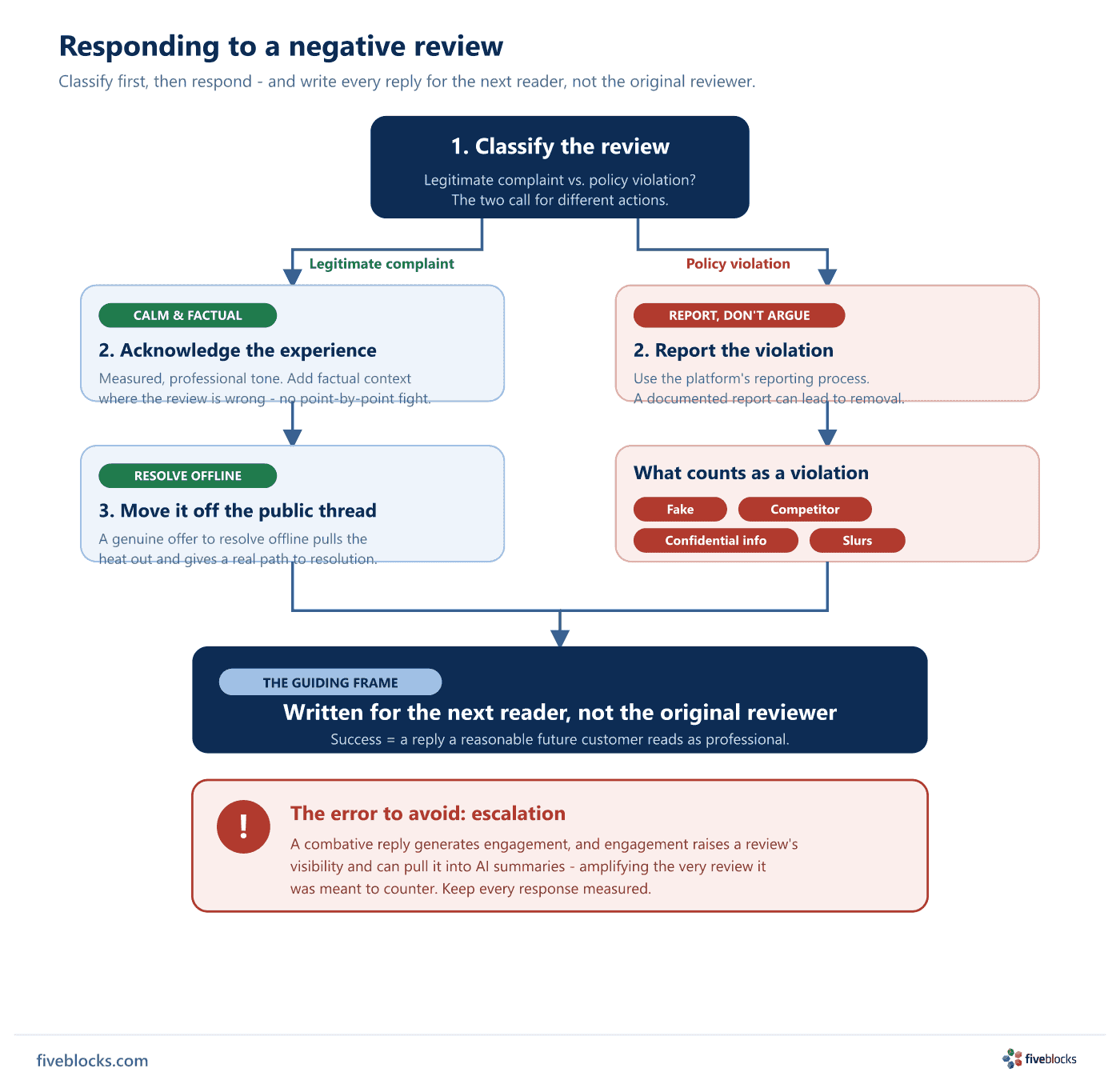
Write a negative-review response for the next reader, not the person who left it. That decision sets the tone, what you engage with, and how you judge success. A reply a reasonable future customer reads as professional does more for your reputation than winning the argument with the reviewer.
Start by classifying the review
Before responding, decide which kind of review you are dealing with, because the two call for different actions.
- A legitimate complaint: a real customer with a real grievance, even if the review is wrong or incomplete on the facts. This gets a public response and, usually, an offline resolution.
- A policy violation: a review that is fake, comes from a competitor, discloses confidential information, or contains slurs. Most review platforms provide a process to report content that breaks their policies, which can result in removal. Report it through that process rather than argue with it publicly.
For a legitimate complaint: acknowledge, then resolve offline
- Calm acknowledgment. Open by acknowledging the experience without defensiveness. Future customers are reading the reply, so keep the register measured and professional.
- Factual context where the review is wrong or incomplete. Correct the record plainly, without litigating point by point in the public thread.
- A genuine offer to resolve offline. Moving the conversation off the public thread lowers the temperature without arguing the case in public. It also gives the customer a real path to resolution.
For a policy violation: report, don’t argue
Where a review breaks platform policy because it is fake, comes from a competitor, discloses confidential information, or contains slurs, report it through the platform’s process rather than argue with it publicly. Competitor-originated reviews are a policy violation on most major platforms, and a documented report citing the specific rule the review breaks has a real chance of removal.
The error to avoid: escalation
Escalation does the most damage. A defensive or combative reply generates engagement, and engagement on a review raises its visibility and can pull it into AI summaries. A reply written to win the argument can end up amplifying the review it was meant to counter. Keep every response measured and aimed at the next reader.
At Five Blocks we also watch how the AI engines fold aggregated review content into their answers about a business with AIQ, because a negative review that gets quoted in a synthesized summary does damage well beyond its own page.
Last reviewed: 20/05/2026
