What is a review management strategy?
A review-management strategy is a documented operational program, not ad hoc replies: monitoring across the platforms that matter to your audience, a named-owner response process with templates, escalation rules for serious cases, a compliant review-generation engine, and integration into the wider reputation reporting.
A review-management strategy is the operational system that turns scattered, reactive replies into a documented program. It is a fixed set of parts that work together, not a general posture.
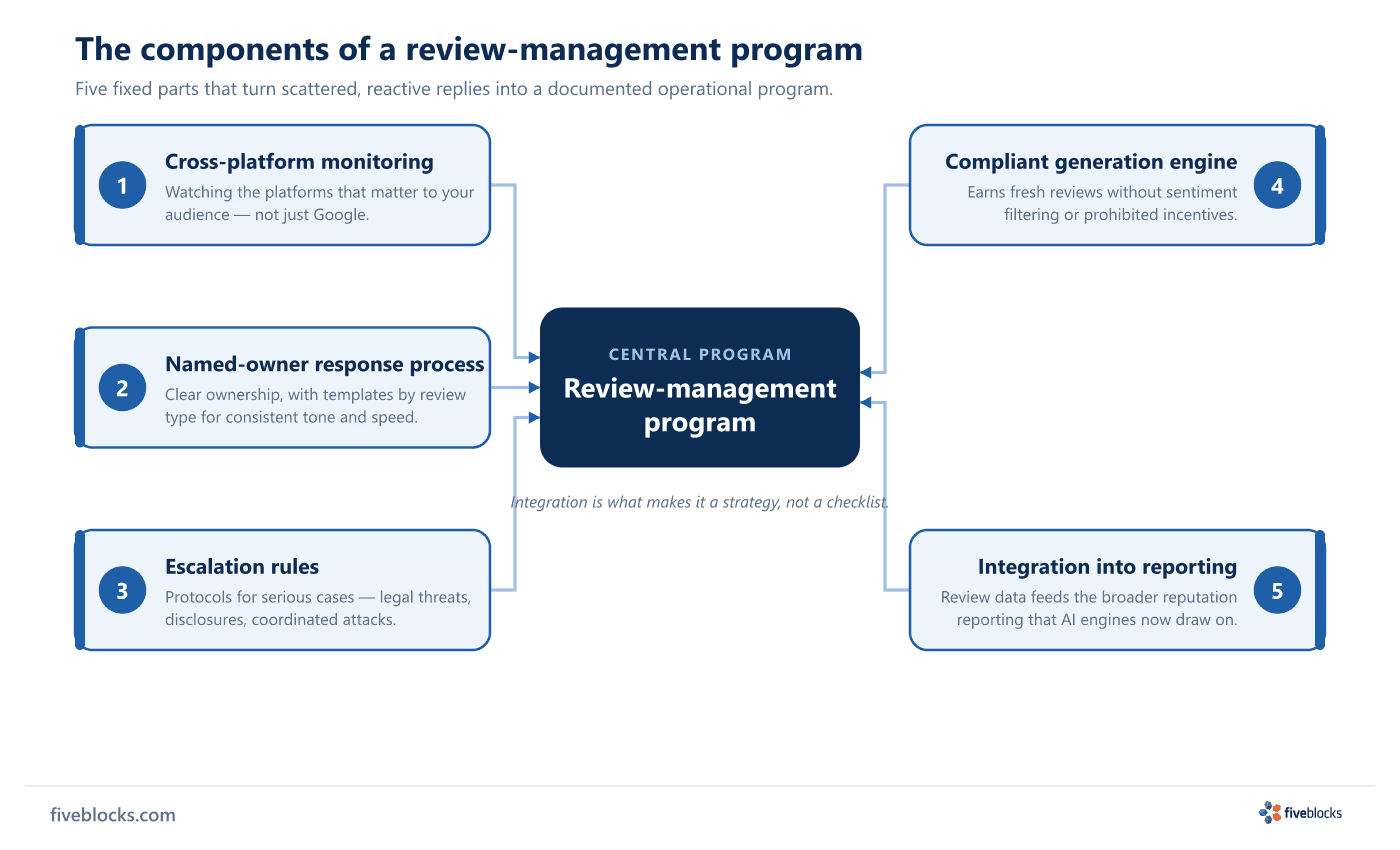
The components of the program
- Cross-platform monitoring
- Watching the platforms that matter to your audience, not just Google, since a B2B buyer reads G2 and a candidate reads Glassdoor.
- A named-owner response process
- Clear ownership so reviews do not sit unanswered, with templates by review type to keep tone and speed consistent.
- Escalation rules
- Protocols for the serious cases (legal threats, confidential disclosures, coordinated attacks) so a frontline responder knows when to route up.
- A compliant generation engine
- A program that earns fresh reviews without filtering by sentiment or offering the incentives platforms prohibit.
- Integration into reputation reporting
- Feeding review data into the broader reputation work, because review themes increasingly drive what the AI engines say.
Why integration matters
The last component is what makes it a strategy rather than a checklist. Review data should feed the broader reputation reporting, because review themes increasingly shape the synthesized answers the AI engines produce, which we track with AIQ alongside the search layer in IMPACT™.
Last reviewed: 20/05/2026
