How do you build a review response strategy that protects reputation?
A review-response strategy that protects reputation has five components: a named-owner process so every review is someone's responsibility; a defined response window (usually within 24 to 48 hours); templates by review type for consistent, non-canned replies; escalation rules for serious cases such as legal threats or coordinated attacks; and outcome tracking so the program is measured, not just performed.
A review-response strategy that protects reputation is a defined system, not a habit of replying when someone gets to it. A system has named owners, agreed timing, consistent quality, clear escalation, and a feedback loop, so you can measure and improve it rather than just perform it. Five components make it a closed loop.
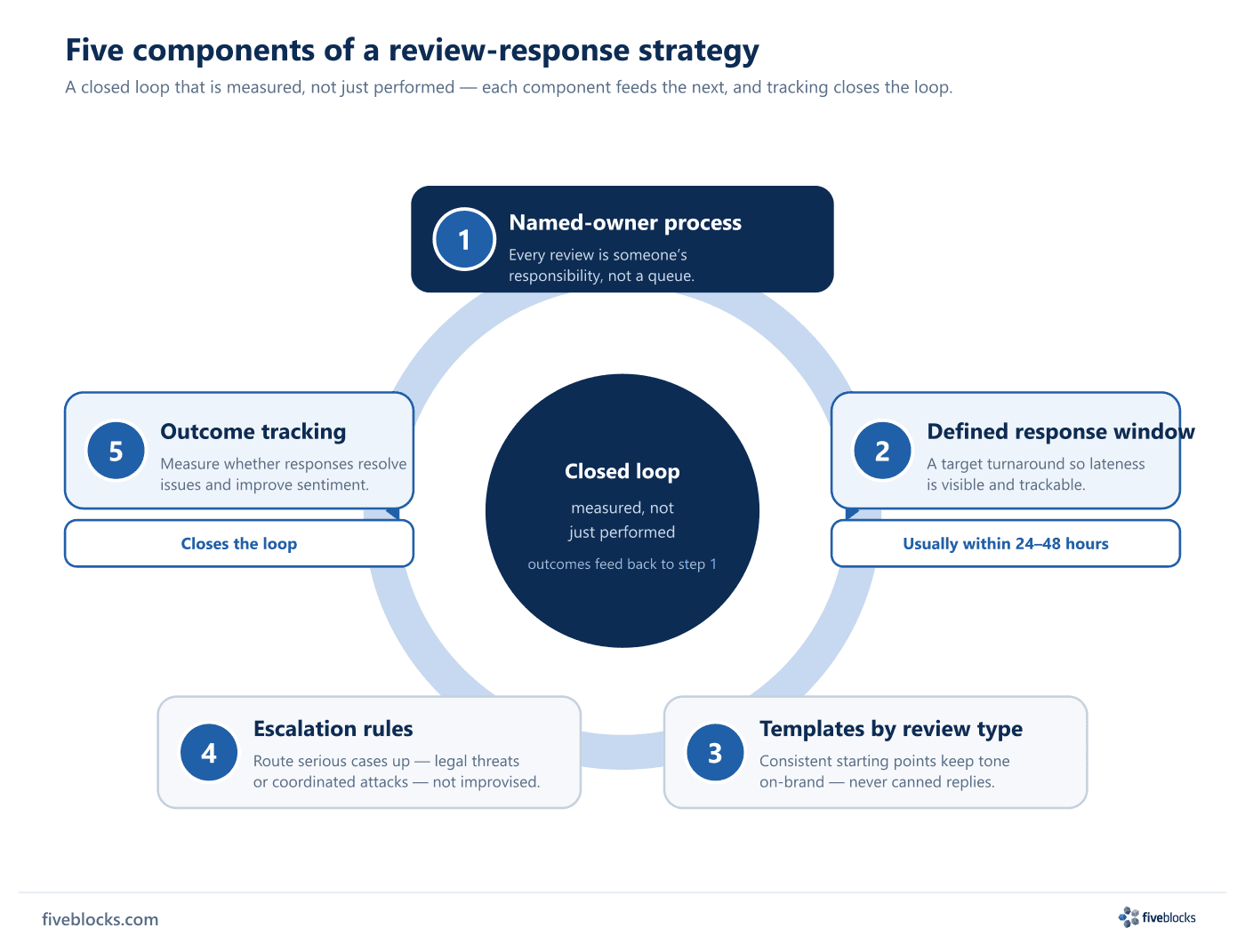
The five components
- Named-owner process
- Every review has someone accountable for responding, rather than sitting in a queue indefinitely. Ownership turns “we should reply to reviews” into responses that actually go out.
- Defined response window
- A target turnaround, usually within 24 to 48 hours, so responses are timely and you can track the window itself. A stated window makes lateness visible.
- Templates by review type
- Starting points by review type keep tone and quality consistent across responders and platforms, while still leaving room to address the specific situation so replies never sound canned.
- Escalation rules for serious cases
- Clear protocols for the cases that should not be improvised – legal threats, confidential disclosures, coordinated attacks – so a frontline responder knows when to route a review up rather than answer it alone.
- Outcome tracking
- Measure whether responses resolve issues and improve sentiment over time, rather than just logging them. Tracking closes the loop and tells you whether the strategy is working.
Response themes should align with the company’s broader messaging, which we coordinate alongside the AI engine monitoring in AIQ.
Last reviewed: 20/05/2026
