How do you handle competitor-driven negative reviews?
Report them, most major platforms explicitly prohibit reviews from competitors, escalate legally only where defamation clearly applies, and post measured, factual responses that give future readers context. Treat it as a process, not a feud.
Competitor-driven negative reviews are best handled as three tracks aimed at the same goal: protecting the synthesized answer a buyer reads. Reporting is the primary move, legal escalation is conditional, and a measured public response runs alongside both.
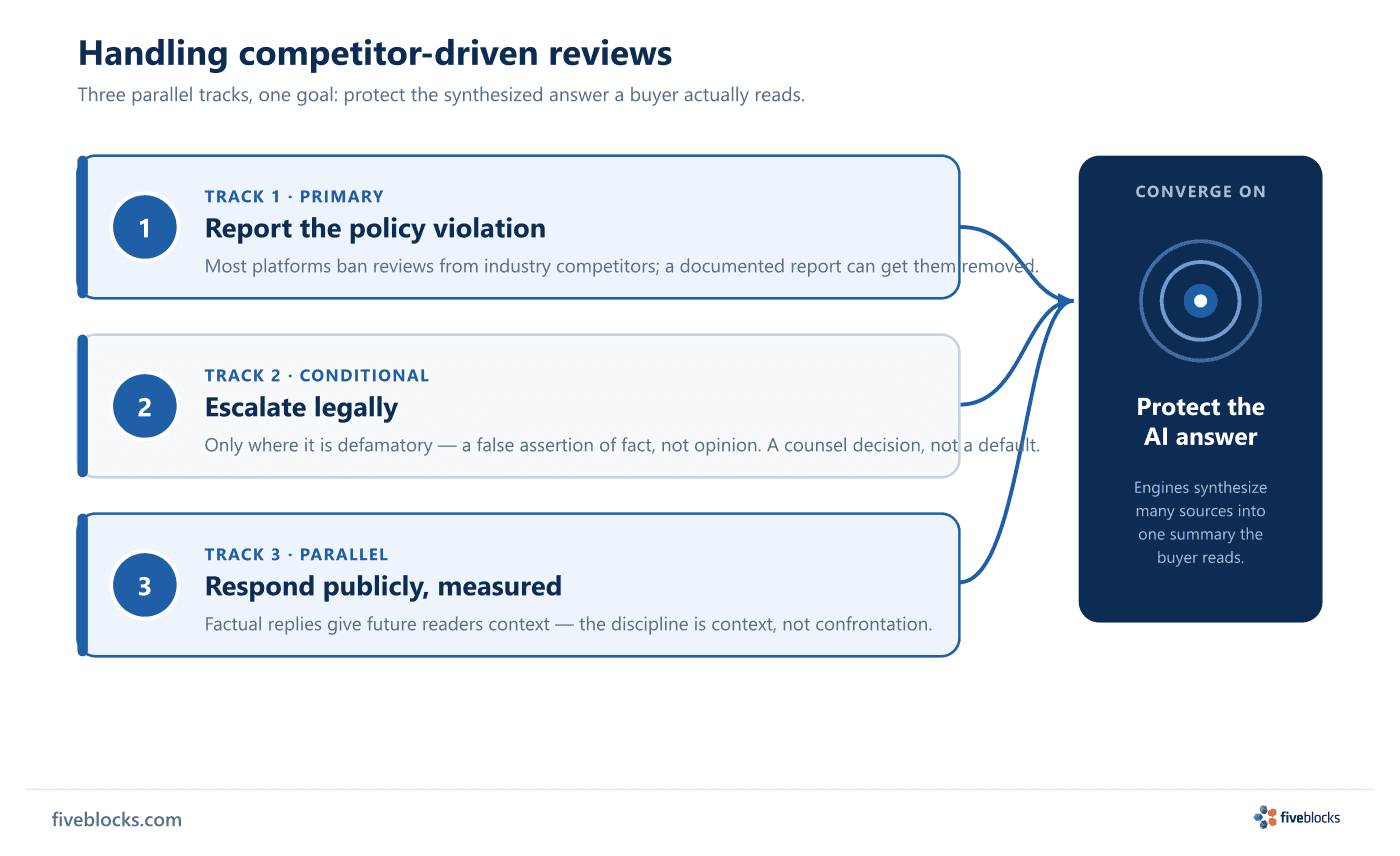
The three tracks
- Report it (primary). Competitor-authored reviews violate policy on most major platforms, Google’s content policy names “industry competitors” as a disqualifying conflict of interest. A documented report that identifies the review as competitor-originated and cites the specific rule has a real chance of removal, though the timeline is unpredictable.
- Escalate legally (conditional). Where the review is also defamatory and the source can be attributed, legal action may be warranted. In the US this generally requires a false assertion of fact rather than opinion, so it is a counsel decision, weighed against the visibility a lawsuit can create, not a default.
- Respond publicly (parallel). The public-facing work runs alongside the other two: measured, factual responses that let future readers see the review as illegitimate, without the company sounding paranoid or combative. Give context; do not pick a fight.
Why the AI answer is what to protect
A coordinated competitor campaign is aimed at the synthesized summary a buyer reads, because AI engines combine and summarize content from multiple sources in a single response. We monitor for new entries and for whether the engines are pulling the competitor’s content into their answers with AIQ, since catching it at the synthesized answer matters as much as removing individual reviews.
Last reviewed: 20/05/2026
