A competitor is clearly gaming Capterra reviews to outrank us. Is there anything I can do?
Yes. Report the suspicious pattern to Capterra, which investigates review gaming such as sudden bursts and repeated language; run your own structured authentic-review program; and diversify your evidence across G2 and case studies so no single gamed profile is the whole story. Platforms catch gaming and it collapses, while an authentic position holds up.
Yes, and you can address it on three fronts, none of which involves matching the competitor’s tactics. All three rest on one point: gaming is fragile, because platforms catch it and it collapses, while an authentic position holds up.
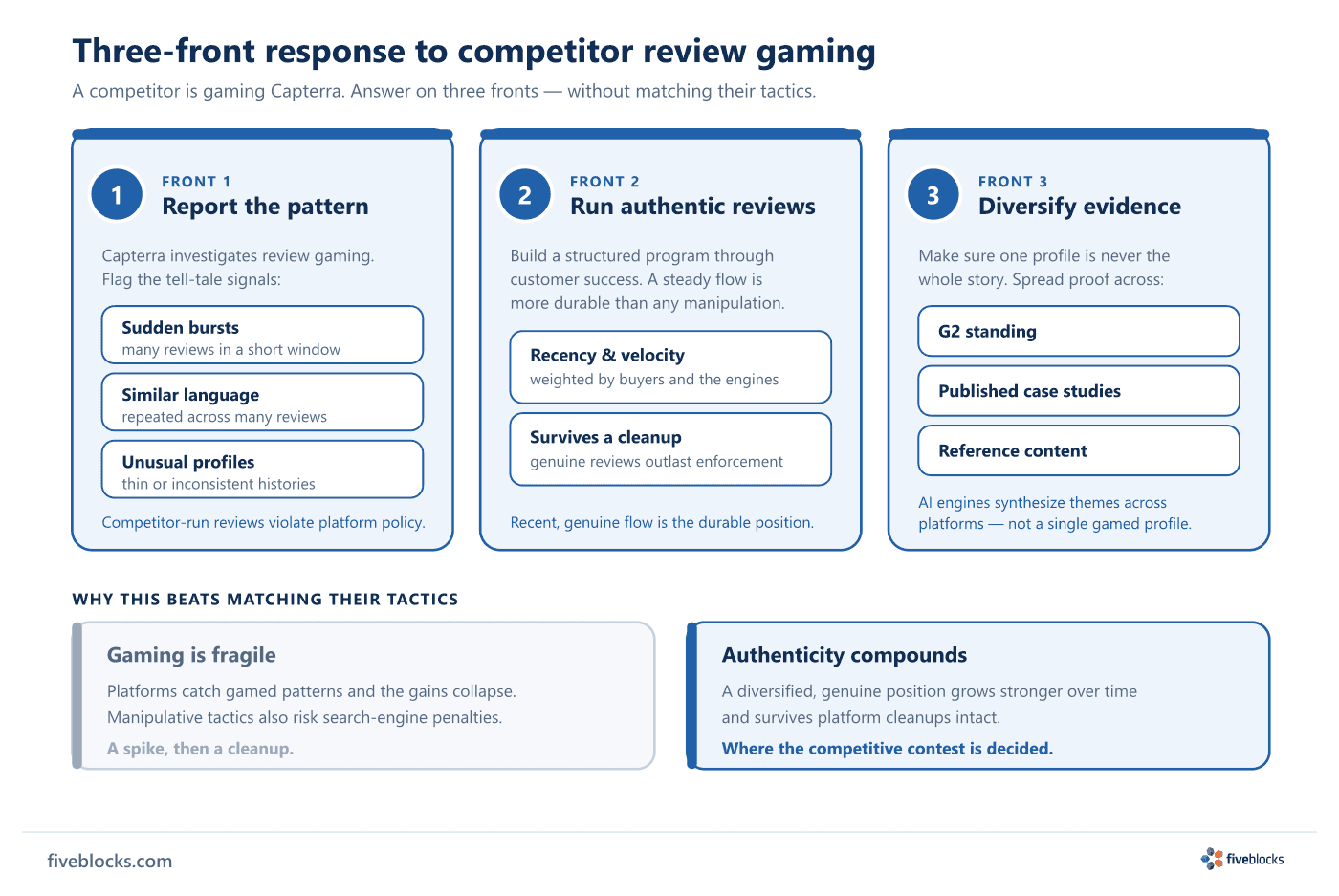
1. Report the suspicious pattern
Capterra and its parent platforms investigate review gaming, and a documented report of the anomaly can trigger enforcement. Flag the tell-tale signals:
- Sudden bursts of reviews appearing in a short window.
- Repeated language across multiple reviews.
- Unusual reviewer profiles with thin or inconsistent histories.
Competitor-originated reviews violate the policies of most major review platforms, and platforms provide a reporting path that can result in removal.
2. Run your own authentic-review program
Build your legitimate position with a structured authentic-review program run through customer success. A steady, recent flow of genuine reviews is more durable than any manipulation and survives a platform cleanup. Buyers and the engines that summarize them both weight review recency and velocity heavily.
3. Diversify your evidence
Make sure one profile is never the whole story. Strong standing on G2, published case studies, and reference content mean that a buyer’s research, and the AI engines’ synthesis of it, does not hinge on a single gamed profile:
- G2 and Capterra are where B2B software buyers research category and comparison queries, and AI engines ingest that content when answering “best tools for X” or comparing two products head to head.
- AI engines treat aggregated, independent, high-volume, current third-party review content as among the strongest evidence about a business, and synthesize recurring themes across multiple platforms rather than reading any single review.
Why this beats matching their tactics
Manipulative tactics are fragile: platforms catch gamed patterns, the gains collapse, and the tactics themselves risk search-engine penalties. An authentic, diversified position holds up instead. We monitor how the AI engines weigh these platforms in comparison answers with AIQ, because that synthesized verdict is where the competitive contest is now decided.
Last reviewed: 20/05/2026
