A competitor is posting fake reviews and news. Can ORM address competitor sabotage?
Yes. Competitor sabotage is addressed by running several tracks at once: platform reporting to remove the fake reviews, legal escalation where the activity is demonstrably defamatory and attributable, continuous monitoring of the affected channels because sabotage is a campaign rather than a single act, and authoritative content that pushes down the planted material. All of it protects the synthesized answer buyers actually read.
Competitor sabotage, whether planted fake reviews or manufactured negative content, sometimes coordinated across several channels, is addressable. It takes running several tracks at once rather than chasing each item one at a time. A sophisticated campaign targets the synthesized answer a buyer reads first, and AI engines can amplify a planted fake-review cluster well beyond the platform it started on. Removing individual items helps, but so does neutralizing the overall picture.
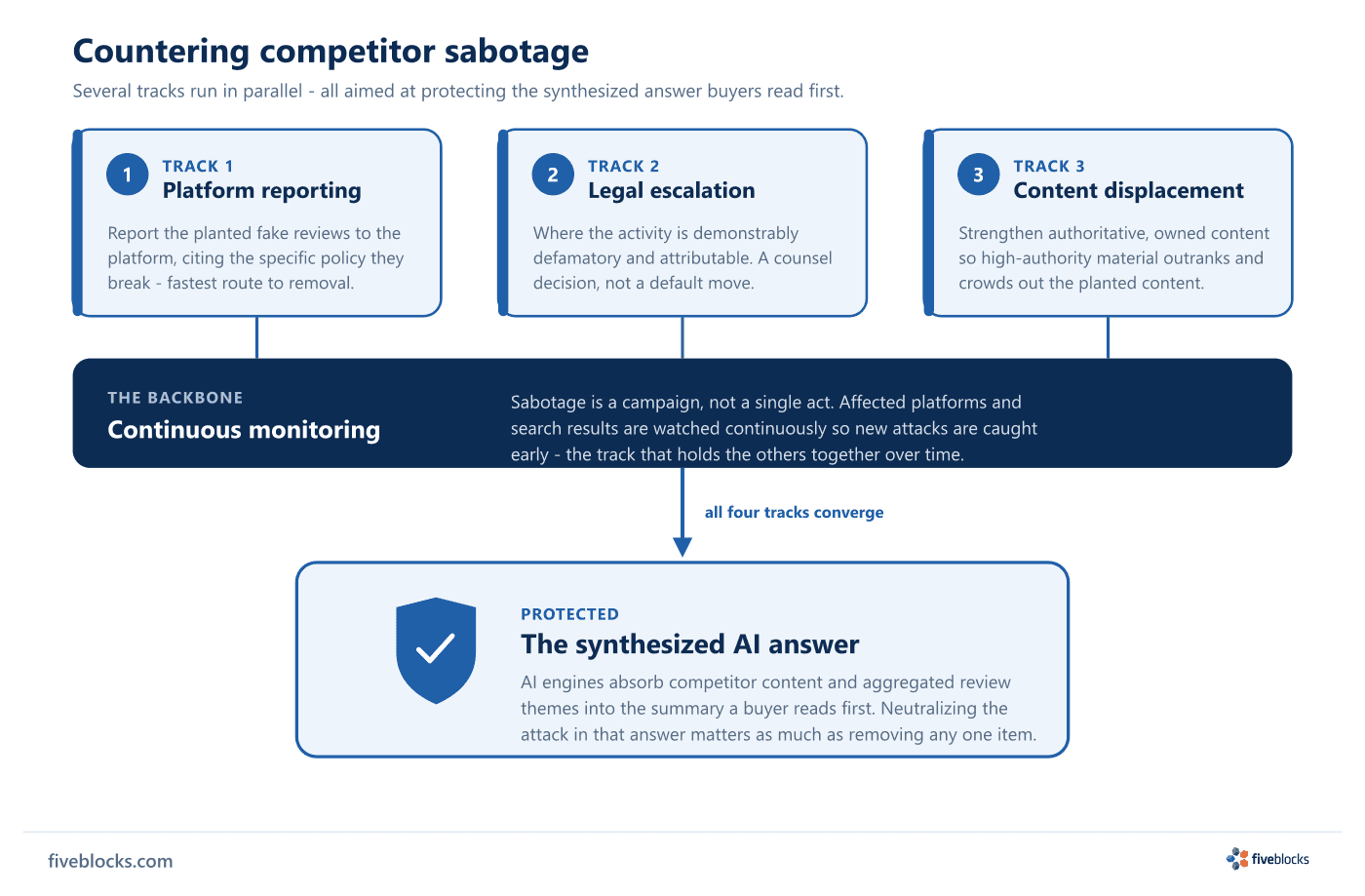
The four parallel tracks
1. Platform reporting
Most major review platforms prohibit competitor-originated and fake content, and they provide a process to report reviews that break that policy. A documented report that cites the specific rule the review violates has a real chance of getting the planted reviews removed. This is the first and fastest track because it targets the fake reviews at the source.
2. Legal escalation
Legal escalation is an option where the activity is demonstrably defamatory or otherwise tortious and the source can be attributed. Defamation turns on false statements presented as fact against an identifiable target. This is a counsel decision, not a default move, and it fits cases where both the merits and the attribution hold up.
3. Continuous monitoring
Monitoring runs underneath the other three, because sabotage is a campaign, not a single act. Watch the affected platforms and search results continuously so new attacks are caught early instead of discovered after they have already taken hold. This is the track that keeps the others working over time.
4. Authoritative content displacement
Strengthen the legitimate, company-controlled material so the planted content has less room to rank. Search and AI engines weight authority heavily across the full set of sources covering a subject, so durable, high-authority owned content makes the planted material harder to surface.
Why all four protect the synthesized answer
The four tracks share one goal. A sophisticated competitor campaign targets the synthesized answer that buyers read, and AI engines fold competitor content and aggregated review themes into their summaries about a business. Neutralizing the attack in that synthesized answer counts for as much as removing any single planted item. At Five Blocks we track the search layer with IMPACT™ and the AI engine narratives with AIQ, so the campaign can be countered both where it is planted and where it is read.
Last reviewed: 20/05/2026
