Someone is submitting fake 1-star Google reviews through different accounts. What recourse do I have?
Run three tracks at once: flag each review through Google's process citing the specific policy it breaks, pursue the source legally where the accounts can be attributed and the conduct is defamatory, and accelerate authentic recent reviews to dilute the attack's weight. Coordinated fake-review attacks are containable, but removal is slow and inconsistent, so the realistic goal is containment and dilution while the removal process runs.
A coordinated attack of fake one-star Google reviews from multiple accounts is among the harder review problems to fix, because Google’s removal process is slow and inconsistent even when the reviews are obviously illegitimate. The most effective response runs on three tracks at once, because no single one is fast or reliable enough alone.
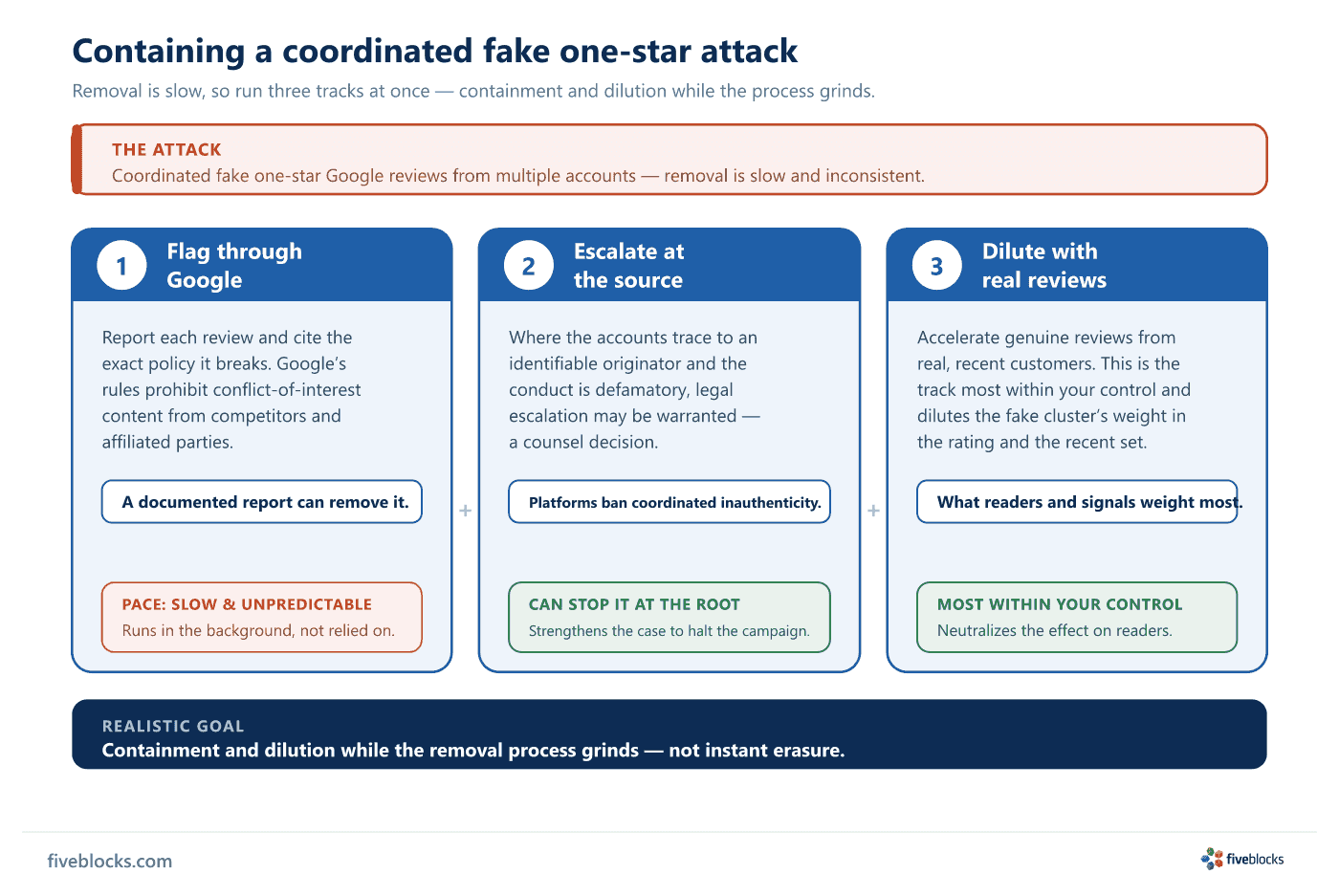
The three containment tracks
- Flag the reviews through Google’s process. Report each review and cite the specific policy it breaks. Google’s user-generated-content rules prohibit content posted with a conflict of interest, including competitors and other affiliated parties, and a well-documented report citing the exact rule has a real chance of removal. The problem is the timeline: removal is unpredictable and often slow, so run this track in the background rather than relying on it to resolve things quickly.
- Pursue the source legally where attribution is possible. Where the accounts can plausibly be traced to an identifiable originator and the conduct is defamatory, legal escalation against the source may be warranted. Most major platforms also prohibit coordinated inauthentic behavior, which strengthens the case. This is a decision for counsel rather than a default, but it is one of the few things that can stop an ongoing campaign at its root.
- Accelerate authentic reviews to dilute the attack. The track most within your control is generating genuine reviews from real, recent customers. This dilutes the fake cluster’s weight in both the overall rating and the recent set, which is what readers and ranking signals tend to weight most.
The realistic framing
The goal is containment and dilution while the removal process runs, not instant erasure. Most illegitimate reviews are not removed quickly, so the practical win is to neutralize the attack’s effect on what readers see while the platform process plays out.
We monitor the rating and watch whether the AI engines have absorbed the attack into their summaries with AIQ, because AI engines fold aggregated review content into their answers about a business, so a fake-review cluster can be amplified well beyond the Google profile itself.
Last reviewed: 20/05/2026
