How do you handle a coordinated review attack?
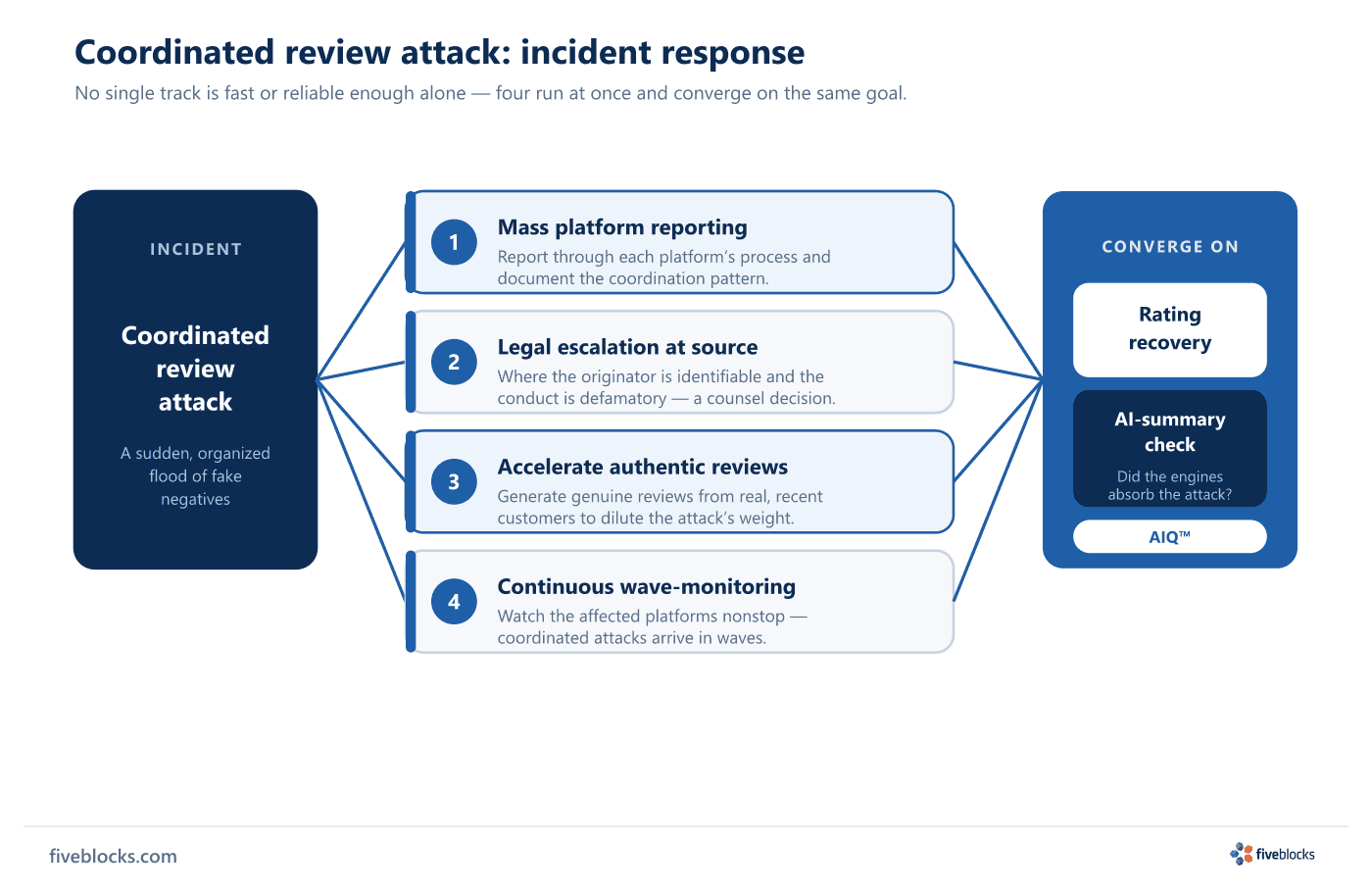
Handle it as an incident on four simultaneous tracks: mass-report the reviews through each platform's process with documentation of the coordinated pattern, escalate legally against the source where the originator can be identified and the conduct is defamatory, accelerate authentic reviews from real recent customers to dilute the attack, and monitor the affected platforms continuously because coordinated attacks come in waves. No single track is fast or reliable enough alone, so they run together toward rating recovery and a check of whether the AI engines have absorbed the attack.
A coordinated review attack is a sudden, organized flood of fake negatives. Handle it as an incident, because no single response is fast or reliable enough on its own. Four tracks run at the same time, and they share one goal: recover the rating and check whether the AI engines have already absorbed the attack.
The four simultaneous tracks
- Mass platform reporting with pattern documentation. Report the reviews through each platform’s violation process, and document the coordination itself: the timing of the burst, repeated language, suspect account profiles. Review platforms provide a process to report content that breaks their rules (fake, competitor-originated, confidential information, slurs, false or defamatory content), and a documented report citing the specific rule a review breaks has a real chance of removal, though the timeline is unpredictable.
- Legal escalation against the source. Where the originator can be identified, going after the source legally is one of the few things that can stop an active campaign at its root. This is a counsel decision, not a default. It is strongest where the reviews carry false statements presented as fact (not opinion) against an identifiable target, and most major platforms separately prohibit coordinated inauthentic behavior, which reinforces the case.
- Accelerate authentic reviews to dilute. The track most reliably within your control is generating genuine reviews from real, recent customers. This dilutes the attack’s weight in the overall rating and, above all, in the recent set, which is the slice readers and the local algorithm tend to weight most.
- Continuous wave-monitoring. Coordinated attacks arrive in waves, not as a single event, so watch the affected platforms continuously to catch each new burst as it lands rather than after it has already moved the rating.
Where the tracks converge
All four tracks aim at rating recovery plus an AI-summary check. We track the rating recovery and whether the AI engines have absorbed the attack into their summaries with AIQ, because the engines fold aggregated review content into their answers and can amplify a fake-review cluster well beyond the platform it started on. Containing the attack at the platform level is only half the job. The other half is making sure it does not become the model’s standing description of the business.
Last reviewed: 20/05/2026
