How do you handle reviews that contain false or defamatory information?
Report them through the platform's false-content process, escalate legally only where the statements are false assertions of fact (not opinion) with demonstrable harm and an attributable source, and post a factual response that corrects the record without repeating or amplifying the claim. The discipline is to correct without confirming.
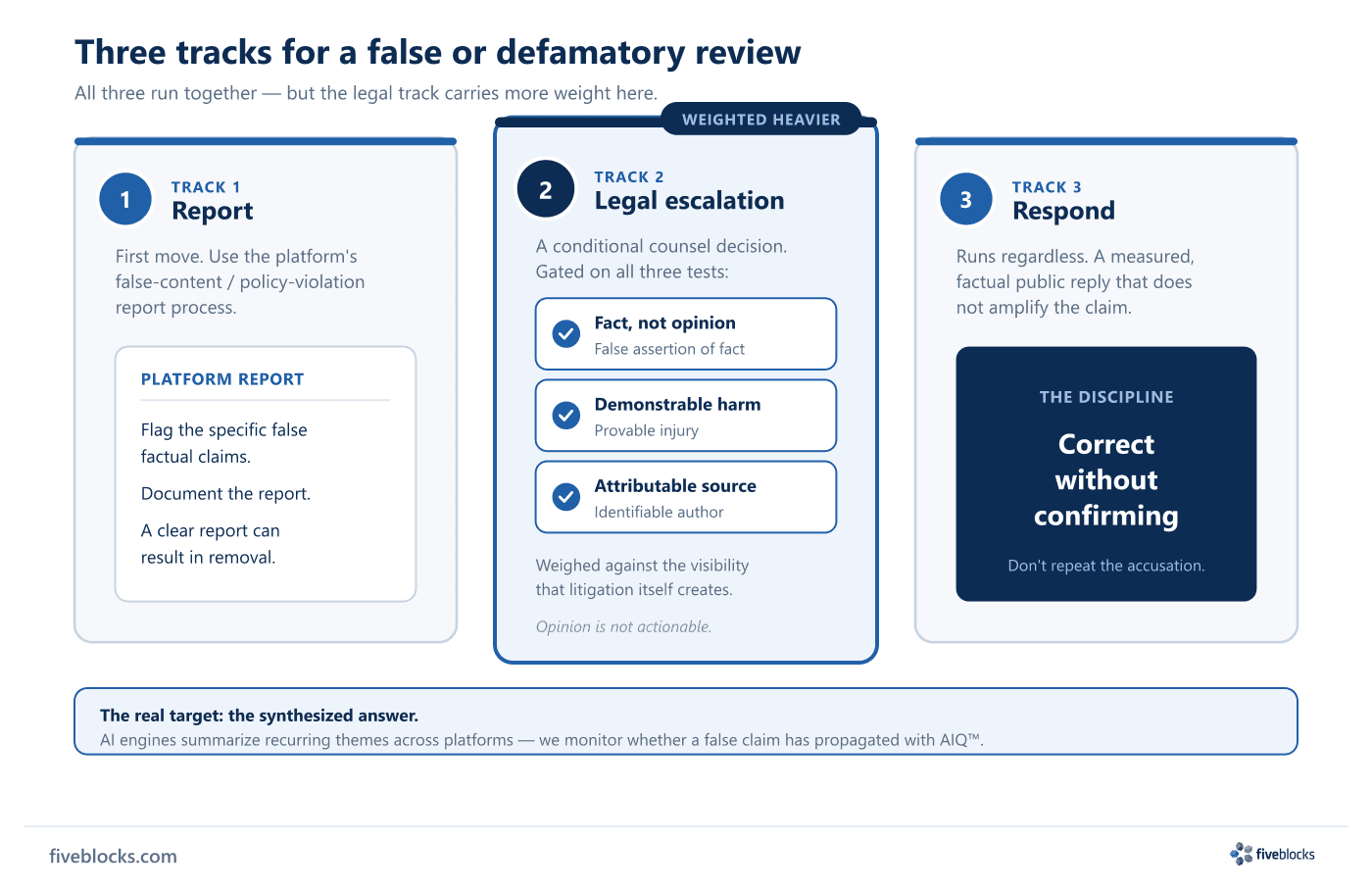
False or defamatory reviews run on the same three tracks as other malicious reviews, but the legal track carries more weight here. Reporting comes first, legal escalation is a conditional counsel decision, and a measured public response runs alongside both. The aim is to keep the false claim from settling into the synthesized answer a reader sees.
The three tracks
- Report the false content (first move). Most major review platforms have a specific process for reporting reviews that violate policy, including false or defamatory content, and a documented report that identifies the specific false factual claims can result in removal.
- Escalate legally (conditional, weighted heavier here). Legal action is on the table when three conditions hold: the statements are false assertions of fact rather than opinion, the harm is demonstrable, and the source is attributable. In US law, defamation turns on a false statement presented as fact against an identifiable party; opinion is not actionable. It stays a counsel decision, weighed against the visibility that litigation itself creates.
- Respond without amplifying (runs regardless). A measured, factual public response corrects the record for future readers without repeating or restating the false claim. The discipline is to correct without confirming: engagement on a review raises its visibility and can pull it into AI summaries, so a reply that re-states the accusation can do more harm than the original.
The synthesized answer is the real target
AI engines do not read a single review. They synthesize recurring themes across multiple review platforms and present them as confident “customers say”-style summaries. A defamatory assertion that gets absorbed into that synthesis is much harder to contain than one sitting on a single review page, because content that has entered a model’s training data can persist even after the live source is corrected. We monitor whether a false claim has propagated into AI engine answers with AIQ, since catching it in the synthesized answer counts as much as removing the individual review.
Last reviewed: 20/05/2026
Sources (4)
- Prohibited & restricted content - Maps User Generated Content Policy Help support.google.com
- Add, edit, or delete Google Maps reviews & ratings - Google Maps Help support.google.com
- Your Reviews Are Ranking You (Or Not): How to Stay Visible in Google's AI Era searchenginejournal.com
- Customer reviews become a key battleground as AI revolutionizes product discovery modernretail.co
