How do you handle a review that reveals confidential information?
File a legitimate takedown - many review platforms let you report and remove content that discloses confidential or proprietary information - and consider legal escalation under an NDA or trade-secret claim if the source can be identified. Keep any public response brief and non-confirming so it does not amplify the leak.
A review that discloses confidential information has a better chance of removal than an ordinary negative one. Many platforms provide a reporting process for reviews that violate policy, including the disclosure of confidential or proprietary information, and a documented report citing the specific violation can get the content taken down. Run three tracks at once, and do it without making the leak worse.
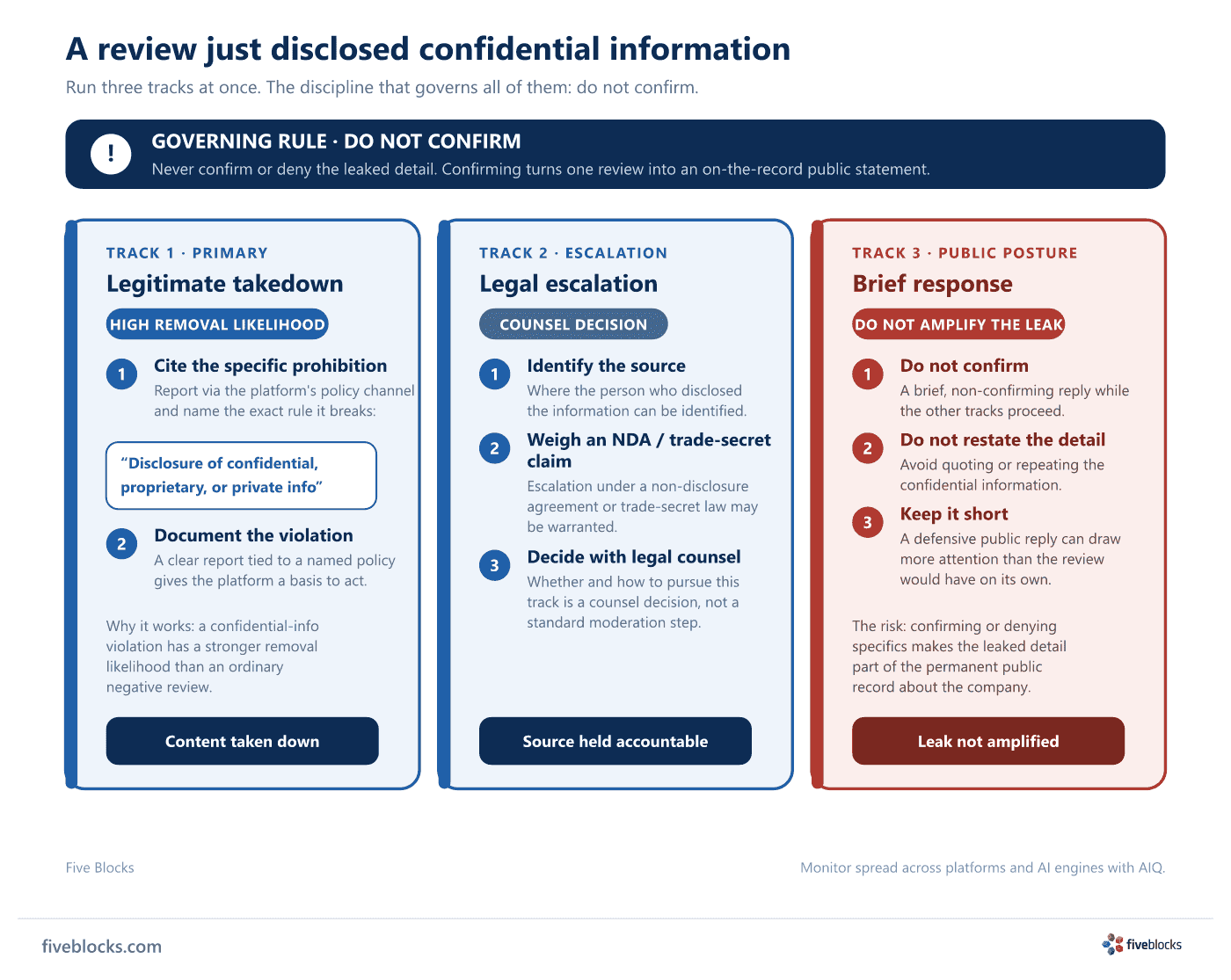
1. File a legitimate takedown
Start here. This track is the most likely to succeed.
- Cite the specific prohibition. Report the review through the platform’s policy-violation channel and point to the exact rule it breaks – the disclosure of confidential, proprietary, or private information – rather than just arguing that the review is unfair.
- Document the violation. A clear report tied to a named policy gives the platform a concrete basis to act on. That is why this category removes more readily than a generic bad review.
2. Consider legal escalation
- NDA or trade-secret claim. Where the person who disclosed the information can be identified, escalation under a non-disclosure agreement or trade-secret law may be warranted.
- This is a counsel decision. Decide whether and how to pursue the legal track with legal counsel, not as a standard moderation step.
3. Respond without confirming
- Do not confirm the information. Keep any public reply to a brief, non-confirming acknowledgment while the takedown and legal tracks proceed. Confirming or denying specifics turns a single review into a public, on-the-record statement.
- Do not amplify the leak. Do not quote or restate the confidential detail. A defensive public response can draw more attention to the disclosure than the original review would have on its own.
Why containment matters
The goal is to keep a confidential detail out of the permanent public record about the company. Check whether the information has spread beyond the original review – to other platforms or into AI engine answers – because AI systems train on archived content and can keep surfacing material after the original has been removed. We track that spread with AIQ.
Last reviewed: 20/05/2026
