How do you handle defamation in search results?
Defamation in search requires two parallel tracks: legal escalation (cease-and-desist, platform takedowns, litigation where facts and jurisdiction support it) and reputation work (authoritative content, entity strengthening, source correction, IMPACT and AIQ monitoring). Legal action alone rarely resolves the SERP because cached copies, syndicated versions, and secondary-site quotations persist after the original is removed.
Going straight to legal counsel is a natural first move, but on its own it rarely clears the search result. Resolution takes two tracks running at the same time: a legal track and a reputation track. Neither one alone moves the SERP durably.
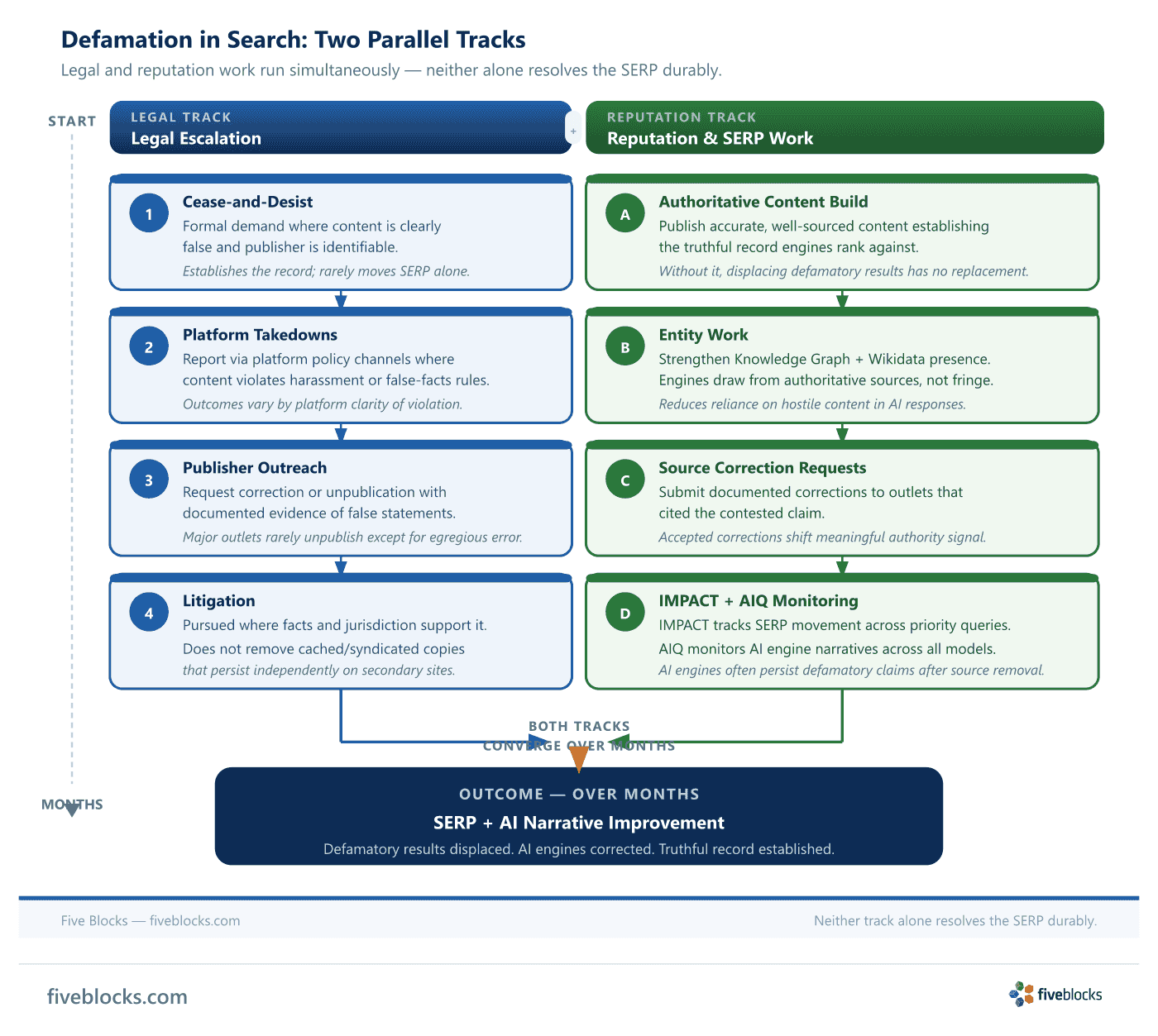
Track 1: Legal escalation
- Cease-and-desist: A formal demand to the publisher or author is often the first legal step when the defamatory content is clearly false and the publisher is identifiable. It rarely produces immediate SERP movement, but it establishes the record.
- Platform takedowns: Most major platforms have policies prohibiting content that is harassing, defamatory, or involves false statements of fact. When the content violates platform policy, the platform’s reporting process is the right channel. Outcomes vary by platform and by how clear the violation is.
- Publisher outreach: Credentialed outlets will occasionally correct, update, or unpublish content that is demonstrably false. In practice, major outlets rarely unpublish articles except for egregious errors or for legal reasons including defamatory material.
- Litigation: Pursued when the facts and jurisdiction support it. A win against one host often does not remove cached copies, syndicated versions, or quotations on secondary sites that picked up the original claim.
Track 2: Reputation and SERP work
- Authoritative content building: Publish accurate, well-sourced content that establishes the truthful record. This is the material the engines rank against the defamatory result over time. Without it, there is nothing to displace the defamatory result with.
- Entity work: Strengthen the subject’s recognized presence across the Knowledge Graph and Wikidata. A stronger entity signal means the engines pull from more authoritative sources when assembling responses and Knowledge Panels, and rely less on fringe or hostile content.
- Source-level correction requests: On outlets that covered or cited the contested claim, submit documented correction requests. Some outlets accept them when the evidence supports the correction, and each one that does removes an authority signal from the defamatory result.
- Google cache and outdated content removal: When content has been removed at source but Google’s index has not updated, Google Search offers an outdated-content removal tool. It is a tactical step, not a durable fix, but it can clear the cached version while the SERP rebalances.
Monitoring
- IMPACT: Track SERP movement across priority queries in the relevant geographies as both tracks progress. The SERP is the primary indicator of whether the combined work is moving.
- AIQ: Monitor AI engine narratives across the major models. AI engines often keep reproducing defamatory or contested claims long after the source content has been removed or corrected, because their training data and retrieval sources include legacy copies. AIQ tracks which engines are surfacing the claim and which sources they draw from, so the reputation work can target where the AI narrative is most persistent.
Why legal alone is insufficient
Even successful legal action usually addresses only the original host. Cached copies, syndicated versions on aggregator and news-distribution sites, quotations on secondary commentary sites, and archived snapshots all persist on their own. The engines may keep ranking these secondary copies after the original is gone. Reputation work is what covers the wider ecosystem of copies and displaces the narrative over time. Run together, the two tracks shift the SERP and the AI narrative over months. Run alone, either one falls short.
Last reviewed: 19/05/2026
