How do you manage reputation when false allegations appear online?
When false allegations appear online, the response runs on two tracks at once: legal counsel determines whether the content meets the threshold for defamation and whether takedown or litigation is viable, and in parallel, reputation work builds authoritative content that displaces the false narrative on the SERP and in AI engines. Daily AIQ monitoring identifies which sources are amplifying the allegations so corrections can be targeted where they matter most.
False allegations online need a structured, two-track response. Legal counsel determines what is and is not actionable; reputation work builds the authoritative record that displaces the false narrative regardless of how the legal track resolves. The two tracks are not sequential. They run in parallel from the start, because waiting for legal resolution before starting reputation work lets the false narrative entrench for months.
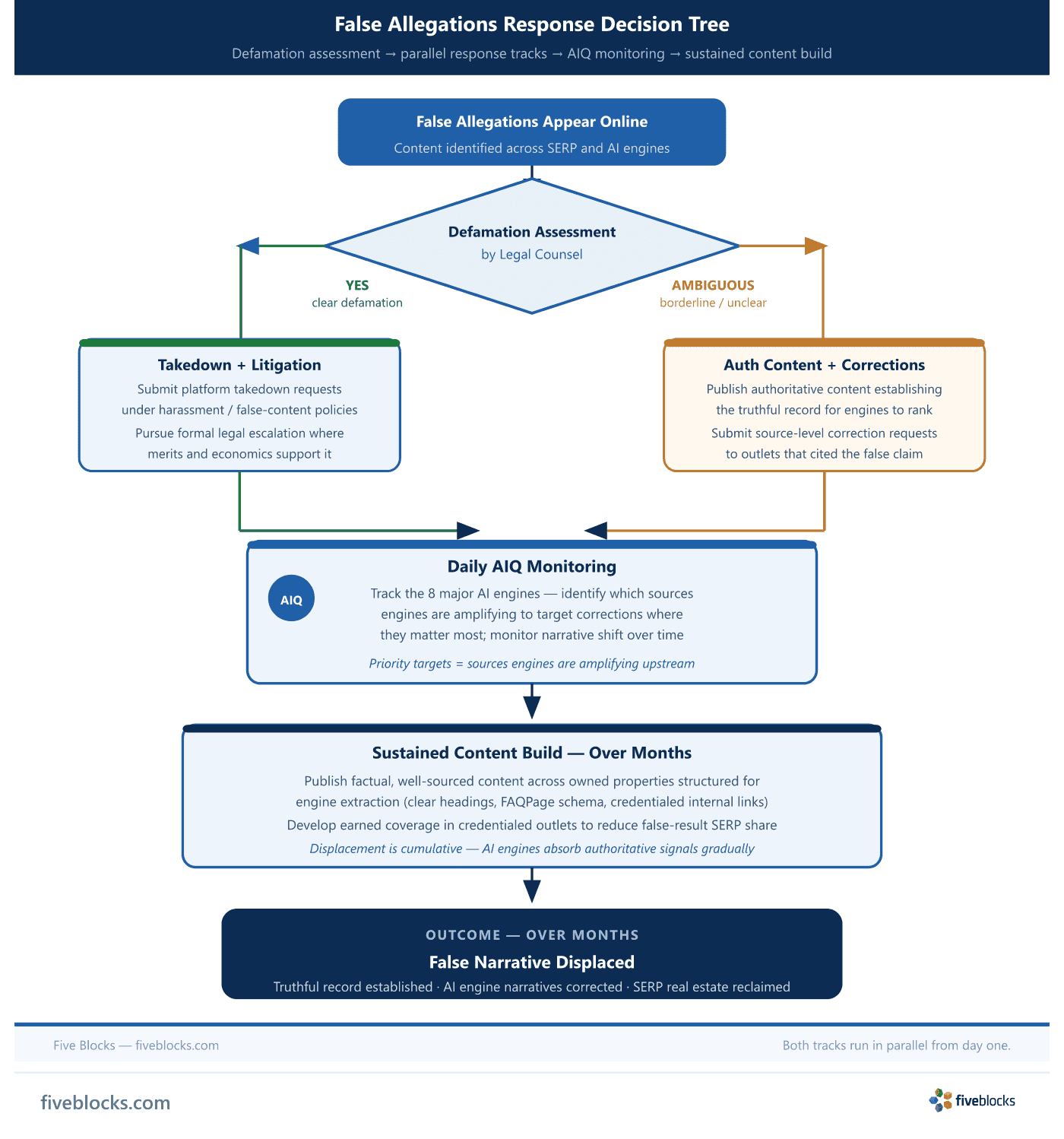
Step 1: Legal assessment by counsel
Counsel evaluates the specific claims against the applicable legal standard before any public response. In most US jurisdictions, defamation requires a false statement of fact (not opinion), publication to a third party, identification of the subject, and provable harm. The assessment determines which response path is viable:
- Clear defamation (yes branch): Where the allegations are demonstrably false statements of fact, the speaker is reachable, damages are provable, and the jurisdiction is favorable, takedown requests and formal legal escalation proceed. Platform takedown requests go in under the harassment and false-content policies that most major platforms maintain. Litigation follows where the merits and economics support it.
- Ambiguous or legally borderline (ambiguous branch): Where legal action is not clearly viable, the content may be characterized as opinion, the speaker may be unidentifiable, or the jurisdiction may be unfavorable. Here the focus shifts entirely to the reputation track: authoritative content that establishes the truthful record, and source-level correction requests to outlets that have repeated or amplified the false claim.
Step 2: Source-level correction work
- Identify every outlet, aggregator, or platform that has repeated or cited the original false allegation. Secondary sources are often what rank in search, not the original claim, so addressing the original source alone is not enough.
- Submit documented correction requests through each outlet’s editorial channel with evidence of the factual error. Some credentialed publishers accept corrections for demonstrable factual inaccuracies; those that do shift a meaningful authority signal away from the false claim.
- Where platform policies apply (harassment policies, false-claims provisions), file the relevant policy-violation report. Outcomes vary by platform and by how clear the violation is.
Step 3: Authoritative content build
- Publish factual, well-sourced content that establishes the truthful record across owned properties. This is the material the engines rank against the false result over time; without it, the SERP has no competing authoritative content to surface.
- Structure the owned content for extraction: clear headings, concise declarative statements, FAQPage schema where appropriate, and internal links to credentialed supporting sources.
- Develop earned coverage in credentialed outlets covering the broader operating record. Third-party coverage that ranks on page one reduces the share of SERP real estate available to the false allegation.
- Sustain the build over months, not weeks. AI engines and search algorithms absorb new authoritative signals gradually, and the displacement builds up over time.
Step 4: Daily AIQ monitoring
- Run daily AIQ monitoring across the eight major AI engines to track how each engine is framing the allegations, which sources it is drawing from, and how the narrative shifts as the reputation work progresses.
- The monitoring output shows which sources the engines are amplifying. These become the priority targets for source-level correction or authoritative counter-content, because changing those upstream sources changes what the engines say downstream.
- AI engines often reproduce false or contested claims for a long time after the original source has been corrected or removed, because their retrieval layers include legacy copies and cached snapshots. Continuous monitoring is what lets the correction work stay targeted rather than scattered.
- Track SERP movement in parallel through IMPACT to confirm both tracks are producing measurable displacement as the work accumulates.
Last reviewed: 19/05/2026
