How do you manage reputation for someone who has been the victim of online harassment?
Online-harassment cases are handled on four parallel tracks: platform reporting on policy violations (harassment, doxing, impersonation, image-based abuse), legal review where applicable, monitoring of AI engines and search for narrative spread, and authoritative counter-content that reasserts the person's actual identity and record. Reputation work supports rather than leads, and the response has to run for months because these campaigns do.
Online-harassment cases need an integrated response across platform, legal, reputation, and often security functions, and the reputation component is rarely the leading edge. Four functions run in parallel, not in sequence, and the work carries on for months because online-harassment campaigns do.
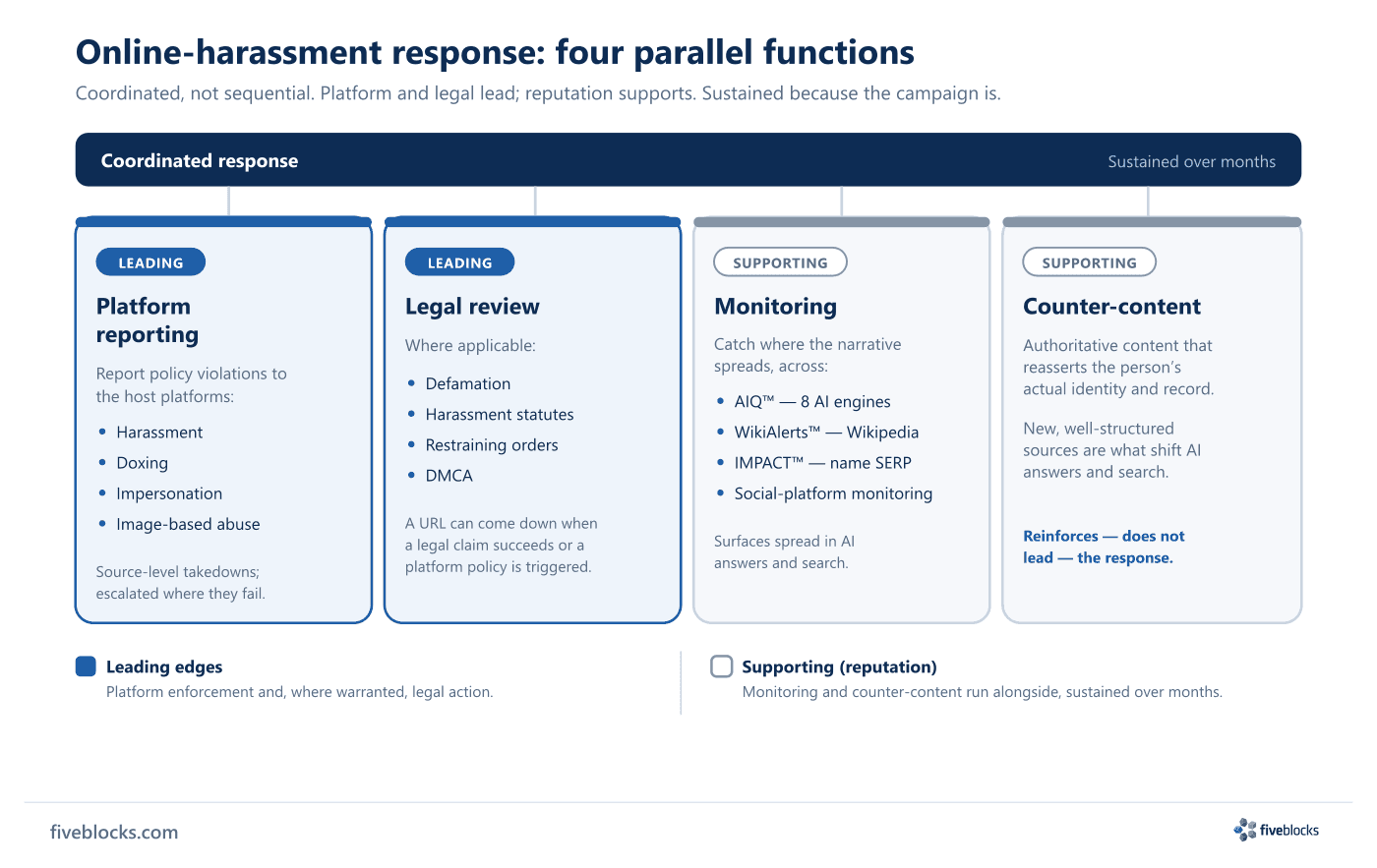
Four parallel tracks
- Platform reporting. Identify which platforms host the harassing content and file reports under the relevant terms-of-service categories: harassment, doxing, impersonation, image-based abuse. Most major platforms prohibit harassment and impersonation and provide source-level takedown mechanisms for these policy violations. Enforcement is tracked, and standard reporting paths are escalated where they fail.
- Legal review where applicable. Defamation, harassment statutes, restraining orders, and DMCA where scraped or republished content or image-based material is involved. Defamation here means false statements of fact against an identifiable person, and a URL can come down when a legal claim succeeds or a platform policy is triggered.
- Monitoring. AIQ across the eight AI engines it currently tracks (ChatGPT, Gemini, Copilot, Perplexity, Claude, Grok, Google AI Overviews, Google AI Mode), WikiAlerts™ on the Wikipedia article if one exists, and IMPACT™ on the name SERP, plus social-platform monitoring. Together these show where the narrative is spreading and where it surfaces in AI answers and search.
- Counter-content. Authoritative content that reasserts the individual’s actual identity and record. AI engines and search draw on the sources around a person, so new authoritative, well-structured content is what shifts those answers. It reinforces the response rather than leading it.
Why reputation supports rather than leads
The leading edges in a harassment case are platform enforcement and, where warranted, legal action. Reputation work runs alongside them for months, because the underlying campaign persists and because AI engines and search pick up corrected sources slowly.
Last reviewed: 19/05/2026
