How do you handle a coordinated online disinformation campaign against your company?
Coordinated disinformation campaigns need an equally coordinated defense: simultaneous monitoring across social, niche press, AI engines, and search; attribution work to identify the source; factual rebuttal on owned properties; platform-policy enforcement where violations exist; and direct stakeholder communication to reach the people the campaign is targeting. A piecemeal response usually fails. The combination is what makes the campaign visibly fail.
A coordinated disinformation campaign differs from ordinary negative coverage because it has a source, a strategy, and a tactical playbook that changes as it runs. It usually operates across several channels at once, social, niche press, AI engines, and search, so the defense has to be coordinated across the same channels rather than aimed at whichever surface is loudest at the moment.
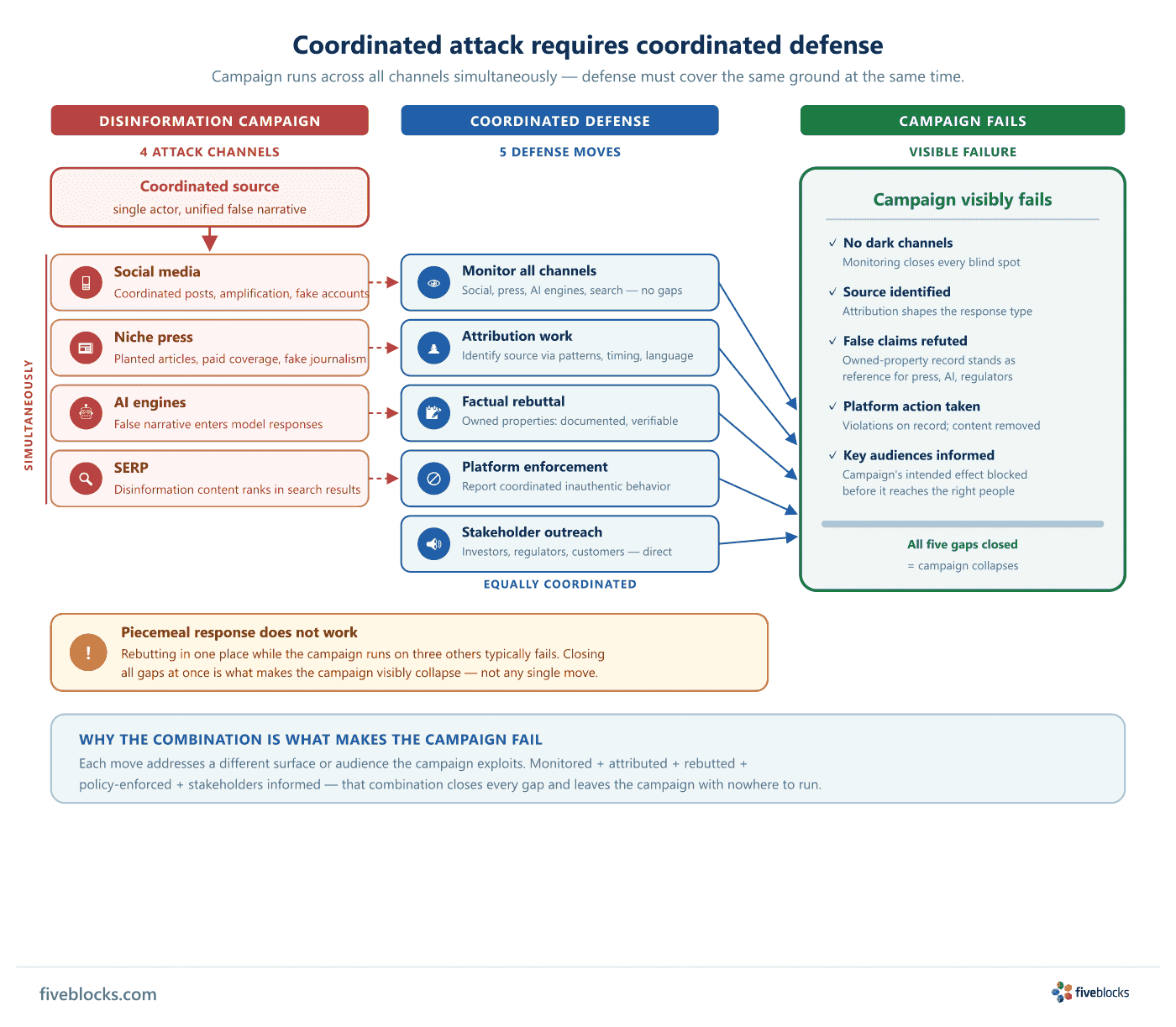
Step 1: Monitor across all affected channels simultaneously
Because the campaign touches several surfaces at once, monitoring has to as well. Watch social platforms for coordinated posting and amplification, niche press for planted coverage, AI engines for whether the false narrative is entering model responses, and search for whether disinformation content is ranking. Any gap in monitoring lets the campaign run undetected on a surface you are not watching.
Step 2: Do attribution work
Identifying the source, where you can, changes how you respond. Attribution sometimes comes from public reporting on the actors involved, and sometimes from forensic analysis of account creation timing, shared language patterns, or coordination signatures. Even partial attribution helps you decide whether the response should be public, private, legal, or regulatory, and whether to name the source at all.
Step 3: Build factual rebuttal on owned properties
Owned properties, company website, blog, official social accounts, press releases, are where the documented factual position lives. The rebuttal answers the specific false claims with verifiable evidence and gives journalists, investors, customers, and regulators a stable reference point. This content also enters the source pools AI engines draw on, which shapes how they describe the situation at query time.
Step 4: Engage platforms on clear policy violations
Major social platforms prohibit coordinated inauthentic behavior, harassment, and the deliberate spread of false information. Where the campaign breaks those policies, reporting it and escalating through official channels is a legitimate enforcement lever. Platforms do not act on every report, but a policy violation is enforceable grounds that carries weight and creates a documented record of the campaign’s conduct.
Step 5: Communicate directly with affected stakeholders
The campaign is trying to influence specific audiences, investors, regulators, customers, employees, partners. Go directly to those audiences with the company’s documented position before they form a view from the disinformation alone. Direct outreach heads off the campaign’s intended effect on the people who matter most.
Why the combination matters
Each of these moves addresses a different surface or audience the campaign is exploiting. Rebutting in one place while the campaign runs unchecked elsewhere usually fails. A disinformation campaign visibly falls apart when the gaps are closed: monitored, attributed, rebutted, policy-enforced, and stakeholders directly informed. That combination is what makes it fail.
Last reviewed: 19/05/2026
