How do you manage reputation when AI generates false crisis narratives?
Respond in four stages: detect and monitor the false claim with AIQ, trace it to the one or two root source inputs, correct those inputs and publish authoritative content on owned properties, then use the remediation channels OpenAI, Google, and Anthropic offer. Retrieval-based engines can shift within weeks; training-based engines update at their next cycle.
AI-generated false crisis narratives are a newer category that now comes up regularly. The pattern: an AI engine starts asserting something incorrect (an executive who never worked there, a regulatory action that did not happen, a financial event with the facts wrong), and stakeholders start acting on it. The response is structured and source-focused, because the engines do not invent false narratives in isolation. They derive them from specific inputs that can be found and corrected.
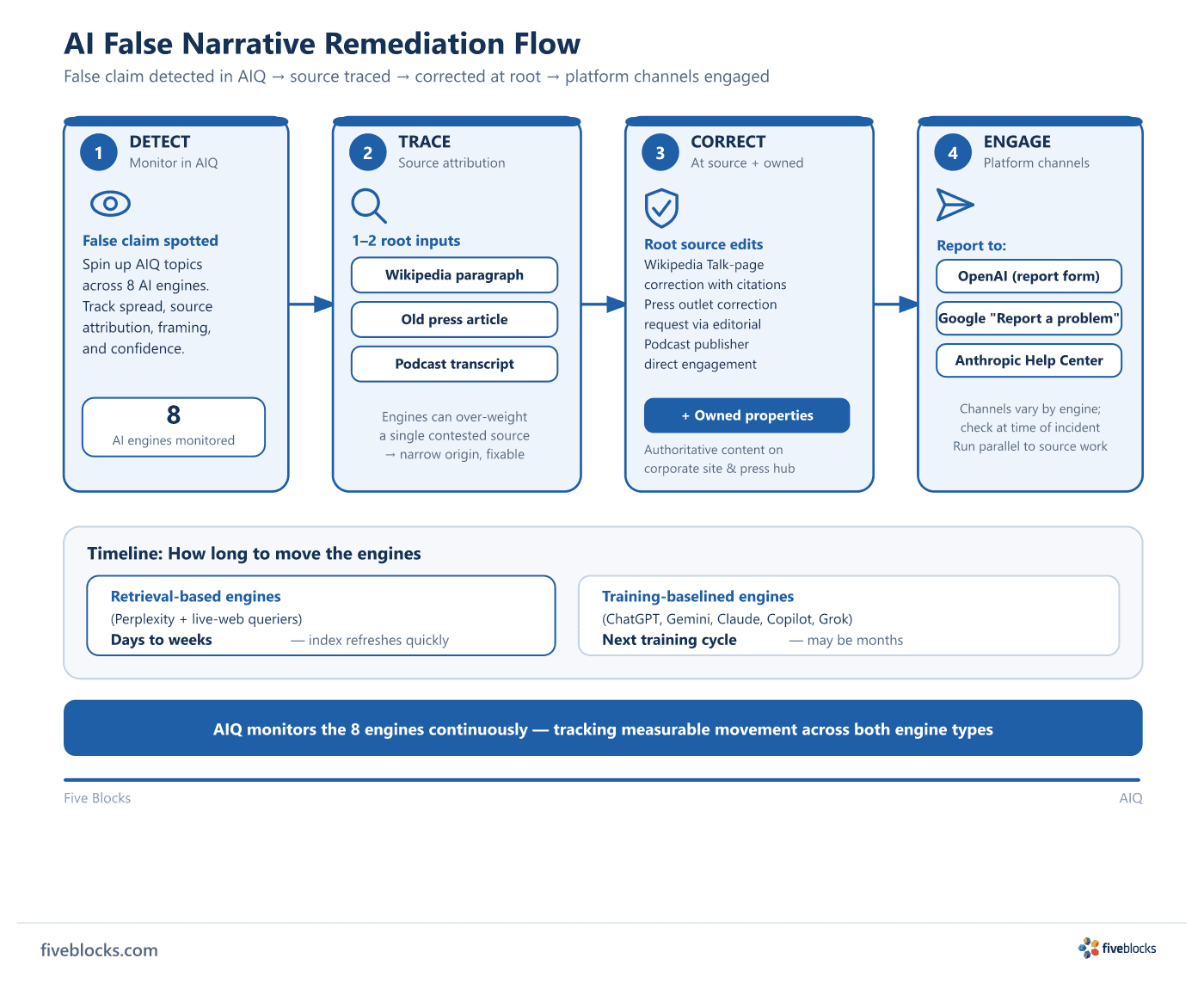
Step 1: Detect and monitor the false claim with AIQ
- Spin up AIQ topics on the specific false claim across the eight AI engines AIQ currently tracks the moment the narrative is detected. Track spread, source attribution, and how each engine frames the claim.
- The monitoring output shows which engines are asserting the false narrative, at what confidence level, and how often, which gives a ranked picture of where the exposure is worst.
- AI engines synthesize answers from source content and can state false claims about a brand as fluently and confidently as accurate ones, so the situation rarely corrects itself without intervention.
Step 2: Identify the root source inputs
- Source attribution in AIQ usually points to one or two specific inputs the engines are over-weighting: a poorly sourced Wikipedia paragraph, an outdated press article, a quoted comment in a podcast transcript, or a low-credibility aggregator piece.
- AI engines can over-weight a single contested or low-quality source when forming an answer, so the false claim often has a narrow, identifiable origin rather than being spread across dozens of sources.
- Identifying the source determines where the correction work goes. Without it, the response is untargeted and slow.
Step 3: Correct at the root inputs and on owned properties
- Wikipedia: Where the root input is a Wikipedia paragraph, submit a Talk-page edit request with sourced citations correcting the specific claim. Corrections that cite independent reliable sources have the highest leverage because the engines weight Wikipedia heavily.
- Press and media: Where the root input is an outdated or inaccurate article, submit a documented correction request through the outlet’s editorial channel. Most credentialed publishers maintain correction policies and will amend demonstrably false factual claims when properly supported.
- Podcast transcripts and other sources: Where the root input is a transcript or other informal source, contact the publisher directly through available channels and document the factual error with evidence.
- Owned properties: At the same time, publish factual content on the corporate site and press hub at the authority level the engines weight, with clear headings, structured data, and sourced statements that address and correct the false claim. This gives the engines a competing authoritative signal to index alongside the false-narrative source.
Step 4: Engage platform remediation channels
- OpenAI, Google, and Anthropic each offer a formal channel for reporting incorrect AI-generated information. Google AI Overviews provides a thumbs-down / “Report a problem” mechanism directly in the interface. Anthropic’s Claude Help Center offers a content-reporting form for policy-violating or factually incorrect output.
- These channels do not guarantee immediate correction, but they are part of the remediation process the providers maintain and should be used in parallel with source-level work.
- Not all providers have equivalent channels; the available path differs by engine and should be checked at the time of the incident.
Timeline: how long to move the engines
- Retrieval-based engines (Perplexity and others that query the live web at run time) can reflect updated authoritative content within days to weeks as their indexes refresh.
- Training-baselined engines update only at their next retraining cycle, which may be months away. For these engines, source correction and owned-property content create the record that feeds the next cycle rather than producing immediate change.
- Together, source correction, owned-property content, and platform engagement usually produce measurable movement in retrieval-based engines within weeks. Training-based engines are slower; continuous monitoring through AIQ tracks progress across both types.
Last reviewed: 19/05/2026
