How do you manage AI search results during a reputation crisis?
Managing AI search results in a crisis is a daily, source-level loop: monitor the specific narrative threads across the AI engines, work out which sources each engine appears to be drawing on, place authoritative counter-content on the properties the engines already trust (including Wikipedia through Talk-page edit requests backed by reliable secondary sources), then check whether the corrected picture is being absorbed and repeat where it is not.
Managing AI search results during a crisis is a different job than press management, and it runs as a continuous loop rather than a one-off statement. The point of leverage is rarely the loudest social account. It is usually a small number of sources the engines have settled on. So the work is to find those sources, change what they say with authoritative material, and check whether each engine picks up the correction. The loop has four stages that repeat daily for as long as the crisis is live.
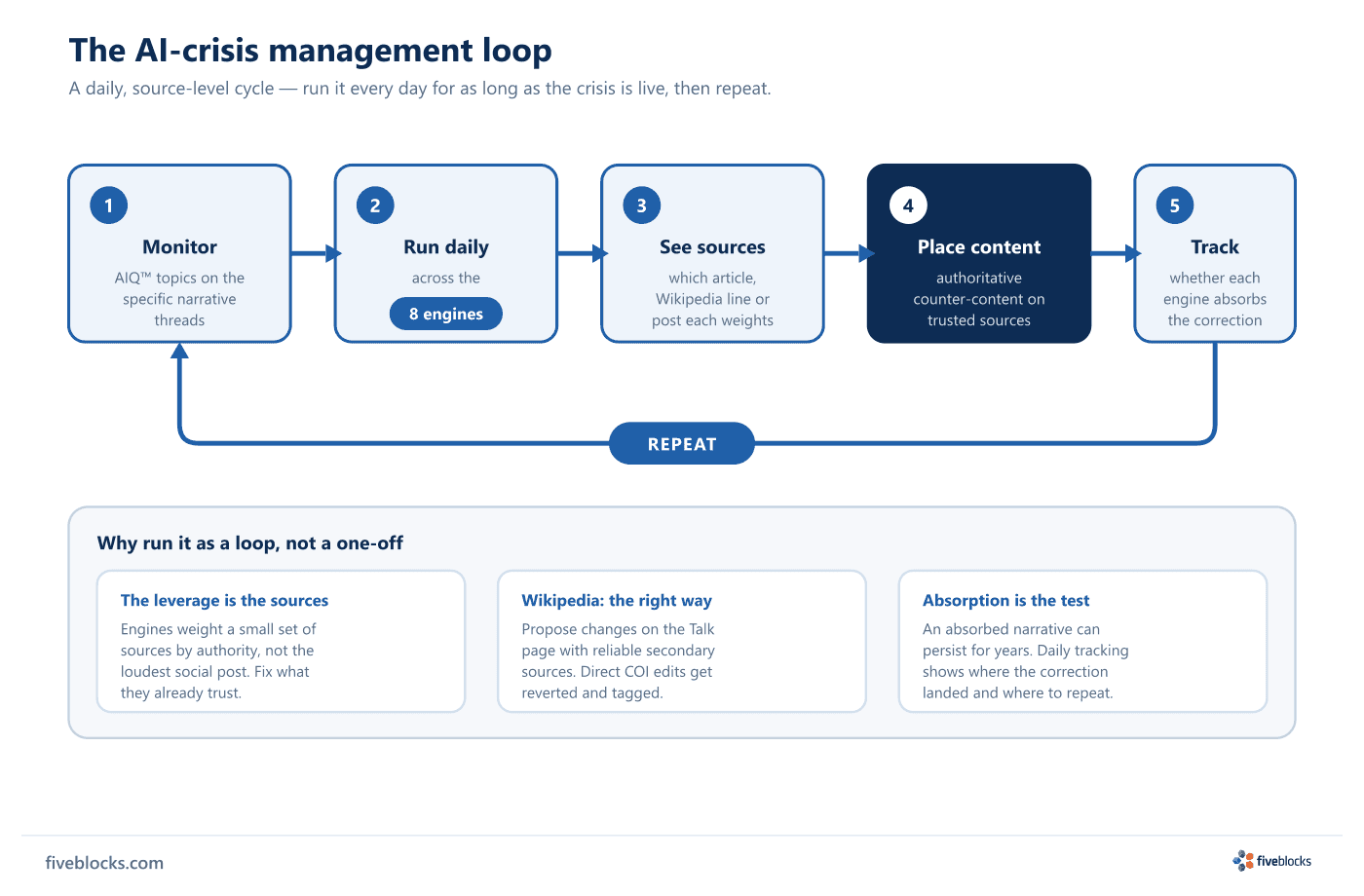
The crisis loop, stage by stage
- Monitor the narrative threads daily across the engines. Set up monitoring topics on the specific contested claim, the framing, and any executive names in the story, and run them daily. AIQ polls eight major AI engines: ChatGPT, Gemini, Copilot, Perplexity, Claude, Grok, Google AI Overviews, and Google AI Mode. You track the picture engine by engine from the first day instead of from a single sample.
- Trace the sources each engine is drawing on. AI engines build an answer by weighting sources on authority signals such as domain reputation, citation patterns, recency, and structural quality, and they can over-weight a single contested source. Some retrieval-based engines show inline citations for the sources they used; others do not, so this stage reads the sources each engine appears to rely on. That tells you where intervention pays off, often a single early article or a Wikipedia paragraph the engines have settled on rather than the noisiest social post.
- Place authoritative counter-content on trusted sources. Move the corrected facts onto properties the engines already weight: the corporate site, credible independent press, and the Wikipedia article. Search and AI engines weight credible independent coverage more heavily than additional owned pages, so the corrections that last are the ones that land in independent secondary sources the engines already trust.
- Check absorption, then repeat. The daily monitoring shows whether each engine has taken up the corrected picture or is holding the old frame. Where an engine still repeats the contested version, the loop returns to source-level work, because uncorrected material can persist in AI training data for years unless it is changed at the source.
Correcting the Wikipedia thread the right way
- Use the Talk-page edit-request process, not direct edits. The compliant path for an interested or paid party is to propose changes on the article’s Talk page with reliable secondary sourcing and let an independent community editor evaluate and implement them, rather than editing the article directly.
- Direct conflict-of-interest edits backfire. Edits made directly from a conflict-of-interest account get reverted and tagged even when the underlying correction is accurate, so the Talk-page route is also the faster way to a change that holds.
- Bring independent sources, not primary ones. Wikipedia accepts corrections supported by independent secondary sources such as mainstream press; a company’s own website or press releases are generally not enough on their own to support a factual change.
Run this as a loop rather than a single intervention because corrections have to hold. AI engines combine many sources into one confident narrative, and once that narrative is in place it can persist even after fresh information appears. The only reliable test of a correction is whether the engines themselves start reflecting it. Daily monitoring closes that loop: it shows where source-level work has moved the picture and where more is still needed.
Last reviewed: 19/05/2026
