What should you do in the first 24 hours of a reputation crisis?
In the first 24 hours, assess the scope of what the engines and the SERP are actually showing, stand up daily AI and search monitoring on the specific narrative threads, coordinate legal and PR before any public statement, identify the highest-influence content driving the worst frame, and stage authoritative response material on owned properties the engines can cite. Most of the damage that turns out to be permanent comes from acting before this groundwork is in place.
Day one is about establishing what is actually true, who needs to know, and what the engines are doing, before anything is said publicly. Get the groundwork right first, because most of the early damage that turns out to be permanent comes from acting before that groundwork is in place. Four workstreams run largely in parallel, and the first public statement comes only after they are underway.
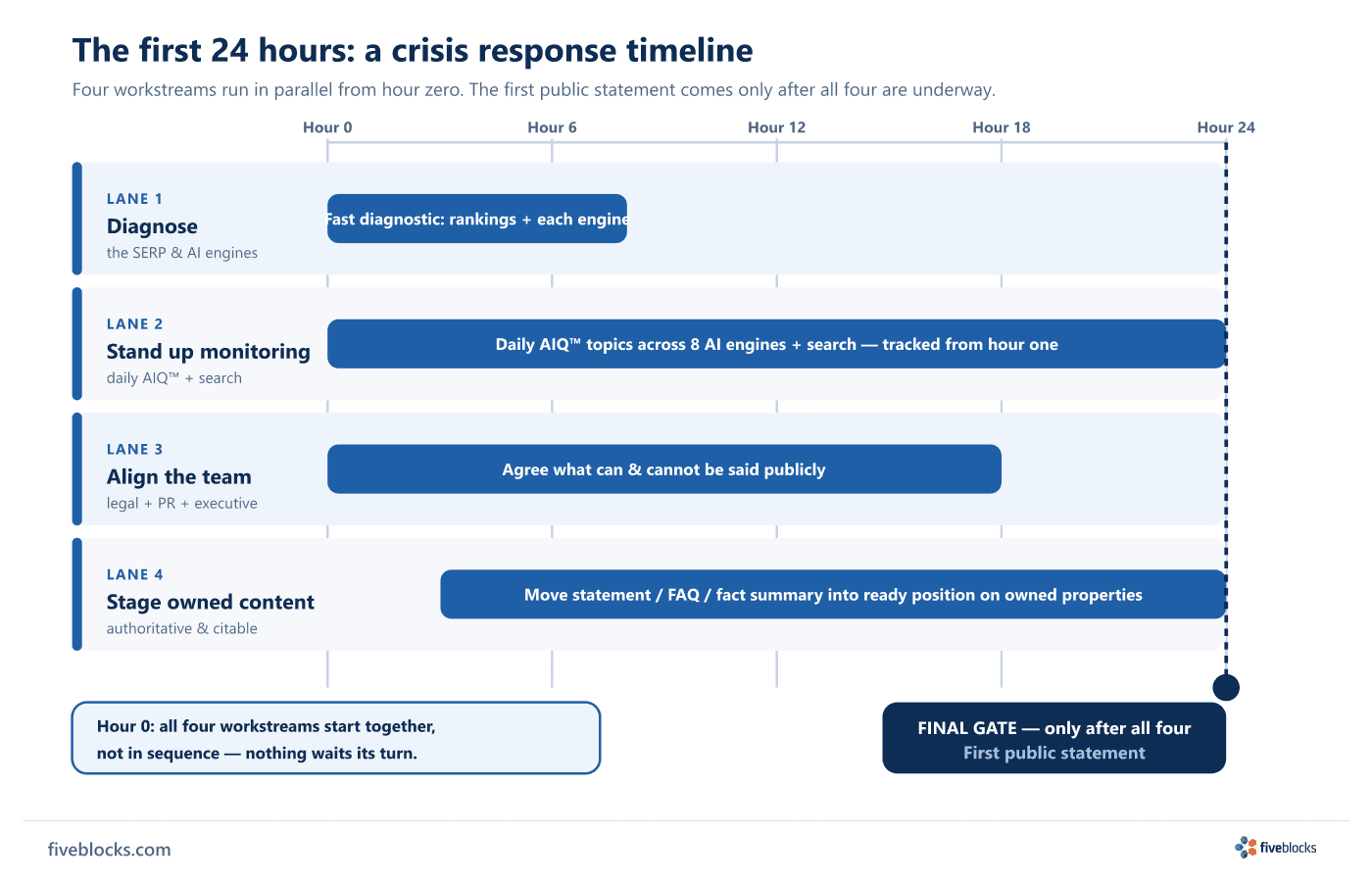
The first 24 hours, step by step
- Run a fast diagnostic. Establish what is ranking on Google for the priority queries, what each AI engine is saying right now, and which specific articles or sources are driving the worst frame. This baseline tells you where the narrative is actually coming from rather than where it feels loudest.
- Stand up daily monitoring. Spin up daily AIQ topics on the specific narrative threads so the picture is tracked from hour one across the AI engines, alongside daily search monitoring. AIQ polls eight major AI engines, so you track the picture engine by engine rather than from a single sample.
- Align legal, PR, and the executive team. Agree on what can and cannot be said publicly before any statement goes out. This alignment keeps the first public move from creating a second, durable problem.
- Stage authoritative owned content. Move a statement, FAQ page, or fact summary on owned properties into ready position, so that anything said publicly is also said in writing on properties the engines can cite. Engines weight credible, citable sources, so a statement that exists only as spoken comment is far weaker than one published where it can be referenced.
What runs concurrently
- The diagnostic, the monitoring setup, and the legal and PR alignment all begin together rather than in sequence. Monitoring does not wait for the diagnostic to finish, and the owned-content staging proceeds while the messaging is still being agreed.
- The first public statement is deliberately the last gate, not the first move. It comes only after the scope is understood, the messaging is aligned across legal, PR, and the executive team, and the owned-property material is staged to receive it.
The reason for the discipline is durability. AI engines synthesize many sources into a single confident-sounding narrative, and once that synthesis hardens it can persist even after fresh information emerges, so the version that forms in the first day is the version stakeholders may keep seeing. Getting the groundwork right in the first 24 hours gives the later response something solid to build on.
Last reviewed: 19/05/2026
