How do you respond to a viral negative news story?
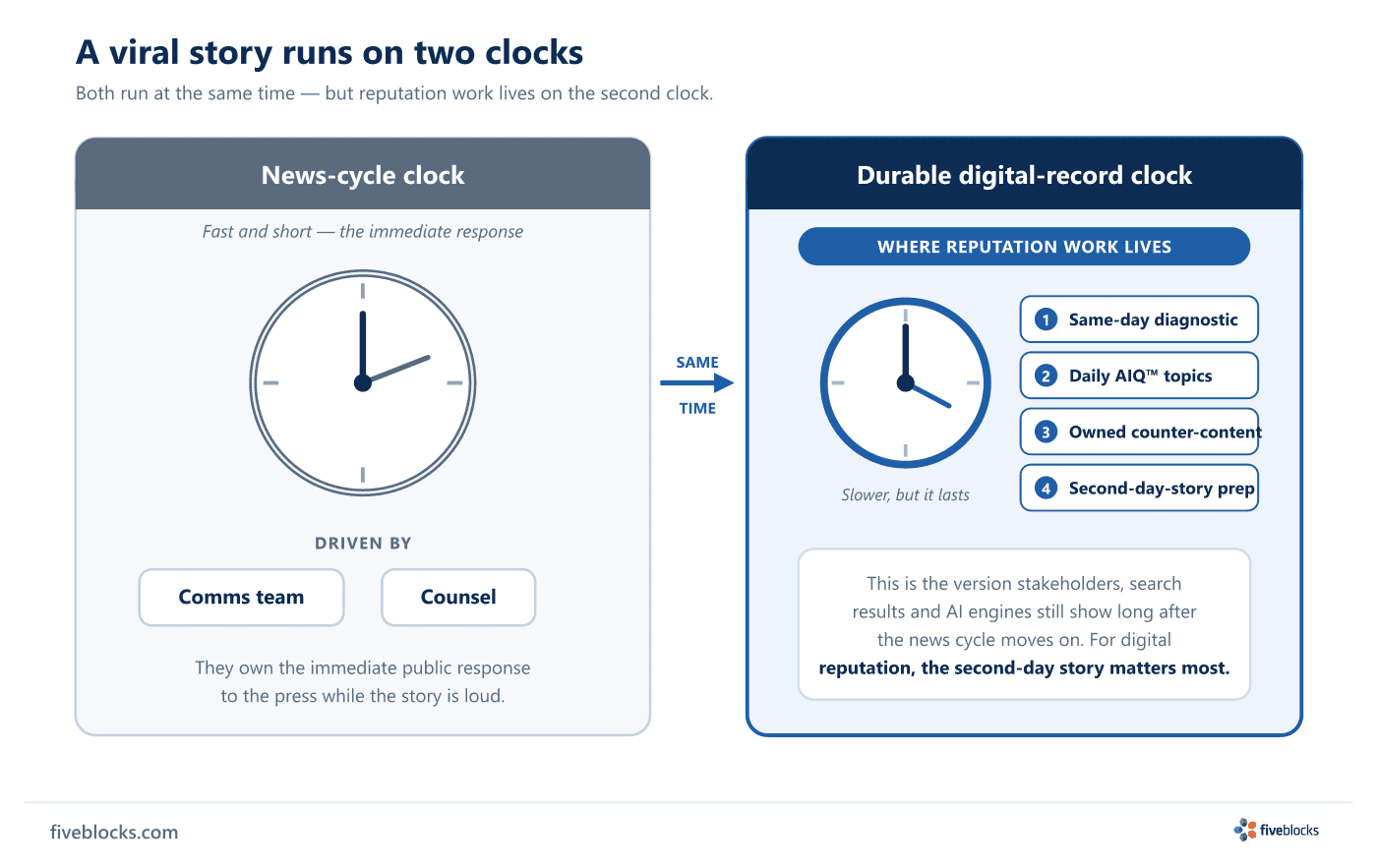
A viral negative story runs on two clocks: the immediate news cycle, which comms and counsel own, and the durable digital record, where reputation work lives. While they handle the press, diagnose what is driving the virality, monitor it daily across the AI engines, and publish authoritative counter-content on owned properties the engines can cite.
A viral negative story has two clocks, and reputation work lives on the second one. The first is the immediate news cycle, where the comms team and counsel drive the response. The second is the durable digital record: what stakeholders, search results, and AI engines will still be showing long after the news cycle moves on. Comms owns the press. We work the durable record, and the two run at the same time.
What to do while the story is viral
- Run a same-day diagnostic. Establish what is actually driving the virality: which outlets, which social accounts, and which sources the AI engines are starting to weight. That tells you where the narrative comes from rather than where it feels loudest. A viral negative social thread can itself begin ranking for the company name.
- Coordinate legal and PR. The comms team and counsel run the public response on the news-cycle clock. The durable-record work is sequenced around what they can and cannot say.
- Stand up daily AI monitoring. Spin up daily AIQ topics on the specific narrative threads so the picture is tracked from the first hours. AIQ polls eight major AI engines, which means the narrative is followed engine by engine instead of from a single sample.
- Produce authoritative counter-content. Publish accurate material the engines can cite on owned properties: the corporate site, executive bio pages, fact pages. Engines draw their answer from the sources they weight most heavily, and they cite credible media and owned material. A fact that exists only as a spoken comment is far weaker than one published where it can be referenced.
- Prepare for the second-day story. Stage the follow-on material now. For digital reputation, the second-day story is usually more important than the first.
Why the second clock matters more
- The news cycle is loud but short. The digital record is quieter and durable; it is what someone finds when they look the story up later.
- AI engines build their answer about an entity by synthesizing across the source ecosystem, so the version that forms in the source pool is the version stakeholders are shown afterward.
- Once that synthesis settles it can persist even after the live coverage is corrected. That is why the goal in the first 72 hours is to get the authoritative, citable version in place for the engines to absorb.
The first 72 hours are about that durable record. Handling the press well matters, but what stakeholders find six months later comes from the authoritative material published on owned properties while the story is still moving.
Last reviewed: 19/05/2026
