How do you handle a crisis that trends on social media?
Most viral social posts do not become lasting reputation problems, and a forceful public response often fuels the reach and turns a 72-hour social moment into a multi-week press story. The better posture is restraint plus monitoring: assess the post's actual reach and trajectory in the first 24 hours, prepare (but do not preemptively publish) accurate content on owned properties that answers the specific factual claims, engage platforms only on clear policy violations, and escalate only if the post breaks into mainstream coverage or starts influencing AI engine responses.
Most viral social posts do not become lasting reputation problems. A forceful public response often fuels the reach and turns a 72-hour social moment into a multi-week press story. The better approach is to read the situation before acting, let the engagement curve run its course, and escalate only on a clear trigger. Restraint here is a strategy, not inaction.
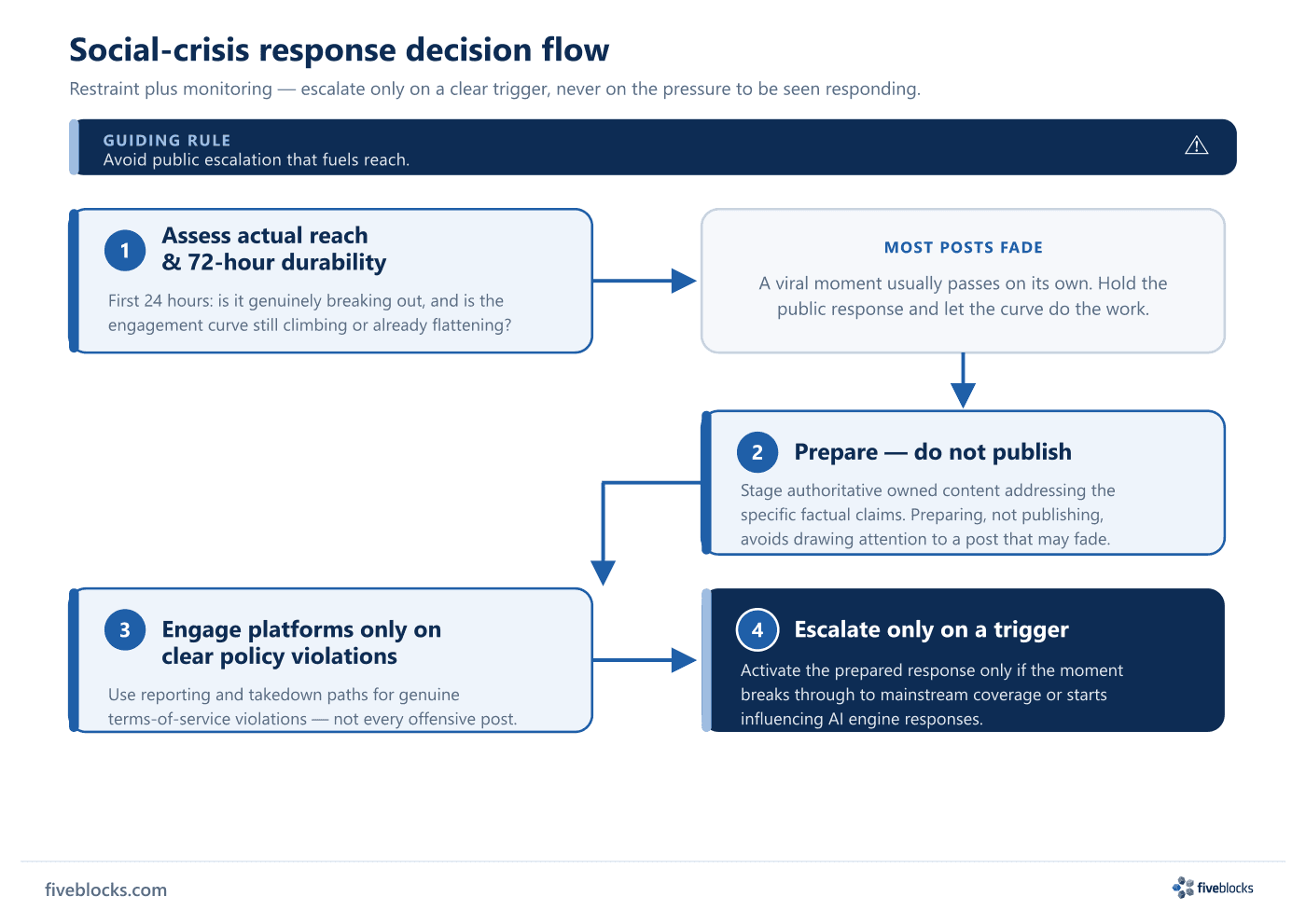
How to handle a crisis trending on social
- Assess actual reach and trajectory first (first 24 hours). Work out whether the post is genuinely breaking out or staying inside its niche, and whether the engagement curve is still climbing or already flattening. Social content is increasingly indexed into branded search, so a viral negative thread can start ranking for the company name. That kind of durability is what to measure, not raw view counts in the moment.
- Prepare accurate content, but do not publish preemptively. Stage material on owned properties that answers the specific factual claims, so stakeholders looking for the company’s version of events can find it if the situation escalates. Preparing it rather than publishing it keeps you from drawing attention to a post that may fade on its own.
- Engage platforms only on clear policy violations. Most major platforms prohibit harassment, coordinated inauthentic behavior, and certain false claims, and they provide reporting and takedown paths for terms-of-service violations. Use those paths for genuine violations rather than reporting every offensive post. A report against content that does not break policy rarely succeeds and can itself become a story.
- Monitor the AI narrative daily during the live event. Watch whether the AI engines are starting to absorb the narrative from the social moment. Engines ingest public social content and fold it into their answers, and that framing can persist after the original post is gone. AIQ polls eight major AI engines, so you can follow the narrative engine by engine rather than from a single sample.
- Escalate only on a clear trigger. If the post breaks into mainstream coverage or starts influencing AI engine responses, the prepared response goes live. If it does not, hold, and the moment passes without amplification.
Why restraint usually wins
- A forceful public response can turn a passing social moment into a multi-week press story by handing it reach it would not otherwise have earned.
- When credentialed outlets pick up a social moment, the story enters the news index and accumulates link authority and freshness. That is the escalation trigger to watch for, and it is exactly what public escalation feeds.
- The trigger, mainstream breakthrough or AI-engine absorption, is observable, so you can decide to act or hold on the signal rather than on pressure to be seen responding.
Last reviewed: 19/05/2026
