How does AIQ change crisis response?
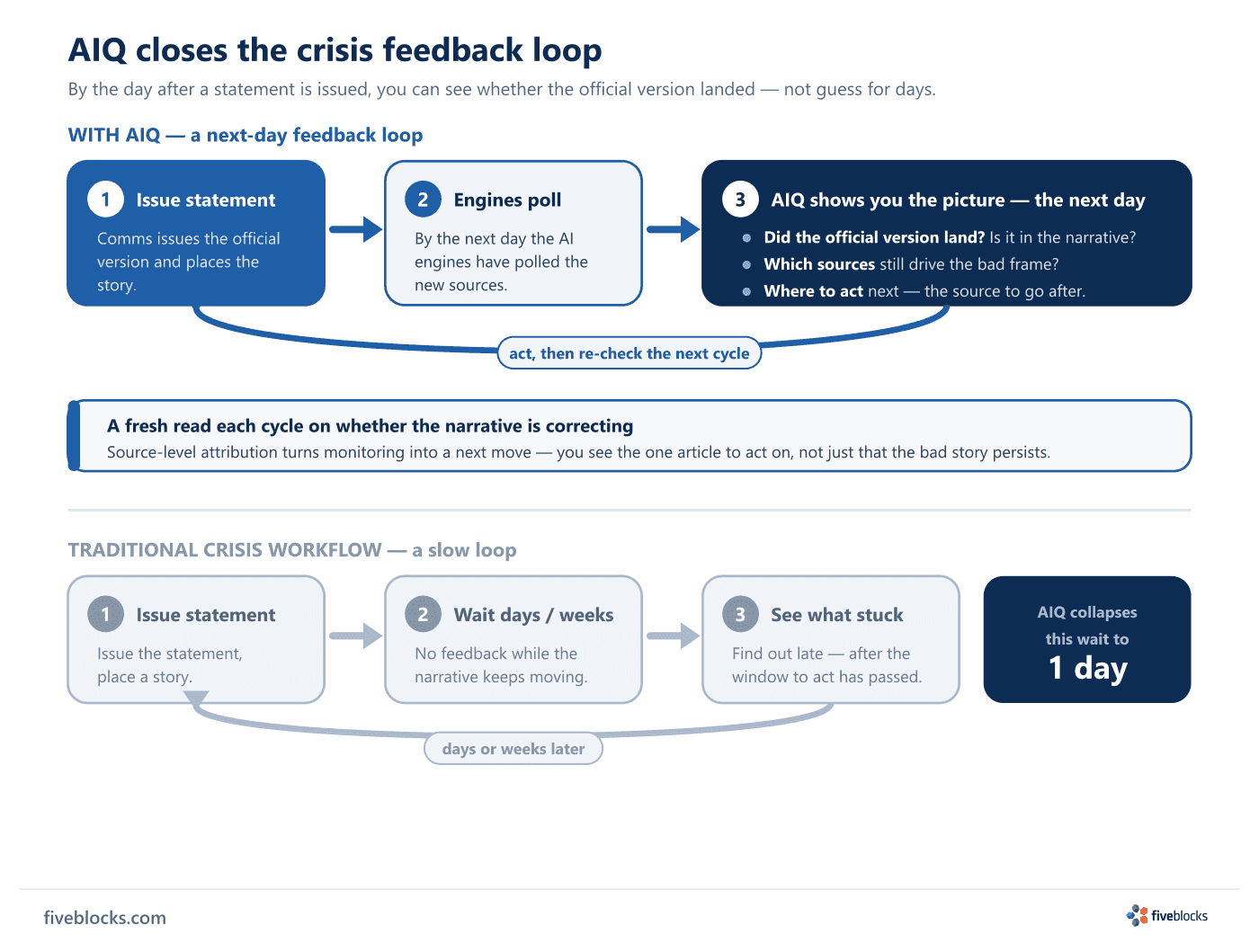
AIQ closes the crisis feedback loop: the day after a statement is issued, comms teams can see whether the official version of events has entered the AI narrative, which sources are still driving the negative frame, and where to act next.
AIQ changes crisis response by closing the feedback loop. In a traditional crisis workflow, the comms team issues a statement, places a story, then waits days or weeks to see what stuck. AIQ shortens that wait. By the day after a statement is issued, the engines have polled, and the platform shows whether the official version of events has entered the AI narrative.
What you can see the next day
- Did the official version land? Whether your statement and placements have entered the AI narrative, or the engines are still telling the contested version.
- Which sources are still driving the bad frame: the citations the engines weight toward the contested account.
- Where the engines diverge: how the picture differs from one engine to another.
Why source attribution is the leverage point
Knowing that ChatGPT is still telling the bad story is one thing. Seeing that a single older article drives a large share of the citations, and is therefore the place to act, is another. That source-level view is what makes monitoring actionable.
The speed advantage matters most when a situation moves daily. Instead of guessing for days or weeks, the comms team gets a fresh read each cycle on whether the narrative is correcting. We use AIQ on every crisis engagement we run.
Last reviewed: 19/05/2026
