How do you manage reputation after executive misconduct allegations?
Executive misconduct allegations demand unusual restraint in the first week: rapid diagnostic, close legal coordination, and daily AI narrative monitoring, but little public action. The reputation infrastructure built during this period is designed to support either outcome (separation or exoneration) as facts develop.
Executive misconduct cases hinge on facts the company often does not have in the first week. Reputation work has to keep options open during that window, so the posture is deliberate preparation rather than public action.
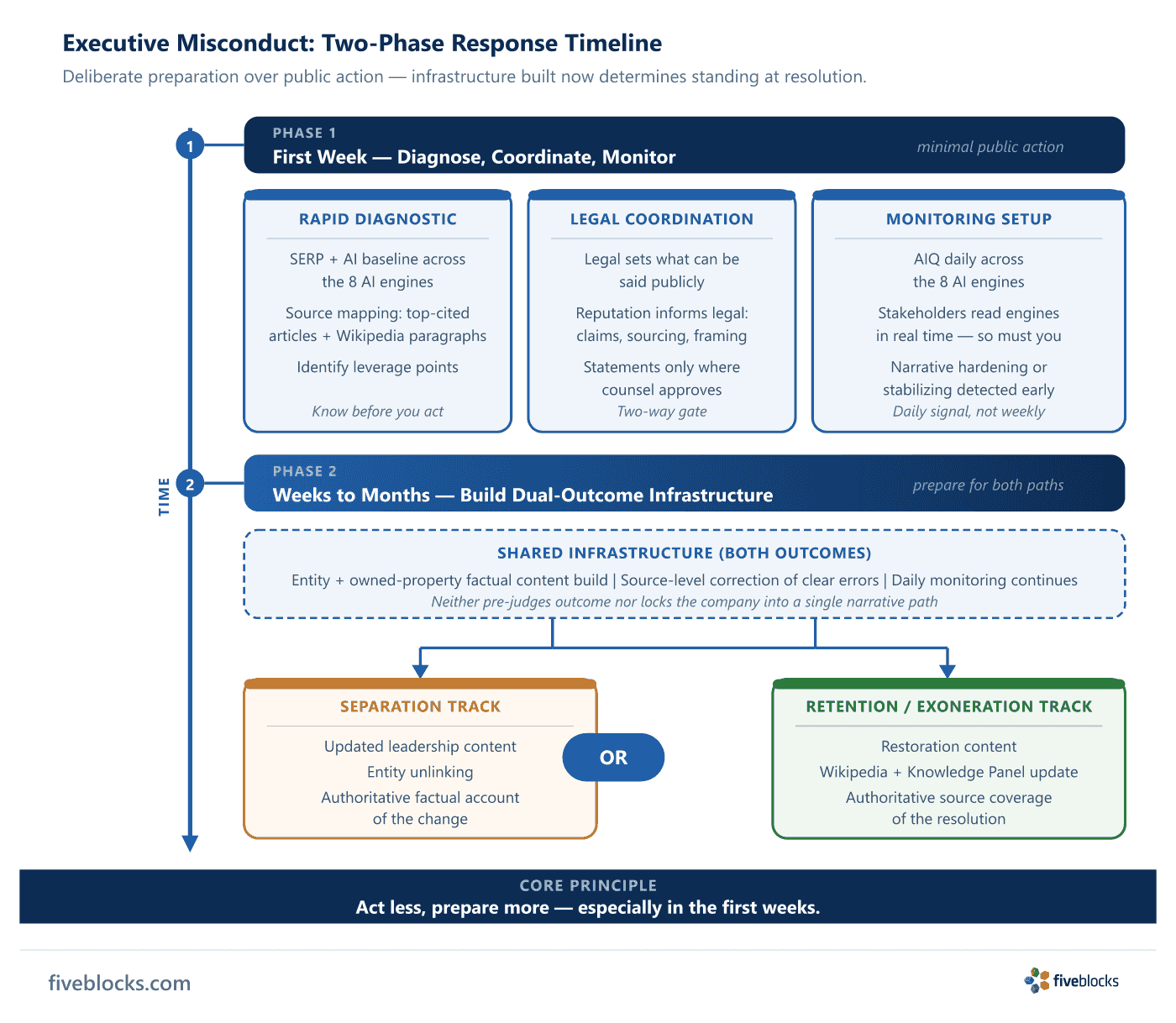
Phase 1, first week: diagnose, coordinate, monitor
- SERP and AI baseline. Run a full baseline on the executive’s name across Google and the eight AI engines AIQ currently tracks. Capture what is ranking, what each engine says, and which sources drive the narrative.
- Source mapping. Identify the most-cited articles and the Wikipedia paragraphs feeding engine responses. These are the leverage points.
- Legal coordination, both directions. Legal tells reputation what can and cannot be said publicly. Reputation tells legal what is appearing in public-facing engines – specific claims, sourcing, and narrative framing – which may bear on the case.
- Approve public statements narrowly. Public statements are made only where counsel approves and where the company has a defensible factual position. Nothing anticipatory, because anticipatory framing often gets cited back.
- Daily AI narrative monitoring. AIQ™ runs daily across the eight engines it currently tracks so the company knows in real time what stakeholders are reading.
Phase 2, weeks to months: build dual-outcome infrastructure
- Entity and owned-property work. Build factual content on owned properties and strengthen entity signals in a way that supports both possible resolutions, without pre-judging the outcome or locking the company into a single narrative path.
- Source-level correction of clear errors. Where coverage contains verifiable factual errors, correction requests go through editorial channels regardless of the broader matter.
- Separation outcome track. Draft infrastructure for the scenario where the company separates from the executive: updated leadership content, entity unlinking, an authoritative factual account of the change.
- Retention and exoneration track. Draft infrastructure for the scenario where the executive is retained after exoneration: restoration content, accurate Wikipedia and Knowledge Panel updates, authoritative source coverage of the resolution.
- Continue daily monitoring. AI engines pick up misconduct narratives quickly and hold onto them. Monitoring shows which sources need attention first and whether the narrative is hardening or stabilizing.
Core principle
Act less, prepare more, especially in the first weeks. This category of engagement is more deliberate and less public-facing than other crisis types. The infrastructure built while facts are still developing is what determines the company’s digital standing at resolution, whichever direction that resolution goes.
Last reviewed: 19/05/2026
