How do you handle reputation when negative internal documents become public?
When negative internal documents become public, the first move is legal review of the leak source, privilege posture, and what statements can be made. The public response is factual and limited to matters where the underlying material is also releasable; rebutting selected excerpts while withholding the rest usually reads as evasive. Daily AIQ monitoring identifies which quoted phrases AI engines are amplifying, and authoritative owned content places the documents in their actual operating context over the following months.
Internal-document leaks (Slack messages, emails, slide decks, internal memos) tend to follow the same path: the material is pulled out of context in early coverage, framed unfavorably, and absorbed into AI engine narratives within days. The response needs legal coordination first, then a content and monitoring plan built on a single idea: context, not concealment, is what resolves the situation for the long term.
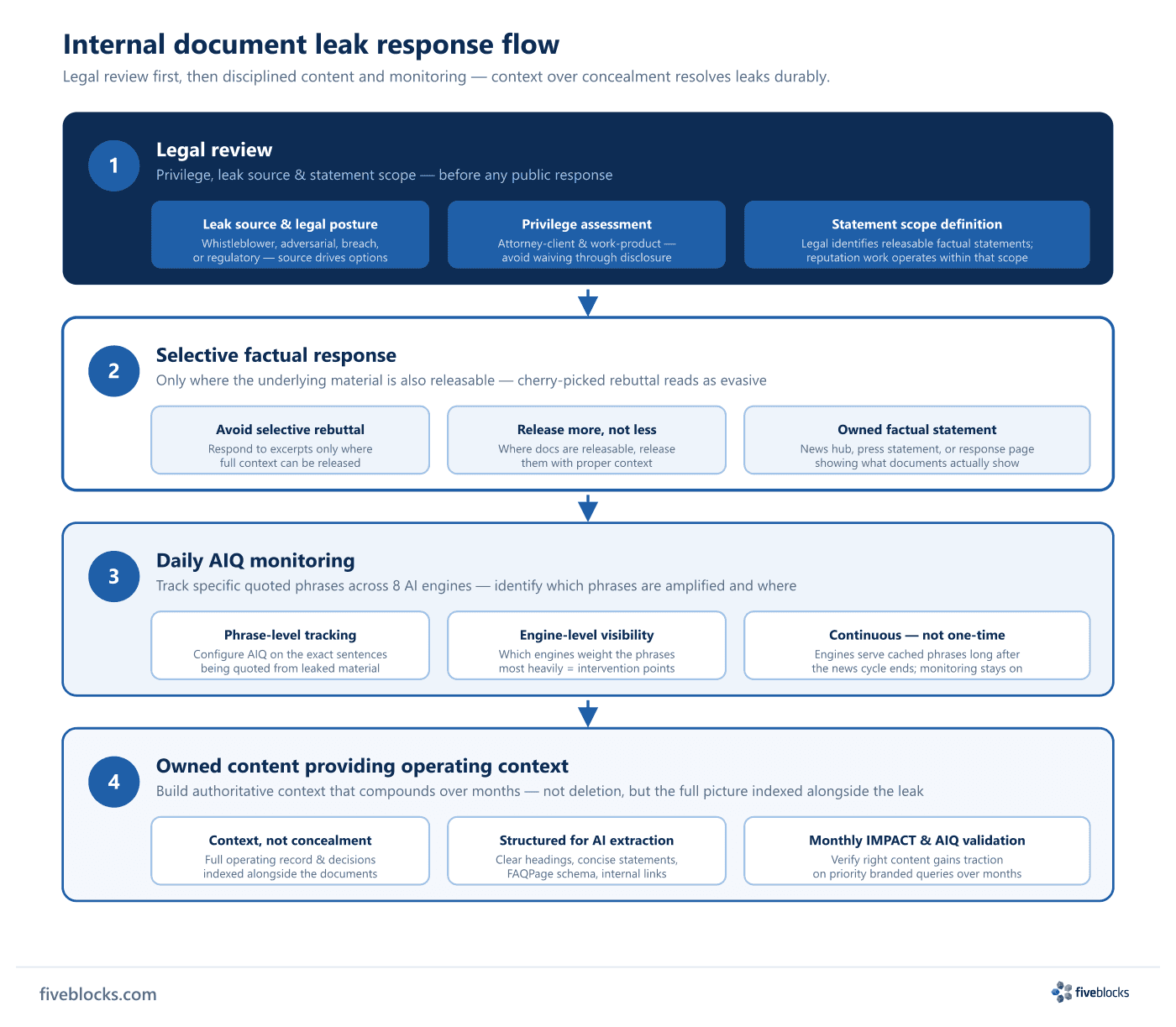
Step 1: Legal review, privilege, leak source, and statement scope
- Determine the leak source and legal posture. Is this a whistleblower disclosure, an inadvertent breach, an adversarial leak to press, or a regulatory release? The source determines both the legal options and what the company can say about it publicly.
- Assess privilege. If the leaked documents relate to matters covered by attorney-client privilege or work-product doctrine, counsel determines the appropriate response so that public disclosure does not waive privilege.
- Define the statement scope. Legal identifies which factual statements the company can make without harming any underlying investigation or legal proceeding. Reputation work operates within that scope, not around it.
Step 2: Selective factual response only where the underlying material is releasable
- Avoid cherry-picked rebuttal. Responding to selected excerpts while the broader document set stays undisclosed usually reads as evasive and adds to the credibility damage. Where the company cannot release the full context, it usually cannot credibly rebut the excerpt.
- Release more rather than less, where legally available. The approach that produces better outcomes is straightforward: where documents can be released with proper context, release them with that context rather than defending against fragments. A company that frames its own materials is in a stronger position than one reacting to others’ framing of those materials.
- Factual statements on owned properties. A news hub entry, press statement, or dedicated response page covering what the documents actually show, in their operating context, gives journalists, AI engines, and stakeholders an authoritative source to weigh against the initial framing.
Step 3: Daily AIQ monitoring on specific quoted phrases
- Run AIQ™ monitoring across the eight major AI engines daily, configured to track the exact sentences and phrases being quoted from the leaked material. Short excerpts get repeated verbatim across engines and can become defining associations even when the wider document context says something different.
- The monitoring output shows which phrases are being amplified and which AI engines are weighting them most heavily. Those are the source-level intervention points: change the upstream sources that feed those phrases and you change what the engines return downstream.
- AI engines often keep serving quoted phrases from leaked documents well after the initial news cycle, because their retrieval layers include cached snapshots and training data that pre-dates any correction. Continuous monitoring is what keeps the response targeted rather than diffuse.
Step 4: Owned content providing operating context over months
- The goal is not to delete or suppress the leaked material; that is rarely achievable and often backfires. It is to make sure the full picture is available and indexed alongside it. Authoritative owned content covering the company’s operating record, the broader decisions the documents reflect, and any process or policy changes made since gives engines and stakeholders accurate context to weigh.
- Structure this content for search and AI extraction: clear declarative headings, concise statements, FAQPage schema where appropriate, and internal links to credentialed supporting sources. Well-structured content is more likely to be cited in AI engine responses than unstructured prose.
- The context-building work builds up over months. As authoritative content accumulates and gains authority signals, the leaked-document framing becomes one input in a fuller picture rather than the only one. Monthly monitoring through IMPACT™ and AIQ™ confirms that the right content is gaining traction on the priority branded queries.
Last reviewed: 19/05/2026
