How do you manage reputation when internal Slack or email leaks go public?
When Slack or email leaks go public, the main risk is that short selected excerpts get quoted out of context, absorbed by AI engines as if they were full statements, and repeated across engines for weeks. Legal handles the leak source, privilege questions, and statement scope. AIQ™ monitoring is set up to track the phrases the engines are quoting, because that quotation pattern is where you can intervene at the source. Companies that release more operating context rather than less, and that address the AI quotation directly, usually end up with the leak as an episode rather than a defining narrative.
Slack and email leaks fail in a specific way: short selected excerpts get quoted out of context, the AI engines absorb the excerpts as if they were full statements, and the company spends weeks fighting interpretations of paragraph fragments. The response requires legal coordination first, then a targeted monitoring and content strategy built around the specific phrases the engines are repeating, not the full document set.
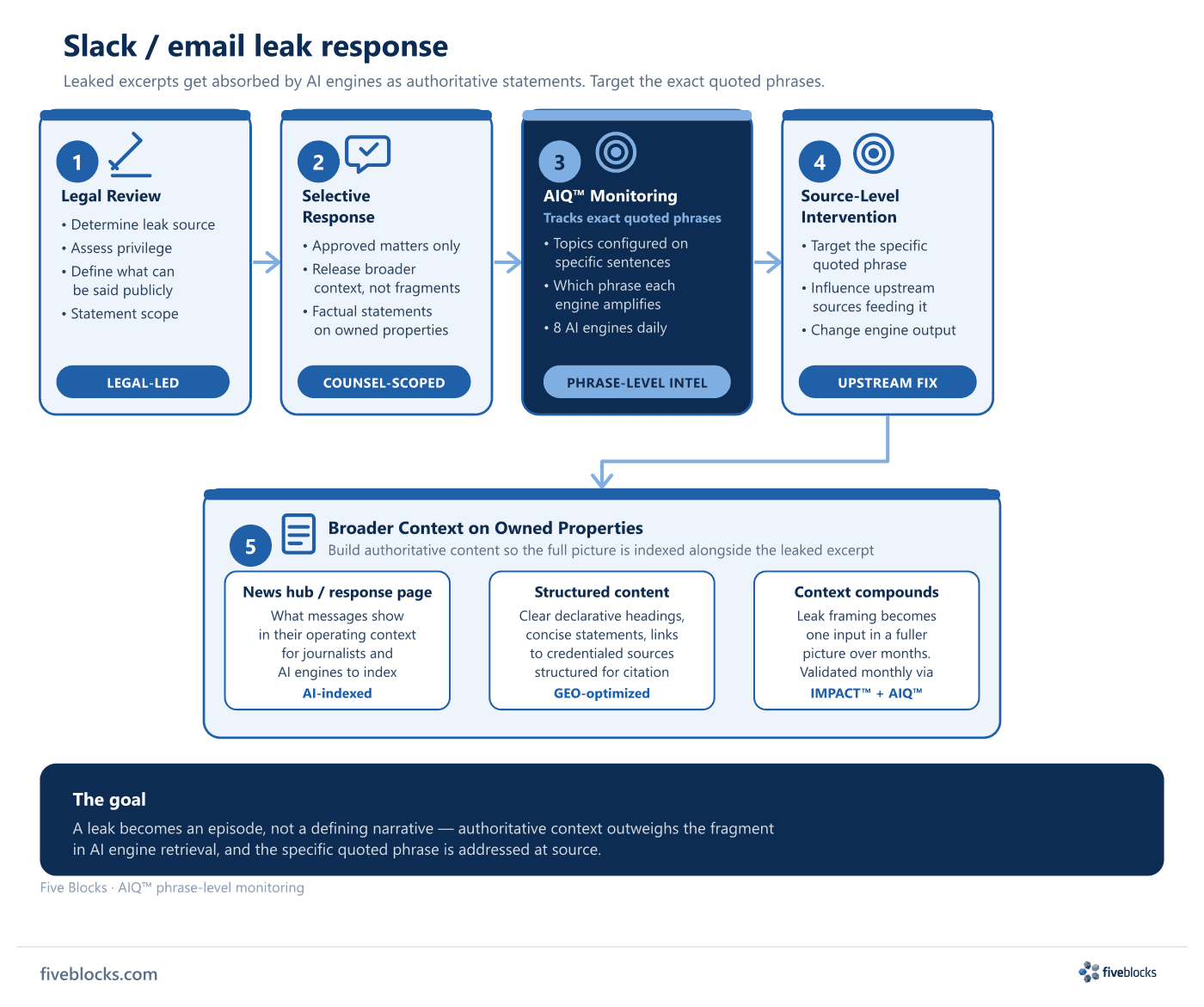
Step 1: Legal-led handling of the leak source and privilege
- Determine the leak source. Was this an insider disclosure, an adversarial breach, a regulatory release, or discovery in litigation? The source determines the legal options and what the company can say about it publicly.
- Assess privilege and statement scope. If the messages involve matters covered by attorney-client privilege, counsel sets the response framework before any public statement is drafted. Reputation work operates within the scope counsel defines, not around it.
- Define what can be said about the underlying matters. The messages themselves may discuss issues that are sensitive on their own, apart from the leak: pending transactions, regulatory matters, personnel decisions. Counsel identifies which factual statements the company can make without harming any underlying investigation or proceeding.
Step 2: Selective public response, limited to approved matters
- Avoid rebutting fragments in isolation. When the full message thread is not released, responding to selected excerpts while the broader context stays undisclosed usually reads as evasive. The credibility damage from a partial rebuttal is often worse than the original excerpt.
- Release more context rather than less, where legally available. Where the surrounding messages can be released with proper context, releasing them lets the company frame its own materials instead of defending against how others frame them. A company that provides operating context is in a stronger position than one that reacts to fragments.
- Factual statements on owned properties. A news hub entry or dedicated response page covering what the messages actually show, in their operating context, gives journalists, AI engines, and stakeholders an authoritative source to weigh against the initial framing.
Step 3: AIQ monitoring on the specific phrases being quoted
- Set up AIQ™ topics to track the specific sentences and phrases being pulled from the leaked messages, not just the company name or the general topic. The quotation pattern, meaning which exact phrase each engine repeats, is usually where the lasting damage happens.
- If a single phrase from a single Slack message is repeated across the eight major AI engines, that phrase is where you intervene at the source. Changing the upstream sources that feed that phrase changes what the engines return downstream.
- AI engines often keep serving quoted phrases from leaked messages beyond the initial news cycle, because their retrieval layers include archived snapshots that pre-date corrections. Daily monitoring is what makes the response targeted rather than diffuse.
Step 4: Authoritative owned content providing broader operating context
- Build out owned content covering the company’s broader operating record and the actual context around the decisions reflected in the leaked messages. The goal is not to delete or suppress the leaked material, which is rarely possible, but to make sure the full picture is indexed alongside it.
- Structure the content for AI extraction: clear declarative headings, concise statements, and internal links to credentialed supporting sources. Well-structured content is more likely to be cited in AI engine responses than unstructured prose.
- The context-building work builds up over months. As authoritative content accumulates, the leaked-message framing becomes one input in a fuller picture rather than the defining frame. Monthly monitoring through IMPACT™ and AIQ™ confirms the right content is gaining traction on the priority branded queries.
Last reviewed: 19/05/2026
