How do you manage reputation during a whistleblower allegation?
Whistleblower allegations carry legal and reputational exposure at the same time, and the wrong move on one side makes the other worse. The response is legal-led: counsel defines the framework, approves every public statement, and sets the lane for reputation work, which runs daily AIQ monitoring on the specific allegations and builds authoritative content on the broader operating record. The discipline that matters most is avoiding any framing that reads as retaliatory, because retaliation framing turns a contained allegation into a regulatory matter and a lasting reputation problem.
Whistleblower allegations need a different posture than most crises because the legal exposure and the reputation exposure are tied together: aggressive communications can create new legal risk, and legal missteps produce immediate reputation consequences. Legal leads the overall response strategy, and reputation work operates within the lane counsel defines.
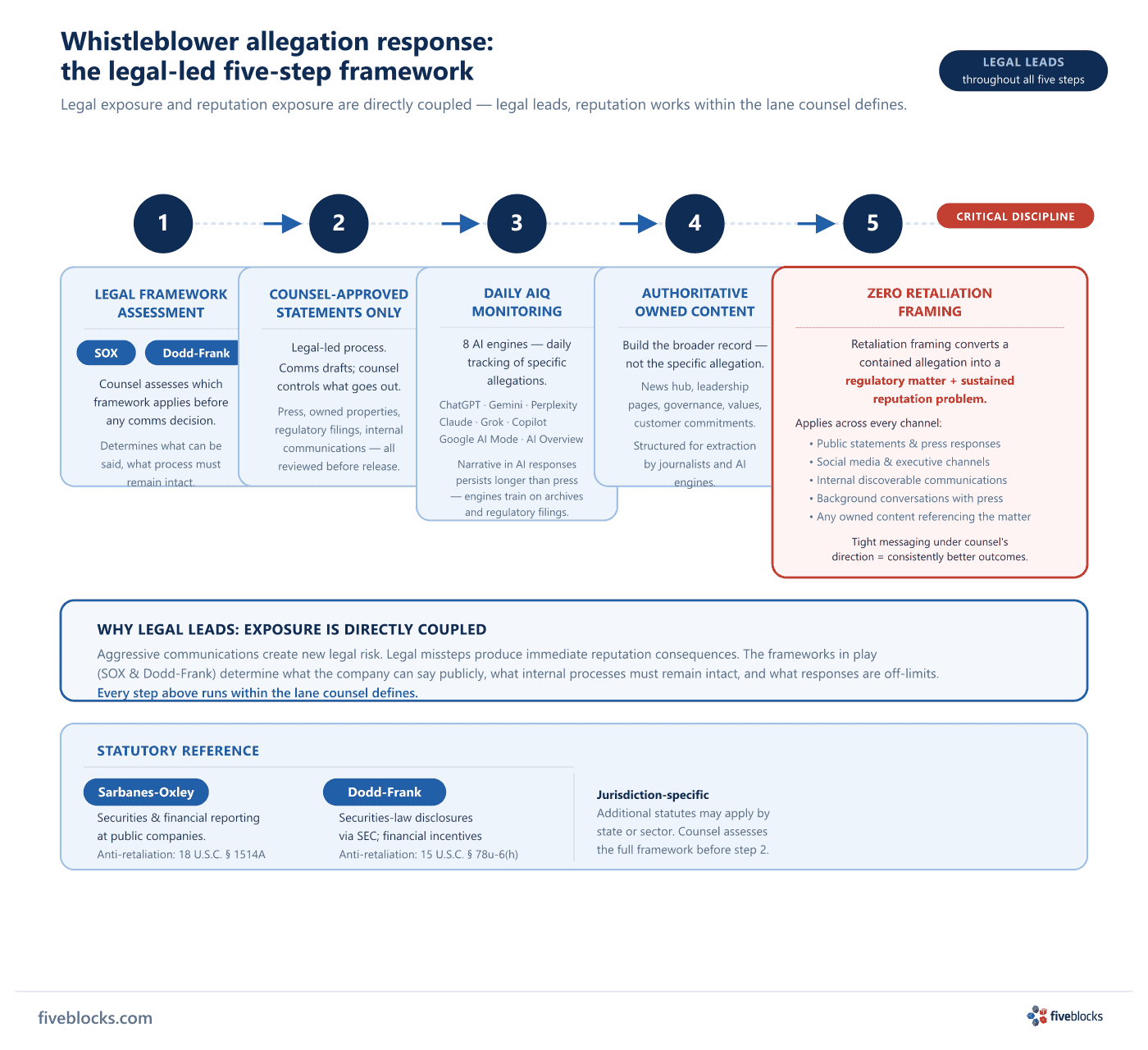
Step 1: Legal framework assessment
Before any communications decision, counsel assesses the applicable regulatory framework. In the US, the main frameworks are Sarbanes-Oxley (SOX), which covers securities and financial reporting at public companies, and the Dodd-Frank whistleblower program administered by the SEC, which governs securities-law disclosures and provides financial incentives and protections for qualifying whistleblowers. Jurisdiction-specific statutes may also apply. The framework in play determines what the company can and cannot say publicly, which internal processes must stay intact or be created, and what categories of response are off-limits.
Step 2: Counsel-approved statements only
Counsel reviews and approves every public-facing statement before release: to press, on owned properties, in regulatory filings, and in internal communications that could become external. Legal leads this process, not communications with a legal sign-off at the end. The reputation function provides drafts and flags the audience-facing context counsel should weigh; counsel controls what goes out. The company makes measured, factual statements where they are required and stays silent where they are not.
Step 3: Daily AIQ monitoring on the specific allegations
AIQ runs daily across the eight AI engines it currently tracks: ChatGPT, Gemini, Perplexity, Claude, Grok, Copilot, Google AI Mode, and AI Overview. It tracks how the specific allegations are being represented, which sources the engines are weighting, and where the narrative in AI responses diverges from the factual record or from what counsel has cleared. Whistleblower narratives often persist in AI engine responses longer than they persist in the press, because the engines train on archived coverage and regulatory filings rather than on the resolution. Daily monitoring identifies the sources driving the narrative and informs where to intervene.
Step 4: Authoritative content on the broader operating record
The company develops its owned properties, including the news hub, leadership pages, and relevant topic and issue pages, to document its broader operating record: operations, values, governance standards, customer commitments, and track record. This content is structured for extraction by journalists and AI engines. Counsel usually restricts direct discussion of the specific allegations, so the content works on the surrounding record rather than engaging the matter head-on. The aim is that when stakeholders and AI engines look at the brand, the specific allegation is not the dominant digital footprint.
Step 5: Zero retaliatory framing
The communication discipline that matters most in a whistleblower situation is avoiding any framing that reads as retaliatory toward the whistleblower. This applies to:
- Public statements and press responses
- Social media and executive channels
- Internal communications that may become discoverable
- Background conversations with journalists
- Any owned content that references the matter
Retaliation framing, including language that implies the whistleblower’s motives are improper or that the company is investigating or monitoring the individual, turns a contained allegation into a regulatory matter under both SOX and Dodd-Frank and produces a reputation problem that is much harder to resolve than the original allegation. Companies that keep the messaging tight under counsel’s direction get better outcomes than those that respond from instinct.
Last reviewed: 19/05/2026
